There are 31 calendar days in the month, and the opportunity cost of funds is 9%.
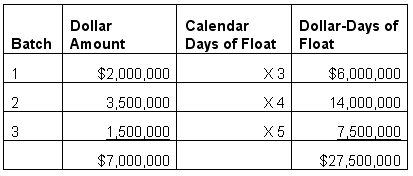
What is the annual cost of float for the batches listed?
Exam dumps demo
Preview page 1 of 215 with real questions 1 to 5 from the full 1076-question AFP set.
The AFP CTP exam, Certified Treasury Professional, is part of the AFP Certifications track and is designed for professionals working in treasury, finance, and corporate liquidity management. It validates knowledge of treasury operations, risk control, capital structure, and relationship management. Earning this certification can help demonstrate practical expertise and strengthen credibility in corporate treasury roles.
The exam matters because it reflects the skills needed to manage liquidity, evaluate capital decisions, and control financial and operational exposure in real business environments. Candidates who prepare well gain a stronger understanding of both strategic and day-to-day treasury responsibilities.
| # | Exam Topics | Sub-Topics | Approximate Weightage (%) |
|---|---|---|---|
| 1 | Maintain corporate liquidity required to meet current and future obligations in a timely and cost effective manner |
|
30% |
| 2 | Manage capital structure, manage costs of long-term capital, and quantitatively evaluate long-term capital resource investments |
|
25% |
| 3 | Manage internal and external relationships |
|
20% |
| 4 | Monitor and control corporate exposure to financial, regulatory, and operational risk (including emerging and reputational risk) |
|
25% |
The exam tests practical treasury knowledge, analytical thinking, and the ability to apply concepts in real corporate scenarios. Candidates need to understand liquidity, capital decisions, relationship management, and risk control at a professional depth. It also measures how well you can interpret situations, choose effective actions, and support sound treasury operations.
There are 31 calendar days in the month, and the opportunity cost of funds is 9%.

What is the annual cost of float for the batches listed?
A U.S. corporation has annual revenues of $500 million and a corporate tax rate of 15%. It has subsidiaries in Country A and Country B. Subsidiary A has annual revenues of $50 million. Subsidiary B has annual revenues of $20 million. The parent company has asked the Subsidiary A to transfer the equivalent of $10 million to Subsidiary B. There is a 5% withholding tax in Country A and a 3% withholding tax in Country B. How much withholding tax will the company owe as a result of this transaction?
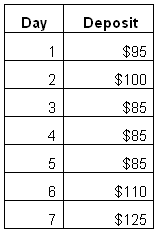
This question is based on the following data describing a company's actual deposits.

If a five-day moving average is used, what was the deposit forecast for day six?
In which of the following instances does the clientele effect come into play?
A company can use all of the following documents to establish a relationship with a bank EXCEPT:
Full exam access, validated answers, and unlimited practice with no download limits.
QA4Exam.com offers Exam PDF material with actual questions and answers plus an Online Practice Test that helps you prepare with confidence for the AFP CTP exam. The practice format gives you a real exam simulation so you can get familiar with the style, pace, and pressure of test day. You also benefit from up-to-date questions and verified answers that help you focus on the most relevant preparation points. In addition, the timed practice helps improve time management so you can complete the exam more efficiently. This combination makes it easier to target weak areas and aim for a first-attempt pass.
The AFP CTP exam is the Certified Treasury Professional certification exam under AFP Certifications. It focuses on treasury, liquidity, capital, relationships, and risk management.
It is intended for professionals involved in treasury, finance, cash management, corporate funding, and risk-related responsibilities who want to validate their knowledge with AFP Certifications.
It can be challenging because it tests practical treasury knowledge and decision-making across multiple domains. Strong preparation and exam-focused practice improve your chances of success.
Braindumps alone are not the best strategy. You should use them with practice tests and review the concepts so you understand why the answers are correct.
Hands-on treasury experience can help a lot, but focused study and realistic practice can also support strong performance. Understanding how the exam applies treasury concepts is important.
They are very helpful for exam-focused preparation, but using them as part of a broader study plan is the best approach. The PDF and practice test help you review questions, verify answers, and build exam confidence.
They help you practice real exam style questions, improve timing, and identify weak areas before test day. That preparation can make a first-attempt pass more achievable.