Prepare for the AICPA CPA Financial Accounting and Reporting exam with our extensive collection of questions and answers. These practice Q&A are updated according to the latest syllabus, providing you with the tools needed to review and test your knowledge.
QA4Exam focus on the latest syllabus and exam objectives, our practice Q&A are designed to help you identify key topics and solidify your understanding. By focusing on the core curriculum, These Questions & Answers helps you cover all the essential topics, ensuring you're well-prepared for every section of the exam. Each question comes with a detailed explanation, offering valuable insights and helping you to learn from your mistakes. Whether you're looking to assess your progress or dive deeper into complex topics, our updated Q&A will provide the support you need to confidently approach the AICPA CPA-Financial exam and achieve success.
During 1990, Fuqua Steel Co. had the following unusual financial events occur:
* Bonds payable were retired five years before their scheduled maturity, resulting in a $260,000 gain. Fuqua has frequently retired bonds early when interest rates declined significantly.
* A steel forming segment suffered $255,000 in losses due to hurricane damage. This was the fourth similar loss sustained in a 5-year period at that location.
* A component of Fuqua's operations, steel transportation, was sold at a net loss of $350,000.
This was Fuqua's first divestiture of one of its operating segments.
Before income taxes, what amount should be disclosed as the gain (loss) from extraordinary items in 1990?
Choice 'a' is correct. $0.
Note: The sale of the steel transportation component resulted in a loss from discontinued operations and is reported after 'income from continuing operations.' The steel forming segment's hurricane damage (4th in 5 years) of $255,000 is only 'unusual in nature' and does not occur infrequently, therefore, it is not an 'extraordinary item,' and should be reported separately as a component of 'income from continuing operations.' The retirement of debt, although unusual, is not infrequent for the company; therefore, the gain does not qualify for classification as an extraordinary item per APBO No. 30 (and SFAS No. 145).
Which of the following types of entities are required to report on business segments?
Choice 'b' is correct. Only publicly-traded enterprises are required to report on business segments.
Choices 'a', 'c', and 'd' are incorrect, per the Explanation: above.
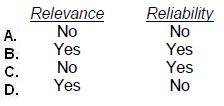
An extraordinary item should be reported separately on the income statement as a component of income:

Choice 'b' is correct, Yes - No. An extraordinary item should be reported separately on the income statement as a component of income:
Yes - net of income taxes.
No - after (not before) 'discontinued operations of a segment of a business.'
What is the purpose of information presented in notes to the financial statements?
Choice 'a' is correct. Information presented in notes to the financial statements have the purpose of providing disclosures required by generally accepted accounting principles. SFAC 5 para. 7
According to the FASB conceptual framework, the objectives of financial reporting for business enterprises are based on:
Choice 'd' is correct. The FASB conceptual framework states that the objectives of financial reporting stem from the informational needs of the external users of the information. SFAC 1 para. 28
Choice 'a' is incorrect. Generally accepted accounting principles (GAAP) are derived from and based on the objectives of financial reporting, not the other way around.
Choice 'b' is incorrect. Information concerning management's stewardship is only one aspect of the information financial statements are intended to provide. SFAC 1 para. 50
Choice 'c' is incorrect. Conservatism is an underlying concept for financial accounting but is not the basis for the objectives. SFAC 2 para. 91-97
Full Exam Access, Actual Exam Questions, Validated Answers, Anytime Anywhere, No Download Limits, No Practice Limits
Get All 163 Questions & Answers