Arcitura Education S90.08B Dumps - Pass SOA Design & Architecture Lab with Services & Microservices Exam in 2026
The Arcitura Education S90.08B - SOA Design & Architecture Lab with Services & Microservices exam is part of the SOA Certified Professional Gen 2 certification path. It is designed for candidates who want to validate their knowledge of SOA, services, microservices, and architecture design in a practical lab-focused format. This exam matters for professionals who need to demonstrate both conceptual understanding and applied design skills in modern service-based environments. Passing it shows that you are ready to work with advanced SOA and microservices architecture concepts with confidence.
Exam Topics and Approximate Weightage
#
Exam Topics
Sub-Topics
Approximate Weightage (%)
1
Fundamental SOA, Services & Microservices
SOA principles, service orientation, microservices basics
20%
2
Microservice Technology Concepts
Service decomposition, communication patterns, deployment concepts
18%
3
Design & Architecture with SOA, Services & Microservices
Architecture styles, service contracts, integration design, governance basics
22%
4
Advanced SOA Design & Architecture with Services & Microservices
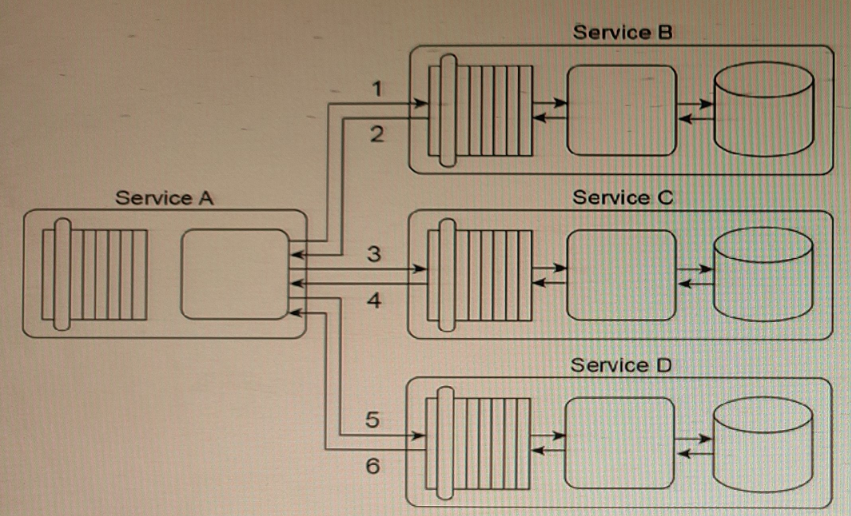
Service A is a task service that is required to carry out a series of updates to a set of databases in order to complete a task. To perform the database updates. Service A must interact with three other services that each provides standardized data access capabilities.
Service A sends its first update request message to Service B (1), which then responds with a message containing either a success or failure code (2). Service A then sends its second update request message to Service C (3), which also responds with a message containing either a success or failure code (4). Finally, Service A sends a request message to Service D (5), which responds with its own message containing either a success or failure code (6).
Services B, C and D are agnostic services that are reused and shared by multiple service consumers. This has caused unacceptable performance degradation for the service consumers of Service A as it is taking too long to complete its overall task. You've been asked to enhance the service composition architecture so that Service A provides consistent and predictable runtime performance. You are furthermore notified that a new type of data will be introduced to all three databases. It is important that this data is exchanged in a standardized manner so that the data model used for the data in inter-service messages is the same.
What steps can be taken to fulfill these requirements?
Correct answer:B
This approach isolates the services used by Service A, allowing it to avoid the performance degradation caused by multiple service consumers. By creating redundant implementations of Services B, C, and D that are accessed only by Service A, the Composition Autonomy pattern also ensures that Service A's runtime performance is consistent and predictable. Applying the Canonical Schema pattern ensures that the new type of data is exchanged in a standardized manner, ensuring consistent representation of the data model used for the data in inter-service messages.
02Question 2
Refer to Exhibit.
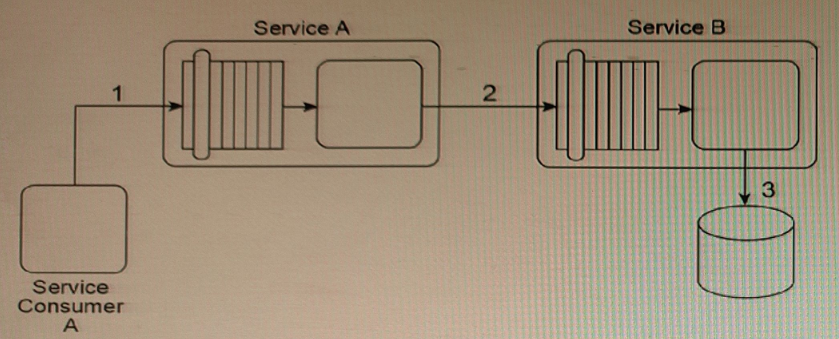
Service A is a SOAP-based Web service with a functional context dedicated to invoice-related processing. Service B is a REST-based utility service that provides generic data access to a database.
In this service composition architecture, Service Consumer A sends a SOAP message containing an invoice XML document to Service A (1). Service A then sends the invoice XML document to Service B (2), which then writes the invoice document to a database (3).
The data model used by Service Consumer A to represent the invoice document is based on XML Schema
Correct answer:A, A
The recommended solution is to use the Data Model Transformation pattern to transform the invoice XML document from Schema B to Schema A before passing it to Service B. This solution maintains the separation of concerns and allows each service to work with its own specific XML schema. Additionally, the Standardized Service Contract principle should be applied to Service B and Service Consumer A to ensure that unnecessary validation is avoided, thus optimizing the invoice XML document. This solution avoids adding logic that will increase the runtime performance requirements.
03Question 3
Refer to Exhibit.
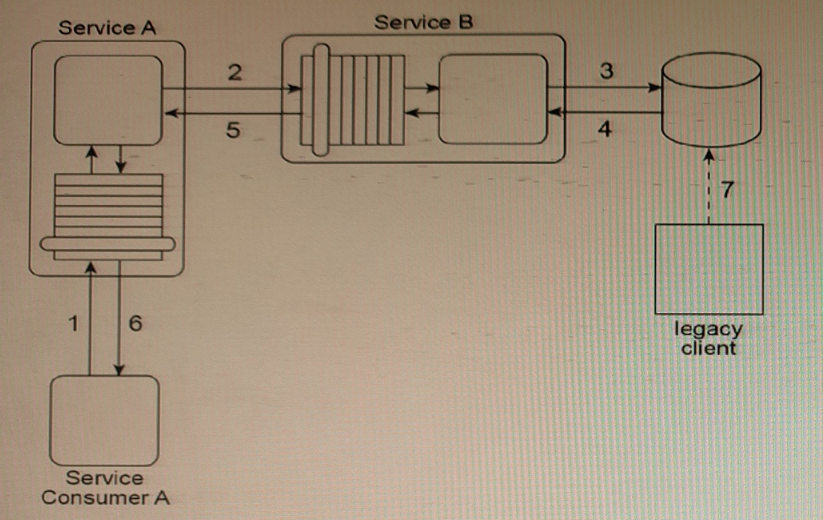
Service A is an entity service that provides a Get capability which returns a data value that is frequently changed.
Service Consumer A invokes Service A in order to request this data value (1). For Service A to carry out this request, it must invoke Service B (2), a utility service that interacts (3, 4) with the database in which the data value is stored. Regardless of whether the data value changed, Service B returns the latest value to Service A (5), and Service A returns the latest value to Service Consumer A (6).
The data value is changed when the legacy client program updates the database (7). When this change will occur is not predictable. Note also that Service A and Service B are not always available at the same time.
Any time the data value changes, Service Consumer A needs to receive It as soon as possible. Therefore, Service Consumer A initiates the message exchange shown In the figure several times a day. When it receives the same data value as before, the response from Service A Is ignored. When Service A provides an updated data value, Service Consumer A can process it to carry out its task.
The current service composition architecture is using up too many resources due to the repeated invocation of Service A by Service Consumer A and the resulting message exchanges that occur with each invocation.
What steps can be taken to solve this problem?
Correct answer:A
This solution is the most appropriate one among the options presented. By using the Event-Driven Messaging pattern, Service A can be notified of changes to the data value without having to be invoked repeatedly by Service Consumer A, which reduces the resources required for message exchange. Asynchronous Queuing ensures that the event notification message is not lost due to the unavailability of Service A or Service B. This approach improves the efficiency of the service composition architecture.
04Question 4
Refer to Exhibit.
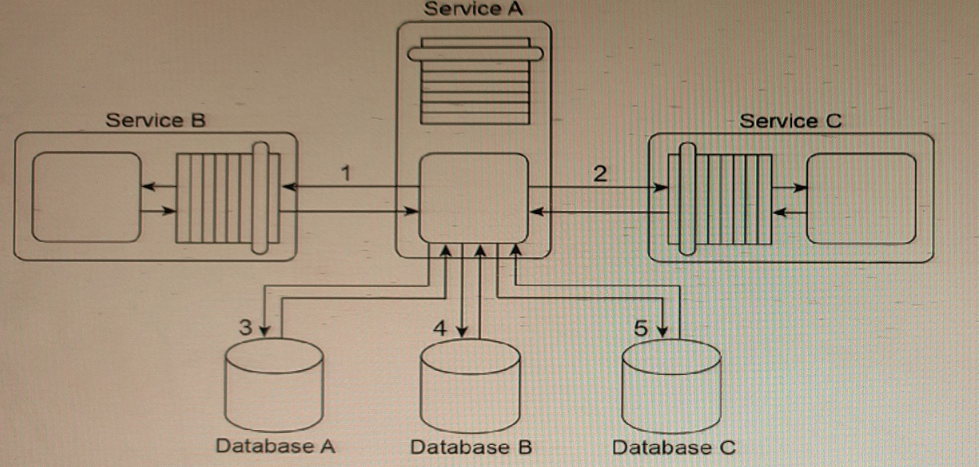
Service A is an entity service that provides a set of generic and reusable service capabilities. In order to carry out the functionality of any one of its service capabilities, Service A is required to compose Service B (1) and Service C (2), and Service A is required to access Database A (3), Database B (4), and Database C (5). These three databases are shared by other applications within the IT enterprise.
All of service capabilities provided by Service A are synchronous, which means that for each request a service consumer makes, Service A is required to issue a response message after all of the processing has completed.
Service A is one of many entity services that reside In a highly normalized service Inventory. Because Service A provides agnostic logic, it is heavily reused and is currently part of many service compositions.
You are told that Service A has recently become unstable and unreliable. The problem has been traced to two issues with the current service architecture. First, Service B, which Is also an entity service, is being increasingly reused and has itself become unstable and unreliable. When Service B fails, the failure is carried over to Service
Correct answer:C
This solution addresses both issues with the current service architecture. By applying the Redundant Implementation pattern to Service B, duplicate deployments of the service are made available, ensuring that when one implementation fails, another can be accessed by Service A. Additionally, the Service Data Replication pattern can be applied to establish a dedicated database that contains a copy of the data from shared Database B that is required by Service A. This replicated database is designed with an optimized data model to improve query execution performance, ensuring that queries issued by Service A to the database can complete more quickly, improving the overall stability and reliability of Service A. By applying these patterns, the problems with Service A can be solved without compromising the normalization of the service inventory.
05Question 5
Refer to Exhibit.
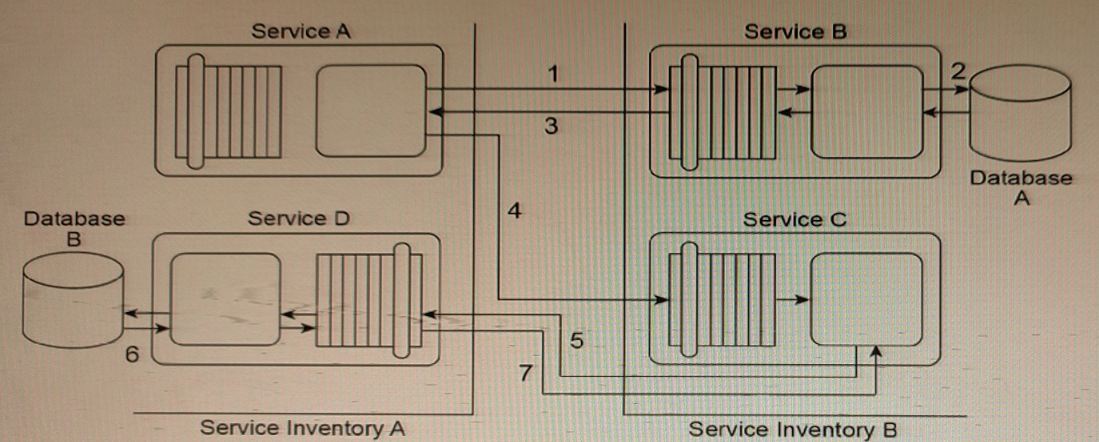
Service A sends a message to Service B (1). After Service B writes the message contents to Database A (2), it issues a response message back to Service A (3). Service A then sends a message to Service C (4). Upon receiving this message, Service C sends a message to Service D (5), which then writes the message contents to Database B (6) and issues a response message back to Service C (7).
Service A and Service D are located in Service Inventory
Correct answer:C
This solution addresses the two main challenges in the service composition architecture: the different XML schema used by services in Service Inventory A and Service Inventory B, and the incompatible data formats of the two databases.
By applying the Data Model Transformation pattern, data model transformation logic can be inserted to map the invoice-related data between the different XML schemas used by the services in Service Inventory A and Service Inventory B. This can be done at the appropriate points in the message flow: between Service A and Service B, between Service A and Service C, between Service C and Service D, and between the Service D logic and Database B.
By applying the Data Format Transformation pattern, data format transformation logic can be inserted to convert the XML-formatted data used by the services to the CSV format required by Database A, and to convert the proprietary XML schema used by Database B to the XML schema used by the services. This can be done between the Service B logic and Database A.
The Protocol Bridging pattern is not necessary in this case because all services are already communicating using the same protocol (presumably HTTP or a similar protocol).
→
Unlock all Arcitura Education S90.08B questions
Full exam access, validated answers, and unlimited practice with no download limits.
This exam tests how well candidates understand core SOA and microservices concepts and how effectively they can apply that knowledge in design and architecture scenarios. It focuses on practical decision-making, architecture analysis, and the ability to choose suitable service-based solutions for real-world situations. Candidates should be ready for both theory and applied lab-style questions.
How QA4Exam.com Helps You Pass
QA4Exam.com offers Exam PDF material with actual questions and answers, plus an Online Practice Test designed to help you prepare for the Arcitura Education S90.08B exam efficiently. The practice test gives you a real exam simulation so you can get familiar with the question style and pacing before test day. The PDF and practice test are updated to help you study with current content and verified answers. You can also improve your time management by practicing under exam-like conditions, which is a major advantage for first-attempt success.
With focused preparation and realistic practice, you can build confidence and reduce surprises in the exam room.
Frequently Asked Questions
1. Who should take the Arcitura Education S90.08B exam?
It is intended for candidates pursuing the SOA Certified Professional Gen 2 certification path and for professionals who want to validate their knowledge of SOA, services, microservices, and architecture design.
2. Is the S90.08B exam difficult?
Yes, it can be challenging because it covers both conceptual knowledge and practical design and architecture skills. Preparation should focus on understanding the topics and applying them in scenario-based questions.
3. Can I pass with only braindumps?
Using only braindumps is not a reliable strategy. You should combine dumps with study and practice so you understand the concepts behind the answers and can handle different question styles confidently.
4. Do I need hands-on experience for this exam?
Hands-on experience is very helpful because the exam includes design and lab-oriented topics. Practical exposure makes it easier to understand how SOA and microservices concepts are applied in real situations.
5. Are the QA4Exam.com dumps and practice test enough for first attempt preparation?
They are very useful for first-attempt preparation because they provide actual questions and answers, verified content, and a realistic practice environment. For best results, use them to reinforce your study and improve exam readiness.
6. What format do the QA4Exam.com products come in?
QA4Exam.com provides an Exam PDF with actual questions and answers and an Online Practice Test that simulates the exam experience. Both formats are designed to support efficient study and exam practice.
7. Can the practice test help with time management?
Yes, the Online Practice Test helps you practice under timed conditions, which improves pacing and time management. This is valuable for building confidence before the real exam.