Question 1
What happens when you attempt to compile and run the following code?
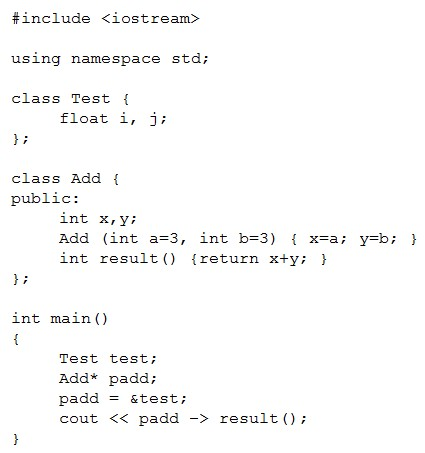
Correct answer:
C

Exam dumps demo
Preview page 1 of 51 with real questions 1 to 5 from the full 257-question C++ Institute set.
The C++ Institute CPA-21-02 - CPA - C++ Certified Associate Programmer Exam is designed for candidates pursuing the C++ Certified Associate Programmer certification. It is a strong choice for learners who want to validate their understanding of C++ fundamentals and core programming concepts. This exam matters because it helps confirm your ability to work with essential language features, structured logic, and object-oriented programming basics. Passing it shows that you are building a solid foundation for more advanced C++ development.
| # | Exam Topics | Sub-Topics | Approximate Weightage (%) |
|---|---|---|---|
| 1 | Absolute Basics | Program structure, syntax rules, identifiers, basic input and output | 12% |
| 2 | Flow Control and More Data Types | Conditionals, loops, arithmetic operations, numeric and character types | 14% |
| 3 | Functions | Function definition, parameters, return values, function calls | 14% |
| 4 | Accessing Data and Dealing with Exceptions | Arrays and strings, data access, exception handling basics | 12% |
| 5 | Fundamentals of the Object-Oriented Approach | Classes and objects, encapsulation, abstraction, object-oriented concepts | 13% |
| 6 | Class Hierarchy | Inheritance basics, derived classes, base classes, polymorphism concepts | 13% |
| 7 | More on Classes | Constructors, destructors, access control, member functions | 11% |
| 8 | The Basics of Functions | Function signatures, scope, call behavior, simple modular design | 11% |
| Total | 100% | ||
The exam tests your ability to understand C++ programming concepts, apply them to practical scenarios, and recognize correct solutions quickly. Candidates should be comfortable with syntax, control flow, functions, classes, inheritance, and exception-related basics. It is not just about memorizing terms, but also about knowing how the language works in real programming situations. Strong preparation helps you answer questions accurately and manage the exam efficiently.
What happens when you attempt to compile and run the following code?
What happens when you attempt to compile and run the following code?
#include
using namespace std;
class A {
public:
int x;
A() { x=0;}
};
class B : public A {
public:
B() { x=1;}
};
class C : private B {
public:
C() { x=2;}
};
int main () {
C c1;
cout << c1.x;
return 0;
}
Which of the following is a logical operator?
What will happen when you attempt to compile and run the following code?
#include
using namespace std;
#define A 1
int main()
{
#if A
cout<<"Hello";
#endif
cout<<"world";
return 0;
}
What happens when you attempt to compile and run the following code?
#include
using namespace std;
int main()
{
int x,y=10;
float f;
f = 5.20;
x=(int) f;
cout << x <<", ";
f=float (y);
cout << f;
return 0;
}
Full exam access, validated answers, and unlimited practice with no download limits.
QA4Exam.com provides the CPA-21-02 Exam PDF with actual questions and answers, along with an Online Practice Test that helps you prepare in a focused way. The practice material is designed to mirror the exam format so you can experience real exam simulation before test day. With up-to-date questions and verified answers, you can study with more confidence and reduce surprises. The timed practice test also helps you improve time management and pacing, which is important for first-attempt success. Using both formats together gives you a practical, efficient way to review the C++ Institute CPA-21-02 exam content.
It is intended for candidates working toward the C++ Certified Associate Programmer certification and for learners who want to validate core C++ knowledge.
The exam can be challenging if you are not comfortable with C++ basics, functions, flow control, and object-oriented concepts, but structured preparation makes it manageable.
Braindumps alone are not the best approach. You should use them with practice and review so you understand the concepts behind the answers.
Hands-on practice is very helpful because it builds confidence with C++ syntax and logic, but targeted study and exam practice can also support first-attempt success.
QA4Exam.com dumps and the Online Practice Test are strong preparation tools, and combining them with your own review of exam topics can improve results further.
The Exam PDF helps you review actual questions and answers, while the Practice Test lets you simulate the exam and improve timing, accuracy, and confidence.
Yes, the materials are presented as up-to-date and verified to support current exam preparation for CPA-21-02.