
Limited-Time Offer: Enjoy 50% Savings! - Ends In 0d 00h 00m 00s Coupon code: 50OFF
Welcome to QA4Exam
Logo

- Trusted Worldwide Questions & Answers

Exam dumps demo

300-110 Exam Dumps and Practice Questions

Preview page 1 of 20 with real questions 1 to 5 from the full 100-question Cisco set.

Cisco 300-110 Dumps - Pass Designing Cisco Wireless Networks Exam in 2026

The Cisco 300-110 exam, "Designing Cisco Wireless Networks", is part of the Cisco Certified Network Professional and Cisco Certified Network Professional Wireless certification path. It is intended for network professionals who design, plan, and support wireless LAN environments. This exam matters because it validates practical knowledge of wireless design concepts that are used in real enterprise networks. Passing it shows that you understand the core skills needed to build reliable and scalable Cisco wireless solutions.

# Exam Topics Sub-Topics Approximate Weightage (%)
1 Mobility Roaming behavior, client mobility requirements, wireless coverage planning, seamless handoff considerations 30%
2 WLAN High Availability Redundancy design, controller failover, resilient wireless services, high availability planning 25%
3 Wired and Wireless Infrastructure Network integration, switching support for WLAN, controller connectivity, infrastructure dependencies 25%
4 Wireless Site Survey Pre-deployment survey, RF assessment, access point placement, coverage and capacity validation 20%

The exam tests how well candidates can apply wireless design knowledge in practical scenarios. It focuses on understanding design decisions, infrastructure planning, and site survey concepts rather than simple memorization. Candidates need both conceptual depth and the ability to evaluate wireless requirements in realistic Cisco environments.

Actual Cisco 300-110 Exam Questions

Question 1

A wireless engineer is preparing for a meeting with a customer to discuss a new wireless network design. The customer is a company that develops code and occupies a three-story building. Which two information points does a pre-site survey questionnaire contain? (Choose two.)

Correct answer: C, E

A pre-site survey questionnaire is used to gather information before the physical survey begins, helping to define design requirements. The two most important information points it should contain are the access point density required and the applications that will run over the wireless network. Access point density (Option C) must be understood early because it depends on the number and types of users in each area, directly influencing the survey approach and AP placement strategy. Applications (Option E) are critical because they define the QoS requirements --- a company developing code may run video conferencing, large file transfers, and real-time collaboration tools, each with distinct bandwidth and latency requirements that shape the RF design criteria. The total number of existing APs (Option A) and the current controller model (Option D) are inventory questions, not design requirement inputs. Client device types (Option B) are important but are a subset of the application question --- applications drive the specific device capability requirements. Reference: WLSD Study Guide --- Pre-Site Survey Requirements Gathering, Customer Questionnaire, Design Requirements Definition.

Question 2

A network engineer is designing a new wireless network for a campus. The network must include optimized performance, avoid interference, availability in high-density areas, and roaming. Which two approaches must be taken? (Choose two.)

Correct answer: A, B

The design requirements --- optimized performance, interference avoidance, high-density support, and roaming capability --- collectively point to a dual-band strategy using narrow channel widths. For 5 GHz operation (Option A), 20 MHz channels are the correct choice for high-density and campus-scale deployments. The 5 GHz band has a significantly greater number of non-overlapping channels compared to 2.4 GHz (up to 24 non-overlapping 20 MHz channels in UNII-1, UNII-2, and UNII-3), enabling a robust channel reuse plan with minimal co-channel interference. Wider 5 GHz channels (Options C and E --- 80 MHz and 40 MHz) would consume multiple channel blocks, dramatically reducing the number of available non-overlapping channels and increasing co-channel interference in dense deployments. For 2.4 GHz operation (Option B), 20 MHz channels are mandatory --- there are only three non-overlapping 20 MHz channels (1, 6, 11) in the 2.4 GHz band. Using 40 MHz channels in 2.4 GHz (Option D) eliminates all non-overlapping channel separation, causing massive co-channel interference and is universally contraindicated in enterprise designs. Reference: WLSD Study Guide --- Channel Planning, High-Density Design, Frequency Band Selection.


Question 3

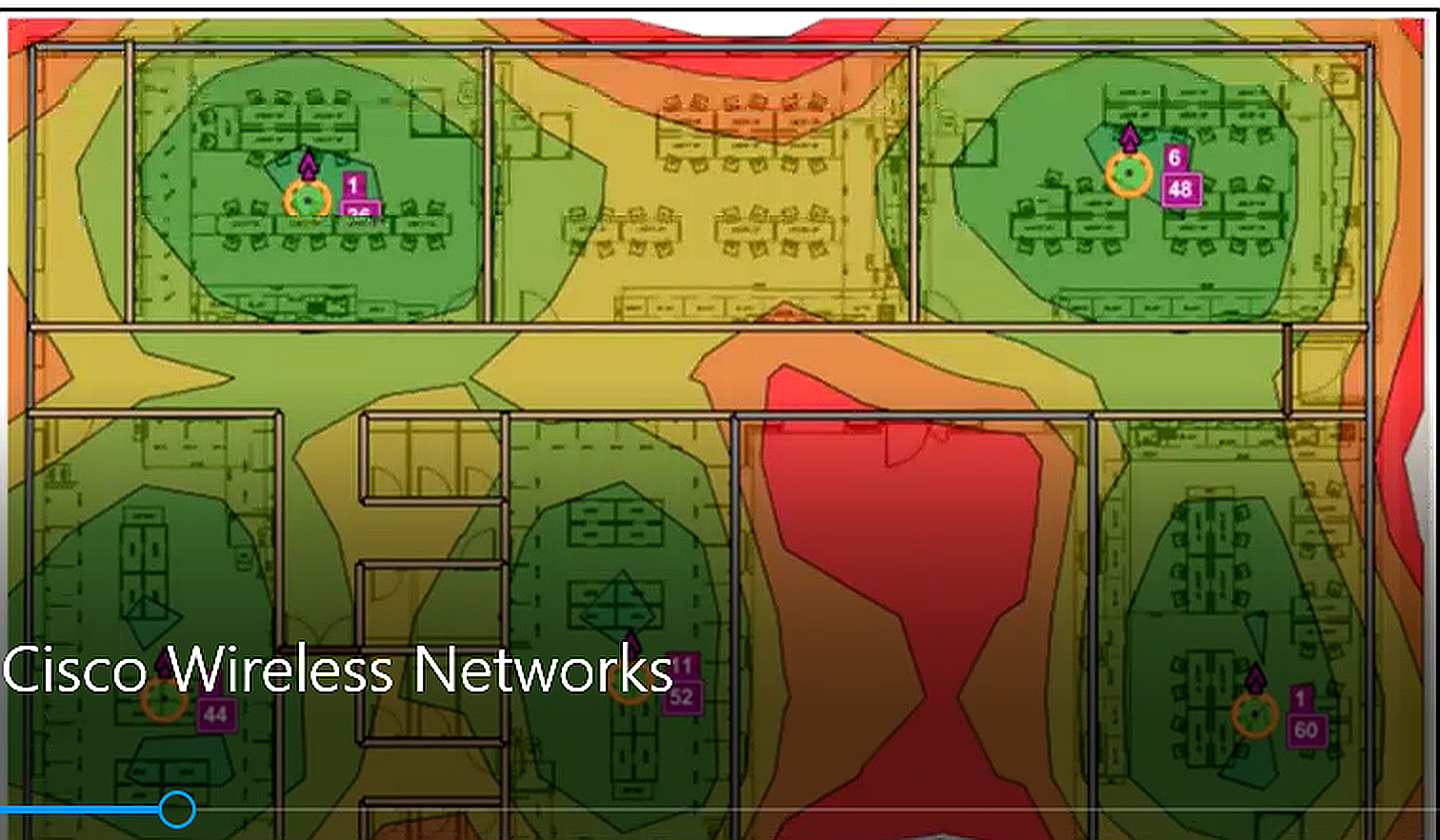
Refer to the exhibit. A wireless engineer is using the Ekahau Site Survey tool to conduct a post-deployment survey. The engineer analyzes the pictured output to determine if SNR meets the voice requirements. How is the voice support based on the output?

Exhibit --- Q15: Ekahau SNR Heatmap --- Post-Deployment Survey Output

Correct answer: D

Voice over WLAN (VoWLAN) deployments require a minimum SNR threshold to maintain acceptable Mean Opinion Score (MOS) values for call quality. Cisco's 300-110 WLSD curriculum specifies that VoWLAN requires a minimum SNR of 25 dB throughout the coverage area. In an Ekahau post-deployment survey SNR heatmap, when the heatmap displays a consistent color indicating SNR at or above this threshold across the entire surveyed area --- including all rooms, corridors, and common areas such as the lobby --- the conclusion is that voice service is supported in all locations. The color coding in Ekahau's SNR heatmap uses green tones to indicate adequate SNR (typically 25 dB) and shifts toward yellow and red for degraded conditions. When the exhibit heatmap shows uniform adequate coverage across all surveyed areas without yellow or red zones, it confirms the SNR requirement for VoWLAN is universally met. Options A, B, and C suggest partial or no coverage, which would be indicated by mixed or poor SNR values --- conditions not present in this scenario. The post-deployment survey with Ekahau is the validation step confirming that the predictive design was accurately realized in the physical environment. Reference: WLSD Study Guide --- VoWLAN Design Requirements, SNR Thresholds, Post-Deployment Survey Validation with Ekahau.


Question 4

In a FlexConnect deployment, which role does the site tag play?

Correct answer: D

In the Cisco Catalyst 9800 IOS XE WLC configuration framework, the site tag serves as the primary organizational and functional grouping element for FlexConnect APs at a given physical location. The site tag defines the FlexConnect site --- a logical boundary within which APs can perform local switching and local inter-AP roaming without requiring CAPWAP tunnel traversal to the WLC for every client handoff. Within a FlexConnect site defined by the site tag, APs can exchange client roaming context information directly with each other (peer-to-peer), enabling fast Layer 2 roaming for clients moving between APs that share the same site tag --- effectively defining the roaming domain for FlexConnect APs at that site. The site tag also references the flex profile (which defines VLAN mappings, local auth settings, and split tunneling parameters) and the AP join profile. Switch port configuration (Option A) is performed on the infrastructure switches, not through the WLC site tag. IP address assignment (Option B) is a DHCP function. Firewall policies (Option C) are applied through ACLs and policy tags, not site tags. Reference: WLSD Study Guide --- Catalyst 9800 Tag Architecture, FlexConnect Site Tag Role, Local Roaming in FlexConnect Deployments.


Question 5

An engineer is performing a passive survey report. The coverage heat map shows the entire site with all signal levels. To see only the desired coverage, which action must the engineer take?

Correct answer: C

To focus the coverage heat map on the desired coverage threshold, the engineer should use the RSSI slider to set the heat map to the desired cutoff filter. This action adjusts the display to show only the signal levels that meet or exceed the specified RSSI value, effectively filtering out weaker signals and highlighting areas with sufficient coverage. In Ekahau and similar survey tools, the RSSI slider provides a dynamic way to set minimum signal thresholds, allowing the engineer to quickly validate whether coverage meets design targets such as -67 dBm for voice or -70 dBm for data. Changing the color scheme (Option A) only modifies the visual representation without filtering data. The RSSI calibration tool (Option B) adjusts how the tool perceives signal levels, not the display filter. Filtering by AP (Option D) would remove APs from the view, potentially hiding coverage gaps. Reference: WLSD Study Guide --- Post-Deployment Survey, Ekahau Heat Map Tools, RSSI Coverage Filtering.


Unlock all Cisco 300-110 questions

Full exam access, validated answers, and unlimited practice with no download limits.

How QA4Exam.com Helps You Pass

QA4Exam.com offers the Cisco 300-110 Exam PDF with actual questions and answers, helping you study the exam format in a focused way. The Online Practice Test gives you a real exam simulation so you can build confidence before test day. You also get up-to-date questions and verified answers, which helps you prepare with current exam content. In addition, timed practice improves your time management skills and helps you work through questions more efficiently. These resources are designed to support first-attempt success for the Cisco Designing Cisco Wireless Networks exam.

Frequently Asked Questions

1. What is the Cisco 300-110 Designing Cisco Wireless Networks exam?

It is a Cisco exam focused on wireless network design topics such as mobility, WLAN high availability, wired and wireless infrastructure, and wireless site survey.

2. Which certification does the Cisco 300-110 exam belong to?

It belongs to the Cisco Certified Network Professional and Cisco Certified Network Professional Wireless certification track.

3. Is the Cisco 300-110 exam difficult?

It can be challenging because it tests wireless design knowledge and practical understanding, especially around infrastructure and site survey decisions.

4. Can I pass with only braindumps?

Braindumps alone are not the best approach. You should also understand the concepts and practice with exam-style questions to improve your chances of passing.

5. Do I need hands-on experience for the Cisco 300-110 exam?

Hands-on experience is very helpful because the exam covers real wireless design scenarios and practical decision-making.

6. Are QA4Exam.com dumps and practice tests enough to prepare?

They are a strong preparation tool because they include actual questions and answers, verified answers, and a practice test format that helps you study efficiently.

7. How do QA4Exam.com practice tests help with first-attempt success?

They help you simulate the exam, manage your time, review question patterns, and build confidence before taking the real Cisco 300-110 exam.