Limited-Time Offer: Enjoy 50% Savings! - Ends In 0d 00h 00m 00s Coupon code: 50OFF
Welcome to QA4Exam
Logo

- Trusted Worldwide Questions & Answers

Exam dumps demo

300-540 Exam Dumps and Practice Questions

Preview page 1 of 12 with real questions 1 to 5 from the full 61-question Cisco set.

Cisco 300-540 Dumps - Pass Designing and Implementing Cisco Service Provider Cloud Network Infrastructure v1.0 Exam in 2026

The Cisco 300-540 exam, Designing and Implementing Cisco Service Provider Cloud Network Infrastructure v1.0, is part of the Cisco Certified Network Professional and Cisco Certified Network Professional Service Provider certification track. It is designed for networking professionals who work with service provider cloud environments and need to validate advanced design and implementation skills. This exam matters because it confirms your ability to build reliable, secure, and highly available cloud network infrastructures using Cisco technologies.

# Exam Topics Sub-Topics Approximate Weightage (%)
1 Virtualized Architecture Virtual network functions, cloud-native design concepts, resource pooling, orchestration integration 22%
2 Cloud Interconnect Interconnect design, routing integration, transport connectivity, cloud edge connectivity 20%
3 Security Segmentation, access control, threat mitigation, secure service provider cloud design 18%
4 Service Assurance and Optimization Telemetry, monitoring, performance tuning, troubleshooting workflows 20%
5 High Availability Redundancy design, failover planning, resilience strategies, operational continuity 20%

The exam tests practical knowledge of service provider cloud network infrastructure design and implementation. Candidates must understand how the topics connect in real-world environments and be able to apply concepts to secure, available, and optimized network solutions. It also measures your ability to evaluate requirements, choose the right design approach, and support dependable operations.

Actual Cisco 300-540 Exam Questions

Question 1

Refer to the exhibit.
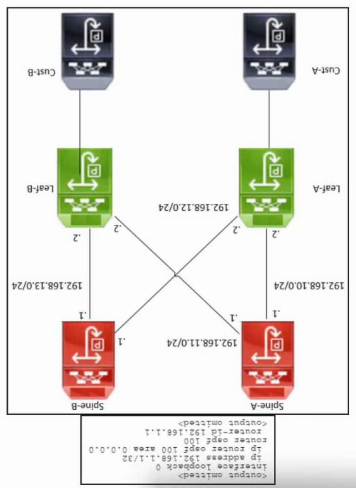
Refer to the exhibit. An engineer must deploy a Layer 3 EVPN over segment routing MPLS in the data center core; however, Cisco switch Spine_A fails to join the OSPF network. Which OSPF command must be run on Spine_A to resolve the issue?

A. otv join-interface loopback0 B. address-family ipv4 C. connected-prefix-sid-map D. segment-routing mpls

Correct answer:

To run EVPN over Segment Routing MPLS (SR-MPLS), the IGP (here OSPF) must be enabled for segment routing so it can:

Advertise Segment IDs (SIDs) for prefixes and links

Carry SR extensions in OSPF LSAs

On Cisco devices, this is done under the OSPF process with:

router ospf 100

router-id 192.168.1.1

segment-routing mpls

Without the segment-routing mpls command, Spine_A will not participate correctly in the SR-enabled OSPF domain, and SR-related adjacencies/LSAs will not form as expected, resulting in failure to integrate into the intended SR-MPLS core.

The other options are not OSPF SR-enabling commands:

A otv join-interface OTV, unrelated to OSPF or SR-MPLS.

B address-family ipv4 BGP address family, not OSPF.

C connected-prefix-sid-map Global SR mapping for connected prefixes but does not itself enable SR for OSPF.

Therefore, the correct command is segment-routing mpls (D).

Question 2

Refer to the exhibit.

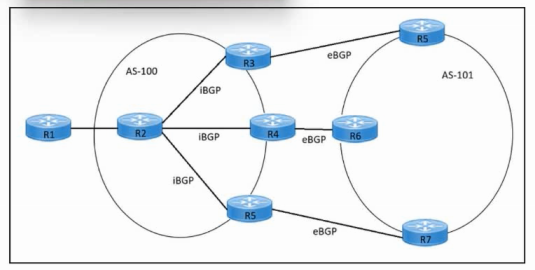
Refer to the exhibit. An engineer must configure iBGP multipath load sharing across three paths. Which two commands must be run on router R2? (Choose two.)

A. router bgp 100 B. ip load-sharing ibgp 3 C. maximum-paths ibgp 3 D. router bgp 101 E. ip load-sharing per-destination

Correct answer:

Router R2 is inside AS 100 and has three iBGP paths (via R3, R4, R5) toward AS 101. To perform iBGP multipath across these three equal-cost paths, BGP must:

Run the correct BGP process for AS 100

Allow installation of multiple iBGP paths in the routing table

This is done with:

router bgp 100

maximum-paths ibgp 3

router bgp 100 -- enters the BGP process for AS 100 (correct AS per diagram).

maximum-paths ibgp 3 -- tells BGP to keep up to 3 iBGP paths to the same destination, enabling CEF to load-share across them.

Other options:

ip load-sharing ibgp 3 -- not a valid command.

router bgp 101 -- wrong AS number.

ip load-sharing per-destination -- controls CEF hashing but does not enable BGP to install multiple iBGP paths by itself.


Question 3

Refer to the exhibit.

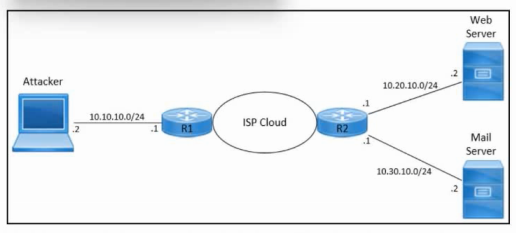
Refer to the exhibit. An engineer must stop a DoS attack on web and mail servers by using destination-based RTBH routing. Which two commands must be run on router R1? (Choose two)

Correct answer: A, C

Destination-based Remote Triggered Black Hole (RTBH) routing is a DDoS mitigation technique where traffic to a victim's IP address is intentionally routed to a special next hop (usually Null0) so that the traffic is dropped as close to the source as possible. On the edge router (R1 in the figure), this is accomplished by installing /32 static routes for the victim endpoints, pointing to the null interface. When these routes are installed (often triggered via BGP in larger deployments), any traffic destined to those exact IP addresses is discarded.

In the topology:

Web server IP: 10.20.10.2

Mail server IP: 10.30.10.2

To perform destination-based RTBH at R1, we must configure static /32 routes to Null0 for each victim IP:

ip route 10.20.10.2 255.255.255.255 Null0

ip route 10.30.10.2 255.255.255.255 Null0

These correspond to:

Option C for the web server (10.20.10.2)

Option A for the mail server (10.30.10.2)

The other options are incorrect for RTBH:

B and D remove /24 routes via 10.10.10.2; they do not implement black-holing and would break normal routing rather than selectively drop attack traffic.

E black-holes 10.20.10.1, which is the default gateway on R2, not the victim server; that would impact overall connectivity instead of just dropping traffic to the attacked host.


Question 4

Refer to the exhibit.

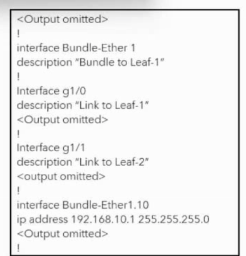
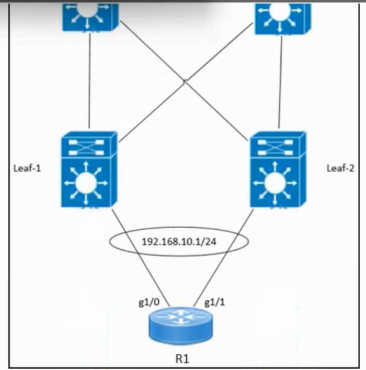
Refer to the exhibit. An engineer must configure EVPN port-active multihoming on router R1. Which command must be run against the g1/0 and g1/1 interfaces on R1 to complete the physical Ethernet bundle for multihoming on a host named Host-1?

Correct answer: D

From Cisco's EVPN VXLAN multihoming design requirements, port-active multihoming uses a single LAG (EtherChannel / Bundle-Ether) between the host/router and the pair of leaf switches. All physical interfaces participating in that bundle must be configured with:

bundle id <number> mode active

This command:

Associates the physical interfaces (g1/0 and g1/1) with Bundle-Ether1.

Uses LACP active mode, which is required for EVPN port-active multihoming.

Enables the host-facing port-channel required to support EVPN multihomed connectivity.

In the exhibit, R1 already has:

interface Bundle-Ether1

description 'Bundle to Leaf-1'

...

interface Bundle-Ether1.10

ip address 192.168.10.1 255.255.255.0

This confirms that the engineer intends to bundle g1/0 and g1/1 together into Bundle-Ether1, and the missing step is adding the interfaces into that bundle.

The correct configuration is:

interface g1/0

bundle id 1 mode active

interface g1/1

bundle id 1 mode active

Why the other options are incorrect

A . evpn ethernet-segment 1

This command is used on EVPN leaf switches (not R1) to define an ESI for multihoming. R1 is not an EVPN VTEP.

B . switchport mode trunk

R1 is a router, not a switch. L3 interfaces do not use switchport.

C . encapsulation dot1q 1

This applies only to subinterfaces, not physical interfaces, and is unrelated to building a LAG for port-active multihoming.


Question 5

Refer to the exhibit.

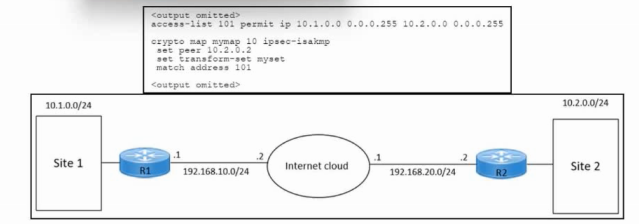
Refer to the exhibit. An engineer must configure an IPsec VPN connection between site 1 and site 2. The indicated configuration was applied to router R1; however, the tunnel fails to come up. Which command must be run on R1 to resolve the issue?

Correct answer: B

For a site-to-site IPsec VPN, each peer must point to the reachable IP address of the remote VPN endpoint---that is, the IP address on the WAN/Internet-facing interface of the remote router.

From the diagram:

R1 outside (toward Internet): 192.168.10.1

R2 outside (toward Internet): 192.168.20.2

Inside LANs:

Site 1: 10.1.0.0/24

Site 2: 10.2.0.0/24

The crypto map on R1 uses:

crypto map mymap 10 ipsec-isakmp

set transform-set myset

match address 101

set peer <REMOTE_PEER_IP>

The <REMOTE_PEER_IP> must be the IP address where R1 can actually reach the IPsec peer, which is R2's Internet-facing interface 192.168.20.2.

If the peer were configured with a LAN IP such as 10.2.0.1 (site 2's internal gateway), IKE packets would never reach the remote router because that address is not routable over the Internet.

Therefore, the correct command to bring up the VPN is:

set peer 192.168.20.2

Option A (10.1.0.1) -- local LAN IP (R1's side), not the remote endpoint.

Option C (192.168.10.1) -- R1's own WAN IP, not the remote peer.

Option D (10.2.0.1) -- remote LAN IP, not reachable directly over the Internet.


Unlock all Cisco 300-540 questions

Full exam access, validated answers, and unlimited practice with no download limits.

Frequently Asked Questions

Who should take the Cisco 300-540 exam?

This exam is for networking professionals pursuing the Cisco Certified Network Professional or Cisco Certified Network Professional Service Provider certification and working with service provider cloud network infrastructure.

Is the Cisco 300-540 exam difficult?

It can be challenging because it covers design, implementation, security, high availability, and service assurance concepts. Candidates who understand the topics deeply and practice with exam-style questions are better prepared.

Can I pass Cisco 300-540 with only braindumps?

Braindumps alone are not the best approach. You should use them as part of a broader preparation plan that includes topic review, practice, and understanding the concepts behind each answer.

Do I need hands-on experience for the exam?

Hands-on experience is strongly helpful because the exam focuses on practical design and implementation knowledge. Real experience makes it easier to understand how the concepts apply in service provider cloud environments.

Are QA4Exam.com dumps enough to pass on the first attempt?

QA4Exam.com dumps and the Online Practice Test can significantly improve your preparation, but the best results come from using them to reinforce your study and build confidence before the exam. They are especially useful for first-attempt readiness.

What format do the QA4Exam.com materials use?

QA4Exam.com offers an Exam PDF with actual questions and answers and an Online Practice Test that simulates the exam environment. Both formats are intended to help you study efficiently and practice under realistic conditions.

How do the practice tests help with time management?

The practice test lets you work through exam-style questions under timed conditions, which helps you improve pacing, reduce mistakes, and manage your time more effectively during the real Cisco 300-540 exam.