
Limited-Time Offer: Enjoy 50% Savings! - Ends In 0d 00h 00m 00s Coupon code: 50OFF
Welcome to QA4Exam
Logo

- Trusted Worldwide Questions & Answers

Exam dumps demo

Databricks-Certified-Professional-Data-Scientist Exam Dumps and Practice Questions

Preview page 1 of 28 with real questions 1 to 5 from the full 138-question Databricks set.

Most Recent Databricks-Certified-Professional-Data-Scientist Exam Dumps


Prepare for the Databricks Certified Professional Data Scientist Exam exam with our extensive collection of questions and answers. These practice Q&A are updated according to the latest syllabus, providing you with the tools needed to review and test your knowledge.

QA4Exam focus on the latest syllabus and exam objectives, our practice Q&A are designed to help you identify key topics and solidify your understanding. By focusing on the core curriculum, These Questions & Answers helps you cover all the essential topics, ensuring you're well-prepared for every section of the exam. Each question comes with a detailed explanation, offering valuable insights and helping you to learn from your mistakes. Whether you're looking to assess your progress or dive deeper into complex topics, our updated Q&A will provide the support you need to confidently approach the Databricks-Certified-Professional-Data-Scientist exam and achieve success.

Actual Databricks Databricks-Certified-Professional-Data-Scientist Exam Questions

Question 1

Question-3: In machine learning, feature hashing, also known as the hashing trick (by analogy to the kernel trick), is a fast and space-efficient way of vectorizing features (such as the words in a language), i.e., turning arbitrary features into indices in a vector or matrix. It works by applying a hash function to the features and using their hash values modulo the number of features as indices directly, rather than looking the indices up in an associative array. So what is the primary reason of the hashing trick for building classifiers?

Correct answer: B
Question 2

In which of the following scenario you should apply the Bay's Theorem

Correct answer: D

Question 3

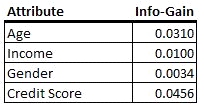
Refer to the exhibit.

You are building a decision tree. In this exhibit, four variables are listed with their respective values of info-gain.

Based on this information, on which attribute would you expect the next split to be in the decision tree?

Correct answer: A

Question 4

Suppose you have been given a relatively high-dimension set of independent variables and you are asked to come up with a model that predicts one of Two possible outcomes like "YES" or "NO", then which of the following technique best fit.

Correct answer: E

Question 5

In which of the scenario you can use the linear regression model?

Correct answer: A, B, C, D

output variable based on the input variables. In all the cases mentioned in the

question option, you can see that output

can be predicted based on the input variable.

Option-A: Input: Location, House Area and Output: House Price

Option-B : Input: Weather condition, Output: Demand for the goods and services

Option-C : Input: Number of Radiation Session Output: Tumor Size Reduction

Option-D : Input: Number of students and Output: Sale quantity of text book


Unlock all Databricks Databricks-Certified-Professional-Data-Scientist questions

Full exam access, validated answers, and unlimited practice with no download limits.