Limited-Time Offer: Enjoy 50% Savings! - Ends In 0d 00h 00m 00s Coupon code: 50OFF
Welcome to QA4Exam

Practice questions demo

NSE6_EDR_AD-7.0 Exam Dumps and Practice Questions

Questions 1 to 5 of the 33-question NSE6_EDR_AD-7.0 bank, each with its correct answer and an explanation. 3 of 5 ask for more than one answer. This is page 1 of 7.

1 / 7

Actual Fortinet NSE6_EDR_AD-7.0 Exam Questions

Question 1

Which two statements correctly describe the IoT probing process on FortiEDR? (Choose two answers)

Correct answer: B, C

The correct answers are B and C.

The FortiEDR 7.0.0 Administration Guide explains that IoT device discovery continuously identifies newly connected non-workstation devices, such as printers, cameras, and media devices. During discovery, each relevant Collector periodically probes nearby neighboring devices. The guide states that nearby devices usually respond by providing information about themselves, including the device/host name and IP address. This directly supports option B.

Option C is also correct because the guide states that Collectors in degraded, disabled, or isolated states do not take part in the IoT probing process. It also says FortiEDR uses the most powerful Collectors in each subnet and excludes weaker Collectors, including disabled and degraded Collectors.

Option A is wrong because the guide explicitly says Collectors running on servers do not take part in IoT probing. Option D is wrong because IoT probing is not described as deep packet inspection of all neighboring traffic; it is a discovery/probing process used to identify nearby devices and collect basic device information.


Question 2

Refer to the Exhibit:

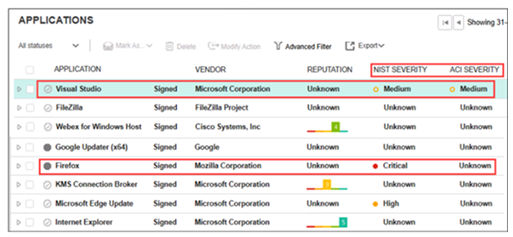
A FortiEDR analyst is prioritizing response efforts. One application has a vulnerability score of Critical but an Unknown ACI rating, while another has a Medium vulnerability score with active ACI evidence of adversary targeting. Which application must be addressed first? (Choose one answer)

Correct answer: D

The correct answer is D.

The FortiEDR 7.0.0 Administration Guide explains that FortiEDR displays two severity ratings for applications: NIST Severity and ACI Severity. NIST Severity is based on FortiEDR's vulnerability scoring system using the NIST Cybersecurity Framework. ACI Severity, however, is Adversary Centric Intelligence provided by FortiRecon and FortiGuard Threat Analysts, covering dark web, open-source, and technical threat intelligence, including threat actor insights. This helps administrators proactively assess risk, respond faster to incidents, understand attackers, and protect assets.

The guide also states that FortiEDR helps analysts prioritize alerts and incidents using risk factors such as severity of vulnerabilities, relevance of threat intelligence feeds, and severity of affected endpoints, so effort is focused on the most significant organizational risks.

Therefore, the application with Medium NIST severity but active ACI evidence of adversary targeting should be prioritized over an application with Critical NIST severity but Unknown ACI rating, because active adversary-centric intelligence indicates current attacker interest or exploitation relevance. In plain terms: a theoretical critical vulnerability matters, but an actively targeted vulnerability is the fire you put out first.

Option B is tempting but incomplete because it relies only on NIST/CVSS severity. FortiEDR's ACI rating exists specifically to add adversary context to prioritization. Option A is wrong because FortiEDR does not treat all vulnerable applications equally. Option C is wrong because asset criticality can matter, but the guide does not say prioritization depends only on asset criticality.


Question 3

What action does an on-premises reputation server take when it receives a hash request that is not found in its local database? (Choose one answer)

Correct answer: C

The correct answer is C.

The FortiEDR 7.0.0 Administration Guide states that for on-premises deployments, the on-premise reputation service requests missing hashes from the cloud reputation service. If a proxy is not enabled, it requests the missing hashes from the cloud reputation service through the manager nginx. If a proxy is enabled, the on-premises reputation service requests the missing hashes through the proxy.

So, when the local reputation database does not contain the requested hash, the on-premises reputation server does not ignore the request, wait for endpoint input, or automatically block the application. It queries the cloud reputation service for the missing hash reputation data.


Question 4

You find third-party software on a user's computer that does not appear in the application list on the communication control console. Which two statements are true about this situation? (Choose two answers)

Correct answer: A, D

The best answers are A and D, but be careful: A is directly verified by the guide; D is the only remaining statement that can be true in policy context, but it is weaker than A.

The FortiEDR 7.0.0 Administration Guide states that the Communication Control tab identifies communicating applications detected in the organization. More specifically, the Applications page lists ''all communicating applications detected in your organization that have ever attempted to communicate.'' Therefore, if software exists on a user's computer but does not appear in the Communication Control application list, the most direct explanation is that it has not attempted external communication.

The guide also explains that FortiEDR Communication Control reduces the scope of administration because Security/IT only needs to handle applications that communicate externally. It also states that non-authorized applications can still execute, and only their outgoing communication is prevented. This confirms that the Communication Control application list is not a full software inventory; it is a list of applications that have communicated or attempted communication.

Option B is not correct. If an application were blocked due to FortiEDR security-policy enforcement after a connection attempt, FortiEDR would generate security-event visibility in the Incidents workflow, not simply hide the application from Communication Control. FortiEDR Collectors send communication-related data for Communication Control, and security events are sent for enforcement/monitoring purposes.

Option C is also wrong. Reputation score affects policy decisions and application risk evaluation, but it does not cause an application to be ignored or excluded from the application list. The guide says each application in the Applications page shows a reputation indicator, which proves reputation is displayed for listed applications rather than used to hide them.

For option D, if the application has never attempted communication, Communication Control has no observed communication event to list. In exam logic, this can be interpreted as the application is not currently being denied by Communication Control policies. However, the stronger technical truth is this: Communication Control does not list installed software; it lists applications that have attempted to communicate.

Question 5

Refer to the exhibit.

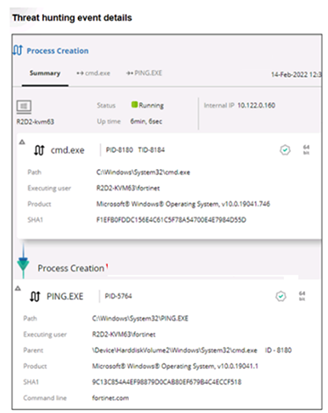
Based on the threat hunting event details shown in the exhibit, which two statements about the event are true? (Choose two answers)

Correct answer: B, D

The correct answers are B and D.

The exhibit shows a Process Creation activity event where cmd.exe is the source process and PING.EXE is the target process. The displayed Executing user is R2D2-KVM63\fortinet, and the command line shows fortinet.com, which means the user fortinet executed a ping command targeting fortinet.com.

The FortiEDR guide explains that Threat Hunting activity events consist of a source, an action, and a target. It also states that Process Actions have another process as the target and include process-related actions such as Process Creation.

The exhibit also shows file-related details for the executable, including the executable path, product, SHA1 hash, and command line. In FortiEDR Threat Hunting, process execution events are tied to executable-file metadata, so the event is associated with the executable file involved in the process action. This supports B in the exam's intended wording.

Option A is not reliable because the screenshot does not prove MITRE details are unavailable; it only shows that no MITRE detail is visible in the current portion of the details pane. The guide states that MITRE indications appear when an activity event has related MITRE information.

Option C is wrong because the screenshot shows the process status as Running and does not show a block indicator. A green check does not mean blocked; it indicates a trusted/signed/allowed status context. There is no evidence that PING.EXE was blocked.


Unlock all Fortinet NSE6_EDR_AD-7.0 questions

Full exam access, validated answers, and unlimited practice with no download limits.