
Limited-Time Offer: Enjoy 50% Savings! - Ends In 0d 00h 00m 00s Coupon code: 50OFF
Welcome to QA4Exam
Logo

- Trusted Worldwide Questions & Answers

Exam dumps demo

NSE6_FMG_AD-7.6 Exam Dumps and Practice Questions

Preview page 1 of 13 with real questions 1 to 5 from the full 65-question Fortinet set.

Fortinet NSE6_FMG_AD-7.6 Dumps - Pass Fortinet NSE 6 - FortiManager 7.6 Administrator Exam in First Attempt 2026

The Fortinet NSE6_FMG_AD-7.6 exam, titled "Fortinet NSE 6 - FortiManager 7.6 Administrator", is part of the NSE 6, NSE 6: Secure Networking certification track. It is designed for candidates who manage and administer FortiManager in real-world environments. This exam matters because it validates practical knowledge of centralized security management, policy control, and device administration across Fortinet deployments.

Exam Topics

# Exam Topics Sub-Topics Approximate Weightage (%)
1 Policy and objects Policy packages, firewall objects, object management, policy installation 30%
2 Advanced configuration Advanced settings, configuration workflows, template use, policy optimization 20%
3 Troubleshooting Policy issues, device sync problems, install errors, diagnostics 20%
4 Administration System administration, access control, backups, system maintenance 15%
5 Device manager Device registration, device status, ADOM handling, device updates 15%

This exam tests how well you can manage FortiManager tasks in a practical setting, including policy deployment, object handling, device oversight, administration, and troubleshooting. Candidates need more than theory because the exam is focused on operational knowledge, configuration understanding, and the ability to identify the right action in FortiManager scenarios.

Actual Fortinet NSE6_FMG_AD-7.6 Exam Questions

Question 1

What are two outcomes of ADOM revisions? Choose two answers.

Correct answer: A, C

The correct answers are A and C. The FortiManager 7.6 Administrator Study Guide states: ''An ADOM revision creates a snapshot of all policy and object configurations for the ADOM''. The lab guide says the same thing in practical terms: ''An ADOM revision creates a snapshot of the policy and object configuration for the ADOM'' and that these revisions are useful for comparing differences and reverting to a previous revision.

Because the revision is a snapshot of the ADOM's policy-and-object state, it saves the current ADOM policy/object state, which supports A and directly proves C. B is false because the study guide warns: ''ADOM revisions can significantly increase the size of the configuration backup files.'' D is not supported by the uploaded sources.

Question 2

An administrator sees that the policy package status of HQ-NGFW-1 is Never Installed. What can you conclude from this status? Choose one answer

Correct answer: D

The correct conclusion is D. The FortiManager 7.6 Administrator Study Guide defines Never Installed as a state where the policy package was never created and was never imported for a managed device. That means FortiManager may already know the device itself at the device layer, but the firewall policy layer has not yet been built for that device.

The lab guide confirms this behavior directly: when you choose Import Later in the Add Device wizard, the policy package status becomes Never Installed because there is still no policy package created for the added FortiGate devices.

So this is not a revision-history issue, and it does not mean ADOM policy changes are merely waiting for first install. It means the policies still exist only on the managed device side until they are imported into a FortiManager policy package.


Question 3

An administrator assigned the Training global policy package to the Branches policy package in ADOM1. Later, the administrator created a new policy package named Remotes on ADOM1.

What should the administrator do to sync the Training global policy package with the Remotes policy package in ADOM1?

Correct answer: C

The correct answer is C. The FortiManager 7.6 Administrator Study Guide explicitly says: ''You must explicitly assign global policy packages to specific ADOMs'' and ''you can even pick specific policy packages in individual ADOMs that you want to apply the global policies to.'' The study guide also explains the assignment workflow: ''This slide shows the steps to assign a global policy package to an ADOM policy package'' and ''First, add the required ADOMs as targets. Second, assign the global policy package to the ADOMs.''

Because Remotes is a newly created policy package, it does not inherit the earlier assignment automatically. The administrator must explicitly assign the Training global policy package to the Remotes policy package. Automatic install does not create that assignment, and unassigning all packages is unnecessary.


Question 4

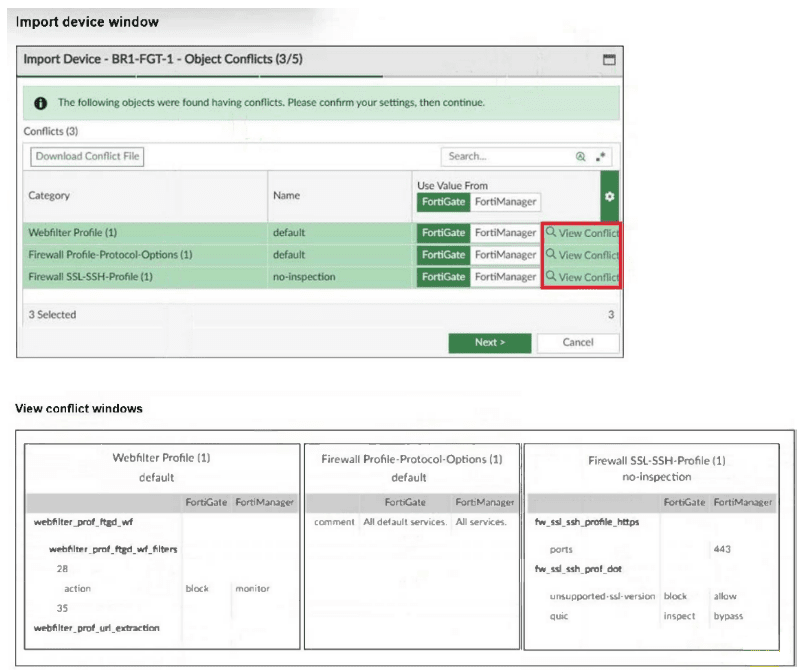
Refer to the exhibits.

An administrator added BR1-FGT-1 to FortiManager and started importing the policy package. During the process, they saw that they need to choose values from FortiGate or FortiManager.

Which conclusion is most clearly supported by the exhibits?

Correct answer: C

The exhibits are directly supported by the lab guide's troubleshooting section. It states: ''The only profile that can be replaced is the Firewall Profile-Protocol-Options profile, because the only difference is a change in the comment field.'' It then explains that for the other two profiles, ''Whether you accept the value from BR1-FGT-1 or FortiManager, it will cause changes on different devices.''

That exactly matches C. The conflict window is not primarily showing a firmware mismatch, and the guide does not say BR1-FGT-1 lacks HTTPS 443 support. It also does not describe this as a FortiGuard database mismatch for QUIC. Instead, the key point is that only the default Firewall Profile-Protocol-Options conflict is minor enough to safely take from FortiManager because the difference is only in the comment field. The web filter and SSL/SSH profiles would cause real configuration differences if replaced.


Question 5

An administrator created a new ADOM named Training for FortiGate devices only. Then, the administrator added the root FortiGate device of a Security Fabric group to the Training ADOM. Which statement correctly describes the expected result for the downstream devices in the Security Fabric, given the actions taken by the administrator? Choose one answer

Correct answer: C

The correct answer is C. The FortiManager 7.6 Administrator Study Guide states that after adding the root FortiGate of a Security Fabric, all downstream devices in the fabric are automatically added as Unauthorized in the root ADOM. That directly matches option C.

This is important because the administrator created a FortiGate-only ADOM named Training, not a Fabric ADOM. The lab guide explains that a FortiGate ADOM is intended for FortiGate devices, while the Fabric type is the special ADOM type that allows FortiGate and other device types together.

So the downstream members are not automatically authorized, and they do not immediately appear as managed devices inside the Training ADOM. They first appear as unauthorized devices in the root ADOM, where the administrator can review and authorize them.


Unlock all Fortinet NSE6_FMG_AD-7.6 questions

Full exam access, validated answers, and unlimited practice with no download limits.

How QA4Exam.com Helps You Pass

QA4Exam.com offers Exam PDF content with actual questions and answers to help you study efficiently for the Fortinet NSE6_FMG_AD-7.6 exam. The Online Practice Test gives you a real exam simulation so you can become familiar with question style, pacing, and pressure before test day. With up-to-date questions and verified answers, you can focus on the areas that matter most for passing. The practice test also helps you improve time management, which is important when you want to finish confidently on your first attempt. Together, these study tools provide a focused and practical way to prepare for Fortinet NSE 6 - FortiManager 7.6 Administrator.

FAQ

1. What is the Fortinet NSE6_FMG_AD-7.6 exam?

It is the Fortinet NSE 6 - FortiManager 7.6 Administrator exam, part of the NSE 6, NSE 6: Secure Networking certification track. It focuses on FortiManager administration, policy management, device manager tasks, troubleshooting, and advanced configuration.

2. Who should take this exam?

This exam is for candidates who work with FortiManager and want to prove their ability to manage policies, objects, devices, and administrative tasks in a Fortinet environment.

3. Is the exam difficult?

It can be challenging because it tests practical knowledge, not just definitions. Candidates need a solid understanding of FortiManager features and the ability to apply that knowledge to real administrative scenarios.

4. Can I pass with only braindumps?

Braindumps alone are not the best approach. You should use them with study and review so you understand the concepts behind the answers and are better prepared for different exam scenarios.

5. Do I need hands-on experience to pass?

Hands-on experience is very helpful because the exam covers real FortiManager administration tasks. Practical familiarity with policy and objects, device manager, and troubleshooting can improve your confidence and accuracy.

6. How do QA4Exam.com dumps and practice tests help with first-attempt success?

The Exam PDF and Online Practice Test help you review actual questions and answers, learn the exam style, and practice under timed conditions. This combination supports better time management, stronger recall, and more confident first-attempt preparation.

7. Are the QA4Exam.com questions and answers verified?

QA4Exam.com provides verified answers so you can study with more confidence. The goal is to help you focus on accurate preparation for the Fortinet NSE6_FMG_AD-7.6 exam.