
Limited-Time Offer: Enjoy 50% Savings! - Ends In 0d 00h 00m 00s Coupon code: 50OFF
Welcome to QA4Exam
Logo

- Trusted Worldwide Questions & Answers

Exam dumps demo

NSE6_FNC_AD-7.6 Exam Dumps and Practice Questions

Preview page 1 of 12 with real questions 1 to 5 from the full 60-question Fortinet set.

Fortinet NSE6_FNC_AD-7.6 Dumps - Pass Fortinet NSE 6 - FortiNAC-F 7.6 Administrator Exam in 2026

The Fortinet NSE6_FNC_AD-7.6 exam, titled Fortinet NSE 6 - FortiNAC-F 7.6 Administrator, is part of the NSE 6, NSE 6: Secure Networking certification track. It is designed for professionals who work with FortiNAC-F and need practical knowledge of configuration, deployment, integration, and monitoring. Earning this certification shows that you can support secure network access operations with confidence and accuracy. It is a valuable credential for candidates who want to validate hands-on administrative skills in a Fortinet environment.

Exam Topics and Approximate Weightage

# Exam Topics Sub-Topics Approximate Weightage (%)
1 Concepts and initial configuration FortiNAC-F overview
Initial setup and access
Basic system settings
25%
2 Deployment and provisioning Deployment planning
Device onboarding
Provisioning workflows
30%
3 Integration Third-party integration basics
Authentication and policy alignment
Connectivity checks
20%
4 Network visibility and monitoring Asset and endpoint visibility
Event and status monitoring
Operational reporting
25%

This exam tests both conceptual understanding and practical administration skills. Candidates should be able to configure FortiNAC-F, understand deployment and integration tasks, and interpret network visibility and monitoring data. The questions are aimed at validating real-world ability rather than memorization alone, so preparation should include hands-on familiarity with the platform.

Actual Fortinet NSE6_FNC_AD-7.6 Exam Questions

Question 1

Refer to the exhibit.
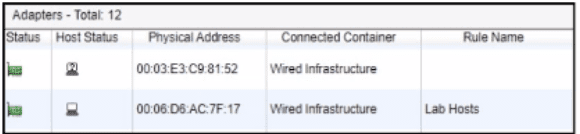
After a successful layer 2 poll, two hosts were learned on the same port The port is a member of the Role-Based Access and Forced Registration groups. The switch has been configured to leverage a single isolation VLAN.

How will FortiNAC-F manage this port?

Correct answer: A

The correct answer is A. The exhibit shows two adapters learned on the same wired port: one appears as a rogue/unknown host, and the other is associated with the Lab Hosts rule. The port is in both Role-Based Access and Forced Registration. FortiNAC-F state-based control takes precedence over policy-based provisioning, and the study guide states that when a rogue host connects to a port in the Forced Registration group, FortiNAC-F isolates that host by moving it into the registration captive network. The guide also explains that the Isolation network can be used as a single network for abnormal host states while still presenting state-specific portal pages.

Because this is a wired switch port using VLAN-based control, FortiNAC-F cannot put one host on the production VLAN and the other host on the isolation portal VLAN at the same time on the same access port. The VLAN change applies to the port, not independently to each MAC address behind that port. Therefore, the presence of the rogue host on a Forced Registration port causes the port to be provisioned to the isolation network. Option B is technically unrealistic for this access-port scenario. Option C is wrong because two MAC addresses alone do not make the port an uplink; FortiNAC-F uses uplink logic for infrastructure-device MACs, manually marked uplinks, or a threshold such as more than 20 MAC addresses. Option D is unrelated because Access Point Management is not triggered by learning two wired hosts on a port.
Question 2

Refer to the exhibit.

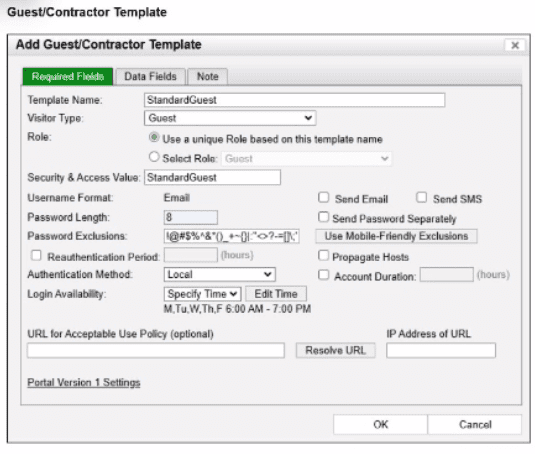
What will happen to the host of a guest user created from this template if the time of connection is 8:00 PM?

Correct answer: A

In FortiNAC-F, theGuest & Contractor Templateis a configuration object that defines the parameters for accounts created by sponsors or through self-registration. One of the critical security controls within this template is theLogin Availabilitysetting. This setting restricts the specific days and times during which a guest or contractor is permitted to authenticate and access the network.

As shown in the exhibit, the 'StandardGuest' template hasLogin Availabilityset to'Specify Time', with a schedule defined asMon-Fri, 6:00 AM to 7:00 PM. If a guest user attempts to connect or authenticate at8:00 PM, which is outside of the permitted window, FortiNAC-F's policy engine will automatically deny the authentication request. When an authentication attempt is denied due to schedule restrictions, the system does not move the host into the 'Authenticated' or 'Registered' state required for production access. Instead, the host ismarked as non-authenticatedin the adapter or host view.

This behavior ensures that even if a guest possesses valid credentials, their access is strictly bound by the organizational policy for visitor hours. The host will typically remain in its current isolation or registration VLAN, and the user will see a message on the captive portal indicating that their account is not currently authorized for login. It is important to distinguish this from 'at-risk' (C), which relates to security scan failures, or 'rogue' (B), which typically refers to unknown devices that have not yet been associated with a valid account or profiling rule.

'Login Availabilitydefines the timeframe during which the guest or contractor account is valid for network access. This schedule is enforced at the time of authentication. If a user attempts to log in outside of the designated window, the authentication is rejected by the system. Consequently, the host record will reflect anon-authenticatedstatus, and the device will remain restricted to the isolation or registration network until a valid login window is reached.' ---FortiNAC-F Administration Guide: Guest and Contractor Templates Section.


Question 3

An administrator has configured the DHCP scope for a registration isolation network, but the isolation process isn't working.

What is the problem with the configuration?

Correct answer: D

In a FortiNAC-F deployment, the configuration of theDHCP scopefor isolation networks (Registration, Remediation, etc.) must perfectly align with the underlying network infrastructure to ensure that isolated hosts can communicate with the FortiNAC appliance. In the provided exhibits, there is a clear discrepancy between theDHCP configurationand theNetwork Topology.

As shown in the 'Network Topology' exhibit, theRegistration Networkresides on a router interface (or sub-interface) with the IP address192.168.180.1. This address represents the default gateway for any host placed into the Registration VLAN. However, the 'DHCP configuration' exhibit shows the scope'REG-ScopeOne'configured with aGateway of 10.0.1.254. This 10.0.1.254 address belongs to the management/service network (port2 of FortiNAC), not the registration subnet. If a host in the Registration VLAN receives this incorrect gateway via DHCP, it will attempt to send all off-link traffic to an unreachable IP, preventing it from loading theCaptive Portalor communicating with the FortiNAC server.

According to theFortiNAC-F Configuration Wizard Reference, when defining a Layer 3 network scope, the 'Gateway' field must contain the IP address of the router interface that acts as the gateway for that specific isolation VLAN. The FortiNAC appliance itself usually sits on a different subnet, and traffic is directed to it via the router's DHCP Relay (IP Helper) and DNS redirection.

'When configuring scopes for a Layer 3 network, theGatewayvalue must be the IP address of the router interface for that subnet. This allows the host to reach its local gateway to route traffic. If the gateway is misconfigured, the host will be unable to reach the FortiNAC eth1/port2 interface for registration... Ensure the Gateway matches the network topology for the isolation VLAN.' ---FortiNAC-F Configuration Wizard Reference Manual: DHCP Scopes.


Question 4

Refer to the exhibit.

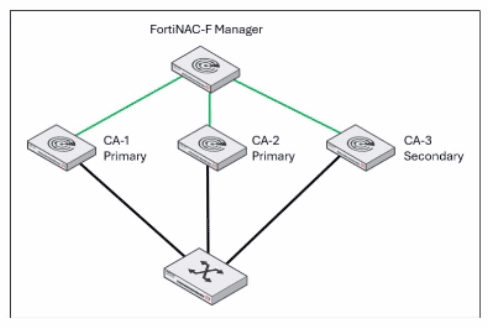
A FortiNAC-F N+1 HA configuration is shown.

What will occur if CA-2 fails?

Correct answer: B

In anN+1 High Availability (HA)configuration, a single secondary Control and Application (CA) server provides backup for multiple primary CA servers. The FortiNAC-F Manager (FortiNAC-M) acts as the centralized orchestrator for this cluster, monitoring the health of all participating nodes.

According to theFortiNAC-F 7.6.0 N+1 Failover Reference Manual, when a primary CA (such asCA-2in the exhibit) fails, the secondary CA (CA-3) is automatically promoted by the Manager to take over the specific workload and database functions of that failed primary. Crucially, the documentation specifies that even after this promotion, the system architecture maintains its N+1 logic. The secondary CA effectively 'assumes the identity' of the failed primary while continuing to operate within the N+1 framework established by the Manager.

It doesnotmerge with CA-1 to form a traditional 1+1 active/passive cluster (A), nor does it engage in load balancing (D), as FortiNAC-F HA is designed for redundancy and failover rather than active traffic distribution. Furthermore, CA-3 does not 'share' management with CA-1 (C); it independently handles the tasks originally assigned to CA-2. Throughout this failover state, the Manager continues to oversee the group, and CA-3 remains the designated secondary unit currently acting in a primary capacity for the downed node until CA-2 is restored.

'In an N+1 Failover Group, theSecondary CAis designed to take over the functionality ofany single failed primary componentwithin the group. The FortiNAC Manager monitors the primaries and initiates the failover to the secondary... Once failover occurs, the secondary continues to operate as the backup unit for the failed primary while remaining part of the managed N+1 HA configuration.' ---FortiNAC-F 7.6.0 N+1 Failover Reference Manual: Failover Behavior Section.


Question 5

An organization has FortiNAC-F deployed and is using Layer 3 isolation networks across multiple sites with firewalls. At a minimum, which three protocols must be allowed between the isolation networks and FortiNAC-F? (Choose three.)

Correct answer: C, D, E

The correct answers are C, D, and E. In a Layer 3 captive or isolation network design, FortiNAC-F port2 acts as the captive network service interface. The study guide states that Layer 3 captive networks require DHCP traffic to be relayed to port2 from the captive networks, and that the FortiNAC-F interface provides DHCP, DNS, and captive portal services to hosts assigned to any captive network.

That means the firewall path between the isolation VLANs and FortiNAC-F must allow DHCP, so isolated endpoints can receive an IP address from the FortiNAC-F captive network scope; DNS, so the isolated endpoint uses FortiNAC-F as its DNS server and gets redirected correctly; and HTTP/HTTPS, so the endpoint can load the FortiNAC-F captive portal page. The guide's browser-redirection flow confirms this sequence: the host is moved to the isolation VLAN, requests DHCP, receives FortiNAC-F as the DNS server, performs DNS lookup, and then Apache/Tomcat services present the portal content.

Option A, DDNS, is not required for captive portal operation. Option B, NTP, may be useful for endpoint time accuracy or certificate-related workflows, but it is not part of the minimum traffic required for FortiNAC-F isolation network operation.


Unlock all Fortinet NSE6_FNC_AD-7.6 questions

Full exam access, validated answers, and unlimited practice with no download limits.

How QA4Exam.com Helps You Pass

QA4Exam.com provides Exam PDF materials with actual questions and answers, along with an Online Practice Test for the Fortinet NSE6_FNC_AD-7.6 exam. These resources help you study with up-to-date questions and verified answers so you can focus on the most relevant exam areas. The practice test creates a real exam simulation that helps you build confidence and improve time management before test day. Using both formats together can make your preparation more efficient and help you aim for a first attempt pass.

Frequently Asked Questions

Who should take the Fortinet NSE6_FNC_AD-7.6 exam?

It is intended for professionals who work with FortiNAC-F and want to validate their knowledge of administration, deployment, integration, and monitoring within the NSE 6, NSE 6: Secure Networking track.

Is this exam considered difficult?

The difficulty depends on your hands-on experience and preparation. Candidates who understand the exam topics and practice with realistic questions usually find it easier to manage.

Can I pass with only braindumps?

Braindumps alone are not the best approach. They can help you review question style, but you should also understand the concepts and practical tasks covered in the exam.

Do I need hands-on experience with FortiNAC-F?

Yes, hands-on experience is very helpful because the exam focuses on configuration, deployment, integration, and monitoring skills that are best learned through practical use.

Are QA4Exam.com dumps and practice tests enough to prepare?

They are strong preparation tools because they include actual questions and answers, verified content, and an online practice format, but combining them with review of the exam topics gives the best result.

How do the QA4Exam.com practice tests help with first attempt success?

They simulate the exam environment, help you practice time management, and let you identify weak areas before the real test, which can improve your chances of passing on the first attempt.

What format do the QA4Exam.com study materials use?

QA4Exam.com offers an Exam PDF with questions and answers and an Online Practice Test designed to mirror exam-style preparation in a convenient study format.