
Trusted Worldwide Questions & Answers
Most Recent Fortinet NSE7_EFW-7.2 Exam Dumps
Prepare for the Fortinet NSE 7 - Enterprise Firewall 7.2 exam with our extensive collection of questions and answers. These practice Q&A are updated according to the latest syllabus, providing you with the tools needed to review and test your knowledge.
QA4Exam focus on the latest syllabus and exam objectives, our practice Q&A are designed to help you identify key topics and solidify your understanding. By focusing on the core curriculum, These Questions & Answers helps you cover all the essential topics, ensuring you're well-prepared for every section of the exam. Each question comes with a detailed explanation, offering valuable insights and helping you to learn from your mistakes. Whether you're looking to assess your progress or dive deeper into complex topics, our updated Q&A will provide the support you need to confidently approach the Fortinet NSE7_EFW-7.2 exam and achieve success.
The questions for NSE7_EFW-7.2 were last updated on Mar 2, 2026.
- Viewing page 1 out of 16 pages.
- Viewing questions 1-5 out of 80 questions
Exhibit.
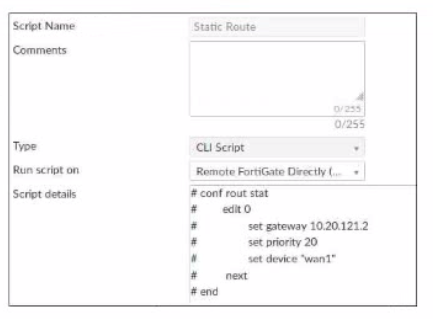
Refer to the exhibit, which contains a CLI script configuration on fortiManager. An administrator configured the CLI script on FortiManager rut the script tailed to apply any changes to the managed
device after being executed.
What are two reasons why the script did not make any changes to the managed device? (Choose two)
Refer to the exhibit, which shows an error in system fortiguard configuration.
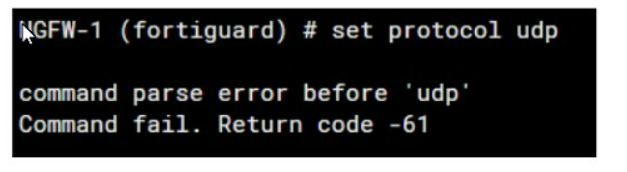
What is the reason you cannot set the protocol to udp in config system fortiguard?
The reason for the command failure when trying to set the protocol to UDP in the config system fortiguard is likely that UDP is not a protocol option in this context. The command syntax might be incorrect or the option to set a protocol for FortiGuard updates might not exist in this manner. So the correct answer is D. udp is not a protocol option.
Which, three conditions are required for two FortiGate devices to form an OSPF adjacency? (Choose three.)
Refer to the exhibit, which shows device registration on FortiManager.
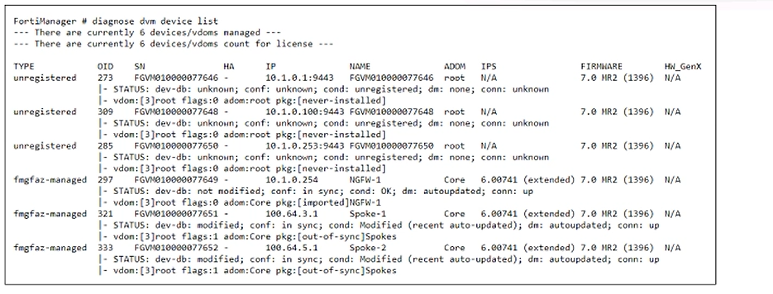
What can you conclude about the Spoke-1 and Spoke-2 configurations with respect to the information cond: Modified (recent auto-updated)?
Which two statements about the BFD parameter in BGP are true? (Choose two.)
Bidirectional Forwarding Detection (BFD) is a rapid protocol for detecting failures in the forwarding path between two adjacent routers, including interfaces, data links, and forwarding planes. BFD is designed to detect forwarding path failures in a very short amount of time, often less than one second, which is significantly faster than traditional failure detection mechanisms like hold-down timers in routing protocols.
Fortinet supports BFD for BGP, and it can be used over multiple hops, which allows the detection of failures even if the BGP peers are not directly connected. This functionality enhances the ability to maintain stable BGP sessions over a wider network topology and is documented in Fortinet's guides.
Unlock All Questions for Fortinet NSE7_EFW-7.2 Exam
Full Exam Access, Actual Exam Questions, Validated Answers, Anytime Anywhere, No Download Limits, No Practice Limits
Get All 80 Questions & Answers