Limited-Time Offer: Enjoy 50% Savings! - Ends In 0d 00h 00m 00s Coupon code: 50OFF
Welcome to QA4Exam

Practice questions demo

NSE7_FSN_AR-7.6 Exam Dumps and Practice Questions

Questions 1 to 5 of the 146-question NSE7_FSN_AR-7.6 bank, each with its correct answer and an explanation. 4 of 5 ask for more than one answer. This is page 1 of 29.

1 / 29

Actual Fortinet NSE7_FSN_AR-7.6 Exam Questions

Question 1

Refer to the exhibit.

The port1 interface configuration on FortiGate and partial session information for ICMP traffic are shown.

Which two things happen to the session information if a routing change occurs that affects this session? (Choose two answers)

Correct answer: A, C

The correct answers are A and C.

The exhibit shows that preserve-session-route is enabled on port1:

config system interface

edit 'port1'

set preserve-session-route enable

next

end

The study guide explains the effect of this setting exactly:

''enable: FortiGate marks existing session routing information as persistent, and applies only the modified routes to new sessions''

It also states:

''The current route must still be present in the FIB. Otherwise, FortiGate flags the session as dirty and reevaluates it''

And the same page further clarifies:

''If you enable this setting, sessions passing through that interface continue to pass without being affected by the routing changes. The routing changes apply only to new sessions. If the route is removed from the FIB, then FortiGate must flag the session as dirty, flush its gateway information, and reevaluate the session.''

This proves:

A is correct because with preserve-session-route enable, existing sessions are normally preserved and routing changes apply only to new sessions.

C is correct because the session remains unchanged unless the current route is removed from the FIB/routing table, in which case FortiGate dirties and reevaluates the session.

Why the other options are wrong:

B is wrong because when the active route is removed, FortiGate does not simply mark the session dirty and stop there. The study guide says it ''flags the session as dirty and reevaluates it'', which means route lookup happens again.

D is wrong because the session does change if the active route is removed. FortiGate flushes gateway information and reevaluates the session.

So the verified answers are: A, C.


Question 2

Refer to the exhibit.

Partial output of command diagnose debug rating is shown. Which FDS server will the FortiGate algorithm choose?

Correct answer: C

The correct answer is C. 64.26.151.37.

The study guide explains the FortiGuard flags shown by diagnose debug rating:

D = Default

I = Initial

T = Timing

F = Failedand specifically: ''F = The server is down''

So even though 121.111.236.179 has the lowest RTT in the exhibit, it has the F flag, meaning FortiGate considers that server failed/down, so it will not be chosen.

To determine which active server is selected, the FortiOS administration guide states:

''The server list is sorted first by weight. The server with the smallest RTT appears at the top of the list regardless of weight. ... Therefore the top position in the list is selected based on RTT while the other positions are based on weight.''

Among the valid, non-failed choices in the exhibit:

64.26.151.37 RTT 45

209.22.147.36 RTT 103

96.45.33.65 RTT 144

208.91.112.194 RTT 107

The active server with the lowest RTT is 64.26.151.37, so that is the server FortiGate will choose.

So the verified answer is: C.


Question 3

Refer to the exhibit.

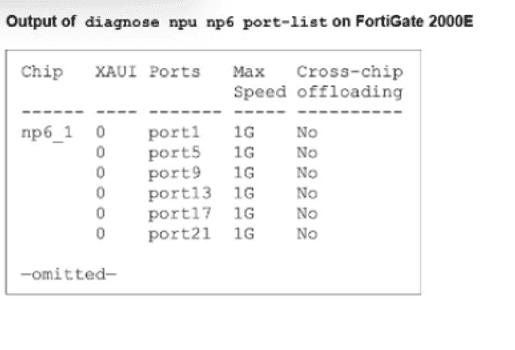
A partial output of diagnose npu up6 port-list on FortiGate 2000E is shown.

An administrator is unable to analyze traffic flowing between port1 and port17 using the diagnose sniffer command.

Which two commands allow the administrator to view the traffic? (Choose two.)

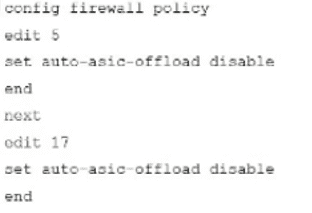
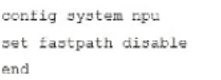
A)

B)

C)

D)

Correct answer: B, C

The administrator cannot see traffic in the sniffer because it is being offloaded to the NPU (NP6). To view the traffic, offloading must be disabled so packets pass through the CPU.

B . config firewall policy ... set auto-asic-offload disable: This is the recommended method to troubleshoot specific traffic. By disabling ASIC offloading in the relevant firewall policies (Policies 5 and 17 in the exhibit), traffic is forced to the CPU and becomes visible to the sniffer.

C . diagnose npu np6 fastpath disable 1: This command temporarily disables the fastpath processing on the specific NP6 processor (ID 1) handling the ports. This forces all traffic handled by that NPU to the CPU, allowing the sniffer to capture it.

Incorrect Options: Option A uses invalid syntax (port-list disable is not a valid command). Option D (config system npu) is not the standard method for granular troubleshooting.


Question 4

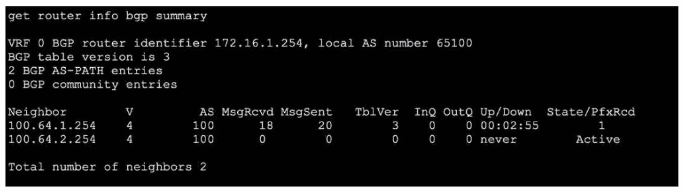
Refer to the exhibit, which shows the output of get router info bgp summary.

Which two statements are true? (Choose two.)

Correct answer: A, C

The get router info bgp summary output lists BGP neighbor status:

Prefix Reception: The 'State/PfxRcd' column shows the number of prefixes received from the neighbor---neighbor 100.64.1.254 has '1', confirming option A.

Received Message Count: Under 'MsgRcvd', 18 packets have been received from neighbor 100.64.1.254. This matches option C.

The second neighbor 100.64.2.254 is in 'Active' state and has received/sent 0 packets, indicating that its TCP connection is NOT established, disproving option B.

There is no indication anywhere that the router is 'still calculating' prefixes; 'Active' just means no session is established, so option D is incorrect.


FortiOS BGP Command Reference: BGP Neighbor States, PfxRcd, and Counters

Question 5

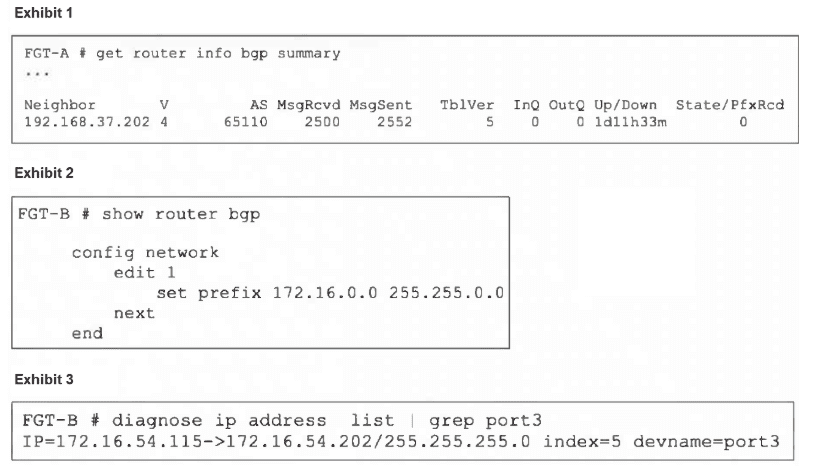
Refer to the exhibits.

An administrator is attempting to advertise the network configured on port3. However, FGT-A is not receiving the prefix.

Which two actions can the administrator take to fix this problem? (Choose two.)

Correct answer: A, D

The exhibits showing the network topology and routing configuration are not visible. Issues with advertising a network prefix typically involve: incorrect OSPF network statement or area assignment, passive interface configuration blocking advertisement, redistribution not being configured if the route comes from a different source, insufficient OSPF adjacency, or incorrect metric/cost values. Two specific fixes would depend on what the exhibit shows.

Unlock all Fortinet NSE7_FSN_AR-7.6 questions

Full exam access, validated answers, and unlimited practice with no download limits.