
Trusted Worldwide Questions & Answers
Most Recent Fortinet NSE7_SSE_AR-26 Exam Dumps
Prepare for the Fortinet NSE 7 - SASE 26 Architect exam with our extensive collection of questions and answers. These practice Q&A are updated according to the latest syllabus, providing you with the tools needed to review and test your knowledge.
QA4Exam focus on the latest syllabus and exam objectives, our practice Q&A are designed to help you identify key topics and solidify your understanding. By focusing on the core curriculum, These Questions & Answers helps you cover all the essential topics, ensuring you're well-prepared for every section of the exam. Each question comes with a detailed explanation, offering valuable insights and helping you to learn from your mistakes. Whether you're looking to assess your progress or dive deeper into complex topics, our updated Q&A will provide the support you need to confidently approach the Fortinet NSE7_SSE_AR-26 exam and achieve success.
The questions for NSE7_SSE_AR-26 were last updated on Oct 12, 2026.
- Viewing page 1 out of 22 pages.
- Viewing questions 1-5 out of 110 questions
Refer to the exhibits. You collected the output shown in the exhibits and want to know which interface TCP traffic will flow through from the user device 10.0.1.101 to the corporate file server 10.0.0.125. All SD-WAN links are stable. Which interface will FortiGate use to steer the traffic? Choose one answer.
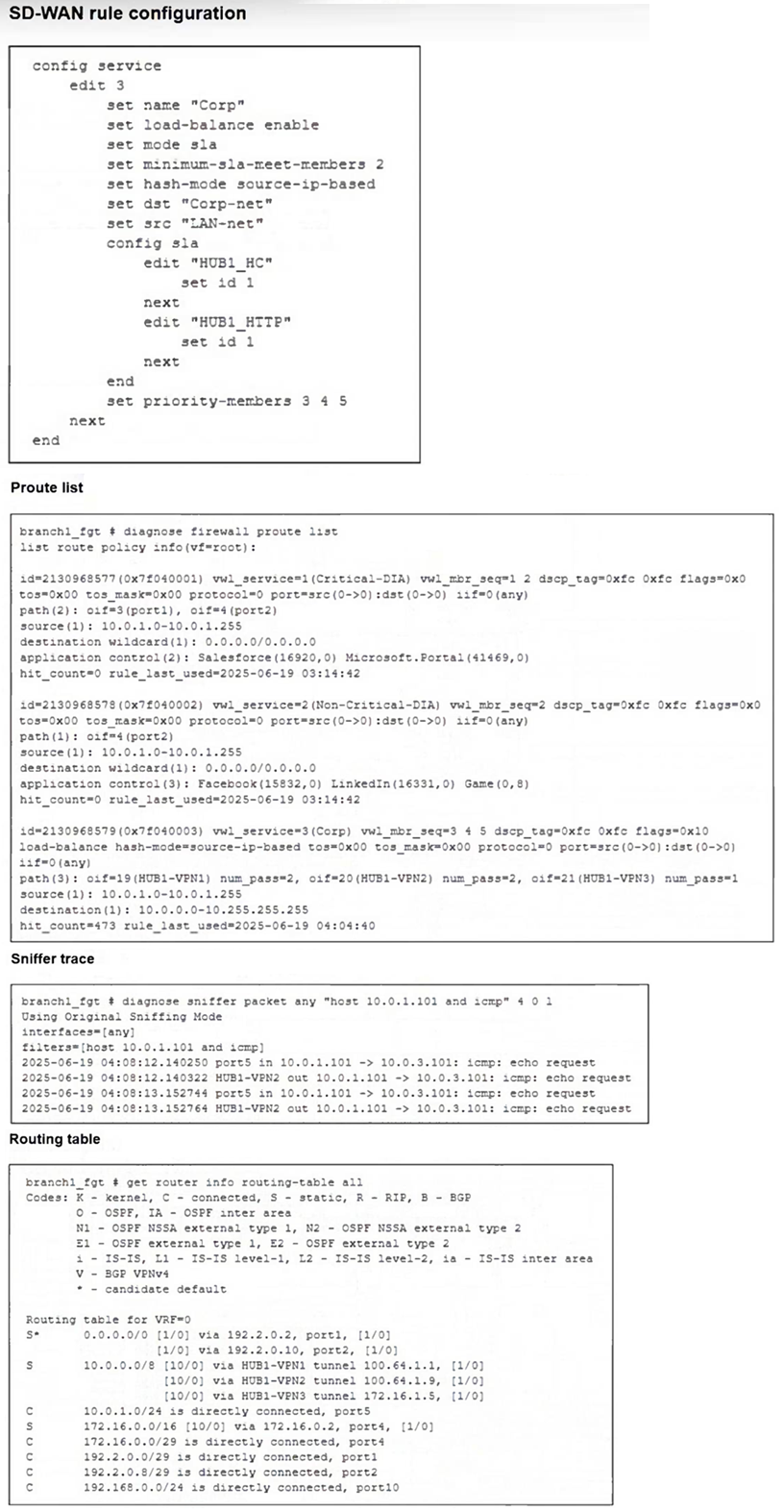
Exhibit 1
From the SD-WAN rule configuration (service ID 3, name "Corp"), the rule is configured as: In the diagnose firewall proute list output for service=3 (Corp), FortiGate shows the actual members considered for this rule and their SLA pass status: Because the rule is SLA-based, FortiGate selects only members that meet the SLA requirements for the rule. The output indicates that HUB1-VPN1 and HUB1-VPN2 pass both SLA checks (num_pass=2), while HUB1-VPN3 passes only one (num_pass=1) and therefore is not selected as an eligible forwarding interface for this rule. Since load-balance is enabled and the rule uses hash-mode source-ip-based, FortiGate will consistently choose an eligible member based on the source IP hash. For traffic sourced from 10.0.1.101, the session can be steered through either HUB1-VPN1 or HUB1-VPN2 (whichever the hash selects), but not HUB1-VPN3. Therefore, the correct answer is B. An operational review should distinguish the rule that matches the traffic from the interface that is ultimately selected. Valid forwarding also depends on destination route eligibility, current member state and the applicable SLA or quality-selection algorithm. A diagnostic showing configured members alone is not conclusive evidence that all those members will carry a particular flow.
Verification qualification: A specific hash-selected interface cannot be predicted from the supplied configuration without the full evaluation. Reference: https://docs.fortinet.com/document/fortigate/7.6.0/cli-reference/838040159/config-system-sdwan; https://docs.fortinet.com/document/fortigate/7.6.0/administration-guide/25967/equal-cost-multi-path
==========
An SD-WAN member is no longer used to steer SD-WAN traffic. The administrator updated the SD-WAN configuration and deleted the unused member. After the configuration update, users report that some destinations are unreachable. You confirm that the affected flow does not match an SD-WAN rule. What could be a possible cause of the traffic interruption?
When an SD-WAN member is deleted, FortiGate can also remove static routes that were tied to that interface. If those routes are needed for destinations not covered by SD-WAN rules, traffic to those networks becomes unreachable. This explains why flows not matching SD-WAN rules are interrupted after the member was removed. A deployment should preserve the distinction between the physical or logical WAN underlay, the IPsec overlay and the SD-WAN zone that groups forwarding members. These layers can have different routing and security-policy requirements. The configured architecture must also allow the required traffic paths and failover behavior rather than assuming every available interface is interchangeable. Before applying a topology change, review the interface dependencies, static and dynamic routing, security policies and provisioning templates. FortiGate can support multiple transport types, but routing and tunnel compatibility still determine whether the intended member is operationally eligible. In the relevant Fortinet FortiOS documentation, the applicable feature should be verified against the deployed software version, the selected configuration mode and the live operational state before the answer is treated as a definitive implementation requirement.
==========
Refer to the exhibits. You use FortiManager to configure SD-WAN on three branch devices. When you install the device settings. FortiManager prompts you with the error "Copy Failed" for the device branch1_fat When you click the log button. FortiManager displays the message shown in the exhibit.
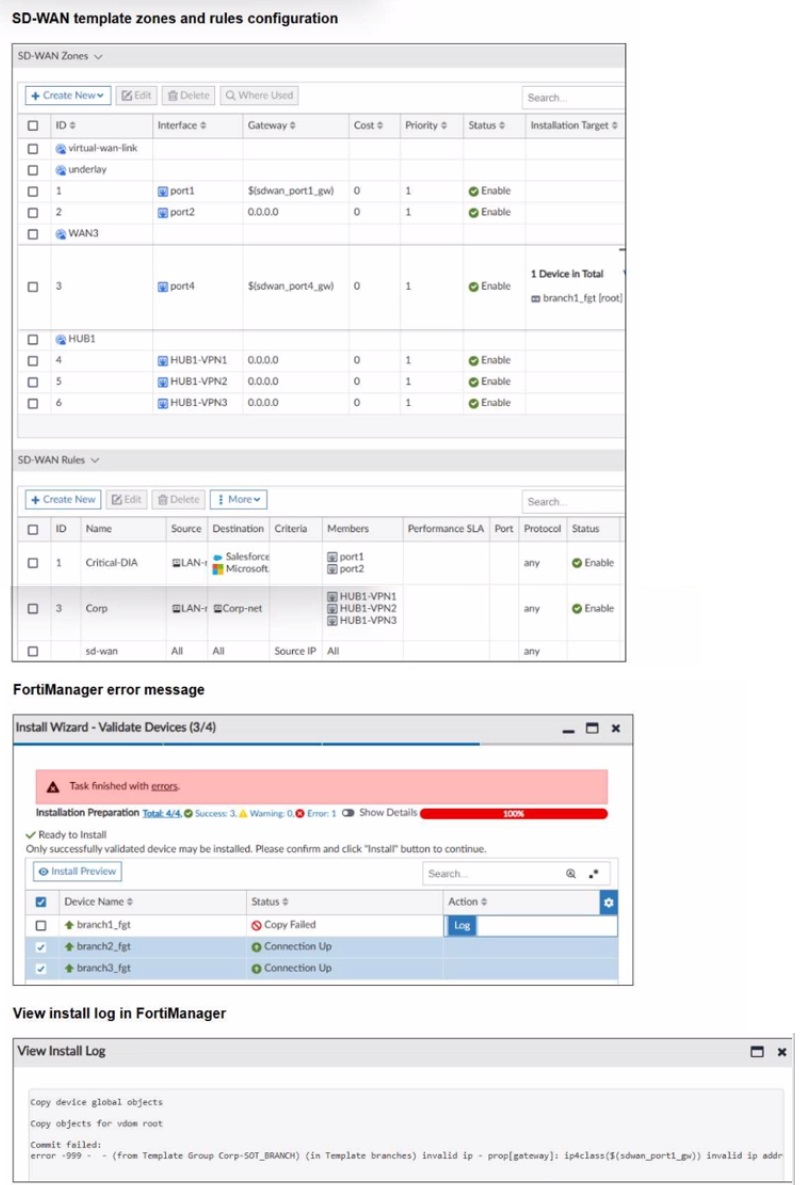
Exhibit 1
The FortiManager installation error is associated with the gateway value produced by metadata substitution, not with a general failure of FortiManager-to-FortiGate connectivity. A template uses a variable such as '$(sdwan_port1_gw)' to provide the interface gateway at installation time. If the current device has no valid value in its per-device metadata mapping, the generated FortiOS configuration contains an invalid IPv4 gateway and the copy or validation operation fails. Therefore the remediation is to inspect the variable definition and its per-device mapping, which is option C in the normalized question. The administrator can verify the mapping for the affected FortiGate, supply a valid address, regenerate the installation preview and reinstall. It is unnecessary to remove all template installation targets: FortiManager supports them alongside metadata variables. Nor must the members of a zone all use identical gateway configuration methods. This conclusion is specifically tied to the error shown in the original exhibit. The uploaded FortiSASE guides describe centralized management generally, but detailed per-device template substitution belongs to the FortiManager 7.6 Administration Guide.
==========
The SD-WAN overlay template helps to prepare SD-WAN deployments. To complete the tasks performed by the SD-WAN overlay template, the administrator must perform some post-run tasks. What are two mandatory post-run tasks that must be performed? (Choose two.)
After using the SD-WAN overlay template, two mandatory post-run tasks remain:"First, administrators must create and assign policy packages to branch devices, as security and access policies are not included in overlay templates. Second, SD-WAN rules must be configured so that traffic can be matched and steered appropriately through the established overlays. Neglecting either task results in ungoverned traffic or inefficient routing, undermining the benefits of SD-WAN."Templates automate topology, but policy and rule definition are critical for operational effectiveness.Reference: FortiManager templates reduce repetitive work but must resolve to valid, device-specific configurations at installation time. Device assignments, metadata mappings, ADOM scope, policy-package interfaces and provisioning order should be inspected together rather than troubleshooting any one object in isolation. A successful management connection does not guarantee a successful configuration installation. Review the installation preview and task log, then validate the resulting device configuration and operational diagnostics. This separates a deployment-time validation failure from a live tunnel, routing or SLA fault.
==========
Refer to the exhibit.
Which statement correctly describes the role of the ADVPN device in handling traffic?
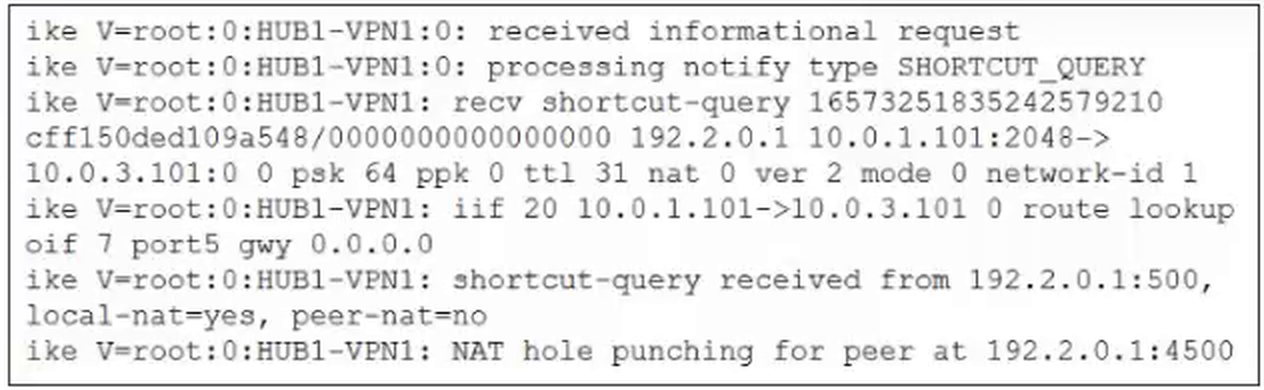
Exhibit --- ADVPN IKE debug output
The exhibit contains IKE debugging messages generated during the ADVPN shortcut discovery process. The important entries include SHORTCUT_QUERY, the incoming shortcut query, the route lookup, and NAT hole-punching information.
Option D is supported by the behavior shown in Fortinet's published ADVPN examples. In the ADVPN shortcut establishment workflow, an initiating spoke can send a shortcut query toward its hub. The hub forwards the discovery information to the destination spoke, which receives that query on its hub-facing tunnel and prepares the subsequent shortcut negotiation.
Fortinet's official ADVPN examples show a destination spoke receiving SHORTCUT_QUERY on its tohub interface, followed by route lookup and shortcut-related operations. The exhibit's HUB1-VPN1 naming is consistent with a spoke-side tunnel toward Hub 1, although interface names alone do not establish the device's role.
Option A is not supported because the displayed log does not demonstrate direct receipt from another spoke. Option B would require evidence that the device is the forwarding hub. Option C incorrectly treats discovery messages as proof of an established shortcut.
The NAT hole-punching entry indicates shortcut negotiation activity, not completion. The strongest interpretation of the provided debug sequence is a destination spoke receiving a forwarded shortcut query from its hub.
==========
Unlock All Questions for Fortinet NSE7_SSE_AR-26 Exam
Full Exam Access, Actual Exam Questions, Validated Answers, Anytime Anywhere, No Download Limits, No Practice Limits
Get All 110 Questions & Answers