Fortinet NSE8_812 Dumps - Pass Fortinet NSE 8 - Written Exam in First Attempt 2026
Fortinet NSE8_812 is the Fortinet NSE 8 - Written Exam and it belongs to the Fortinet Certified Expert,FCX Fortinet Certified Expert Cybersecurity certification path. This exam is designed for experienced professionals who work with advanced Fortinet technologies and need a strong command of secure enterprise design and operations. It matters because it validates high-level expertise across architecture, automation, operations, and solution implementation. Passing this exam shows that you can apply Fortinet knowledge in complex real-world environments.
#
Exam Topics
Sub-Topics
Approximate Weightage (%)
1
Security Architecture
Security design principles, segmentation strategy, high availability planning, policy architecture
18%
2
Automation
API usage, workflow automation, configuration scripts, operational efficiency
This exam tests more than memorization. Candidates must understand how Fortinet technologies fit together, how to choose the right solution for a given environment, and how to troubleshoot and operate systems under practical conditions. It also checks analytical thinking, deployment knowledge, and the ability to apply concepts across multiple security and networking scenarios.
Actual Fortinet NSE8_812 Exam Questions
01Question 1
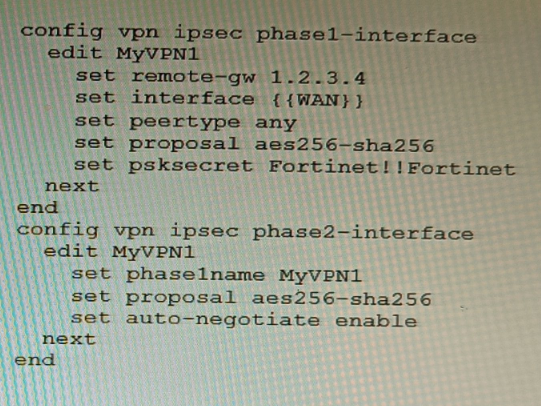
Refer to the exhibit.
FortiManager is configured with the Jinja Script under CLI Templates shown in the exhibit.
Which two statements correctly describe the expected behavior when running this template? (Choose two.)
Correct answer:D, E
D . The administrator must first manually map the interface for each device with a meta field.
The Jinja template in the exhibit is expecting a meta field called WAN to be set on the managed FortiGate. This meta field will specify which interface on the FortiGate should be assigned the 'WAN' role. If the meta field is not set, then the template will fail.
E . The template will fail because this configuration can only be applied with a CLI or TCL script.
The Jinja template in the exhibit is trying to configure the interface role on the managed FortiGate. This type of configuration can only be applied with a CLI or TCL script. The Jinja template will fail because it is not a valid CLI or TCL script.
02Question 2
Which two types of interface have built-in active bypass in FortiDDoS devices? (Choose two.)
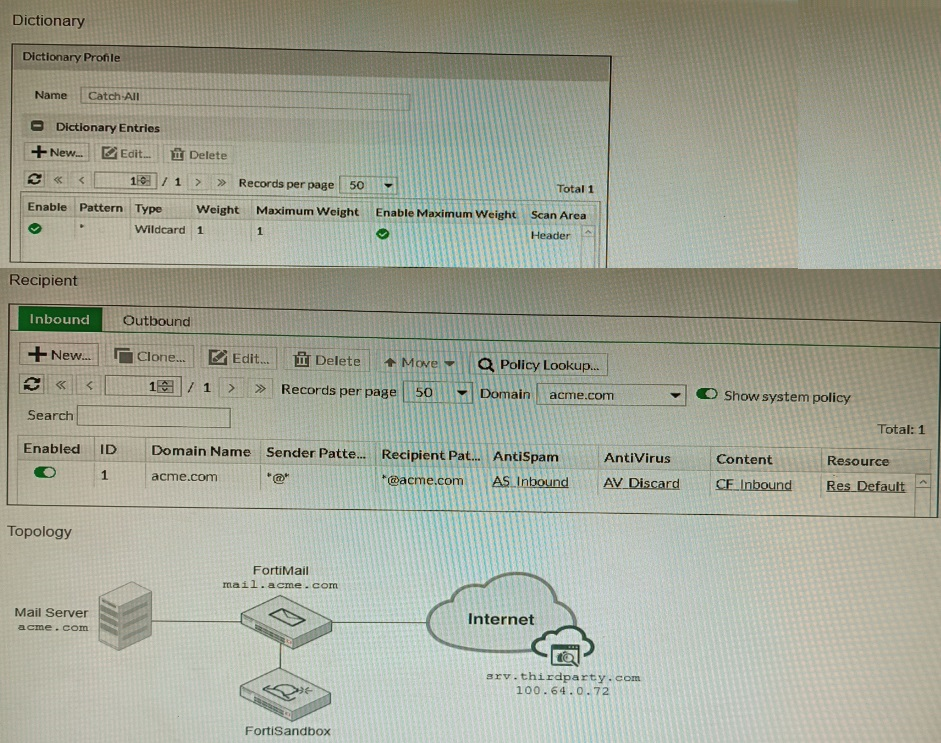
The exhibits show a FortiMail network topology, Inbound configuration settings, and a Dictionary Profile.
You are required to integrate a third-party's host service (srv.thirdparty.com) into the e-mail processing path.
All inbound e-mails must be processed by FortiMail antispam and antivirus with FortiSandbox integration. If the email is clean, FortiMail must forward it to the third-party service, which will send the email back to FortiMail for final delivery, FortiMail must not scan the e-mail again.
Which three configuration tasks must be performed to meet these requirements? (Choose three.)
Correct answer:A, B, E
Ais correct because the scan order must be changed to antispam-sandbox-content in order for FortiMail to scan the email for spam and viruses before forwarding it to the third-party service.
Bis correct because the Catch-All profile must be applied to the CFInbound profile in order for FortiMail to forward clean emails to the third-party service.
Eis correct because an IP policy must be created with a Source value of 100.64.0.72/32 in order to allow emails from the third-party service to be delivered to FortiMail.
The other options are not necessary to meet the requirements. Option C is not necessary because the access receive rule will already allow emails from the third-party service to be received by FortiMail. Option D is not necessary because the Catch-All profile already allows emails to be delivered to any destination.
Here are some additional details about integrating a third-party service into the FortiMail email processing path:
The third-party service must be able to receive emails from FortiMail and send them back to FortiMail.
The third-party service must be able to communicate with FortiMail using the SMTP protocol.
The third-party service must be able to authenticate with FortiMail using the SMTP AUTH protocol.
Once the third-party service is integrated into the FortiMail email processing path, all inbound emails will be processed by FortiMail as usual. If the email is clean, FortiMail will forward it to the third-party service. The third-party service will then send the email back to FortiMail for final delivery. FortiMail will not scan the email again.
04Question 4
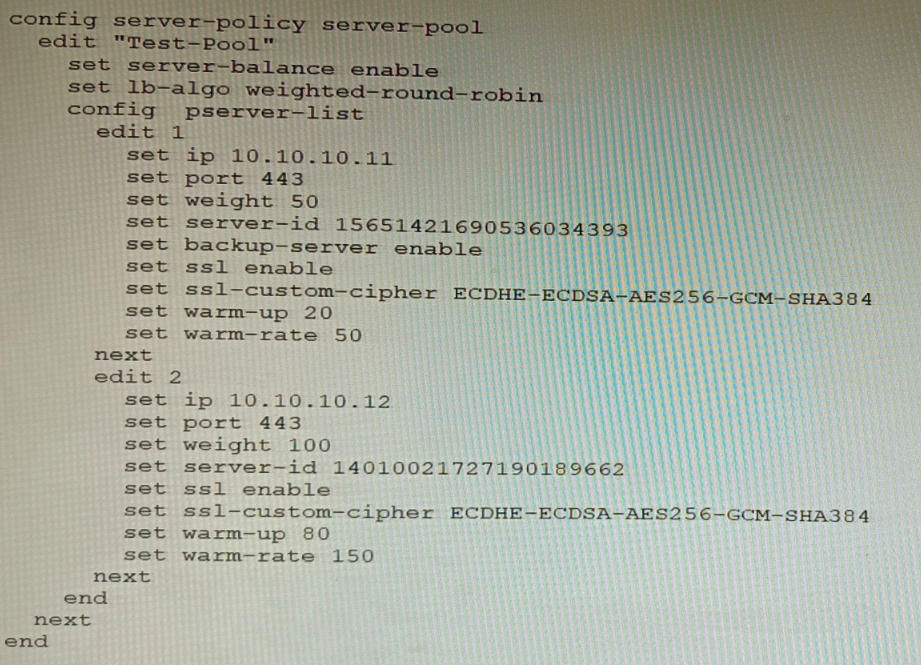
Refer to the exhibit.
A FortiWeb appliance is configured for load balancing web sessions to internal web servers. The Server Pool is configured as shown in the exhibit.
How will the sessions be load balanced between server 1 and server 2 during normal operation?
Correct answer:D
05Question 5
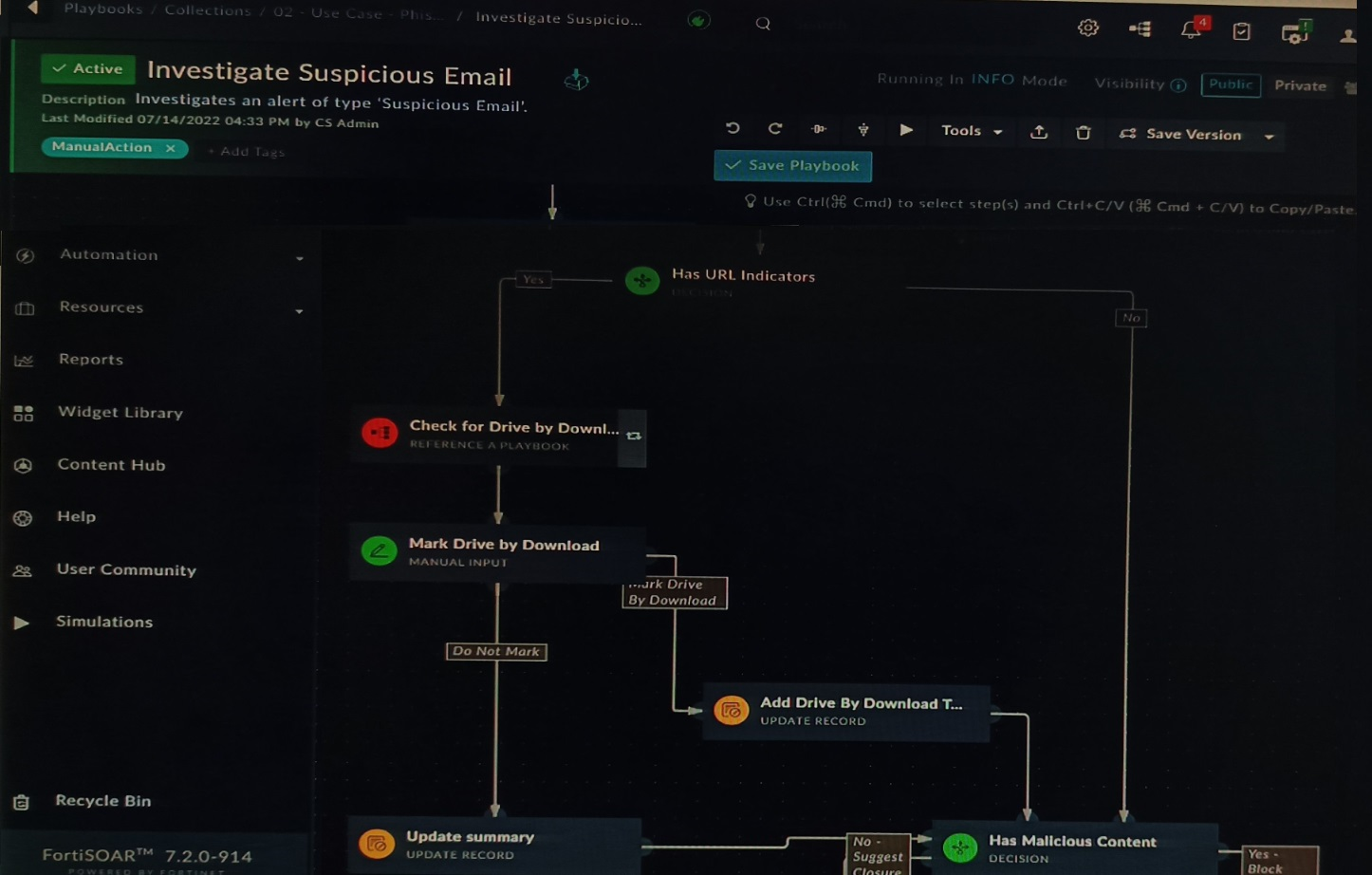
Refer to the exhibit showing a FortiSOAR playbook.
You are investigating a suspicious e-mail alert on FortiSOAR, and after reviewing the executed playbook, you can see that it requires intervention.
What should be your next step?
Correct answer:A
The exhibited playbook requires intervention, which means that the playbook has reached a point where it needs a human operator to take action. The next step should be to go to the Incident Response tasks dashboard and run the pending actions. This will allow you to see the pending actions that need to be taken and to take those actions.
The other options are not correct. Option B will only show you the notification icon, but it will not allow you to run the pending input action. Option C will run the Mark Drive by Download playbook action, but this is not the correct action to take in this case. Option D is not a valid option.
Here are some additional details about pending actions in FortiSOAR:
Pending actions are actions that need to be taken by a human operator.
Pending actions are displayed in the Incident Response tasks dashboard.
Pending actions can be run by clicking on the action in the dashboard.
→
Unlock all Fortinet NSE8_812 questions
Full exam access, validated answers, and unlimited practice with no download limits.
QA4Exam.com provides the Exam PDF with actual questions and answers plus an Online Practice Test to help you prepare efficiently for NSE8_812. The practice test gives you a real exam simulation so you can build confidence before test day. You also get up-to-date questions and verified answers that help you focus on the most relevant exam areas. In addition, timed practice improves your time management and reduces surprises during the real Fortinet exam. With both formats, you can study smarter and aim for first attempt success.
Frequently Asked Questions
What is the Fortinet NSE8_812 exam?
Fortinet NSE8_812 is the Fortinet NSE 8 - Written Exam and it is part of the Fortinet Certified Expert,FCX Fortinet Certified Expert Cybersecurity certification path.
Who should take this exam?
It is intended for experienced professionals who work with advanced Fortinet security, networking, and solution design concepts.
Is the Fortinet NSE 8 - Written Exam difficult?
Yes, it is considered advanced because it tests broad knowledge across architecture, operations, automation, secure SD-WAN, infrastructure, and networking.
Can I pass with only braindumps?
Braindumps alone are not a complete preparation method. You should combine them with hands-on study and practice so you understand the concepts behind the answers.
Do I need hands-on experience for NSE8_812?
Hands-on experience is highly recommended because the exam focuses on practical knowledge, troubleshooting, and real deployment scenarios.
How can QA4Exam.com help me pass on the first attempt?
The Exam PDF and Online Practice Test help you study with actual questions and answers, simulate the exam environment, and practice time management before test day.
What format do the QA4Exam.com dumps and practice test use?
QA4Exam.com offers an Exam PDF and an Online Practice Test so you can review questions offline and also practice in a simulated test format.