Prepare for the HP Aruba Certified Design Expert Written Exam exam with our extensive collection of questions and answers. These practice Q&A are updated according to the latest syllabus, providing you with the tools needed to review and test your knowledge.
QA4Exam focus on the latest syllabus and exam objectives, our practice Q&A are designed to help you identify key topics and solidify your understanding. By focusing on the core curriculum, These Questions & Answers helps you cover all the essential topics, ensuring you're well-prepared for every section of the exam. Each question comes with a detailed explanation, offering valuable insights and helping you to learn from your mistakes. Whether you're looking to assess your progress or dive deeper into complex topics, our updated Q&A will provide the support you need to confidently approach the HPE6-A80 exam and achieve success.
Actual HP HPE6-A80 Exam Questions
01Question 1
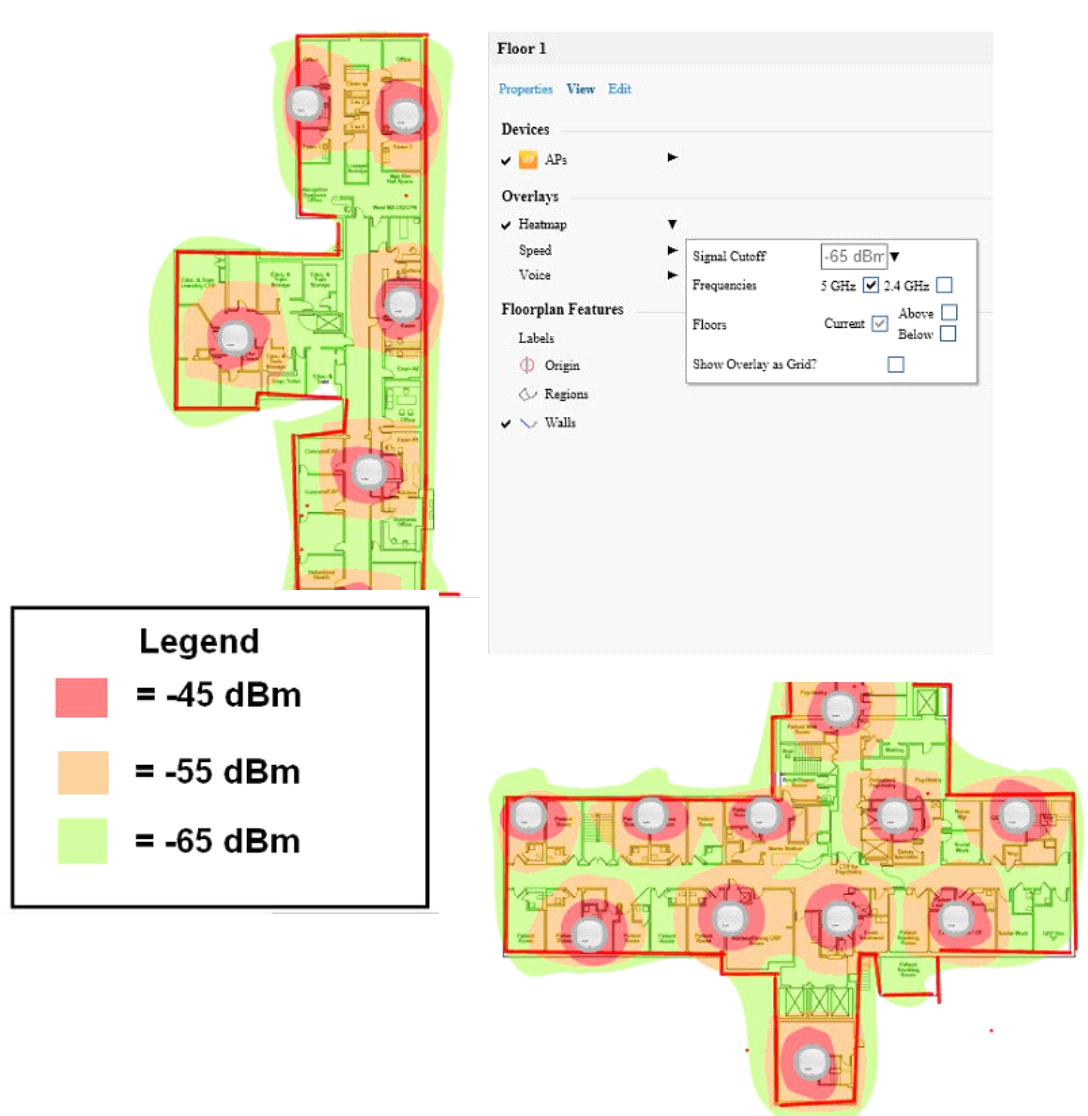
Refer to the exhibit.
A hospital needs an upgrade to 802.1tax for its wireless network. The wireless network supports:
* wireless medical devices
* medical staff voice communicators
* laptops in nurse stations
* medical staff tablets
* visitor and patient personal devices.
All of these devices support both the 2 4GHz and 5GH2 band. Assuming about a max throughput on50 Mbps per AP; the hospital would like. The architect has used VisualRF to plan the AP placement on one of the floors, which the hospital expects will need to suppod about 800 win
to deploy APS in stairwells between floors.
How well does the plan meet the requirements?
Correct answer:C
02Question 2
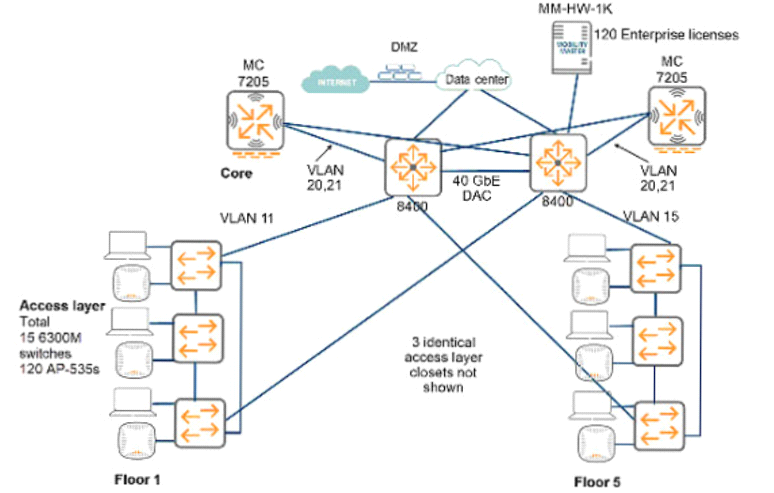
Refer to the exhibit.
A customer has these availability requirements;
* loss of one controller with stateful failover and without impact on wireless client connectivity
* loss of one core switch without loss of connectivity for any endpoints or APs in the building
* loss of any one switch-lo-switch or MC-to-switch link without loss of connectivity for any endpoints or APS in the
building and with minimal impact on infrastructure functionality
* loss of any one access switch with minimal impact to wireless client connectivity
The exhibit shows the current plan for the topology.
Which change should the architect make to the plan to provide better support for the customers availability requirements?
Correct answer:B
03Question 3
An indoor sports stadium has 5.000 seats in two rings:
The stadium has a ceiling height of 72 feet (22 m).
There is a catwalk around the perimeter of me stadium that is 54 feet (13 m) from me floor.
There are two scoreboards at either end of the stadium
The construction of the stadium is concrete and steel.
The customer has indicated a preference for overhead coverage, and the wireless network should support 3500 concurrent
clients. The architect plans to install the APs on the catwalk to service sections of the floor below
Which type or antennas are recommended for the APS that provide the overhead coverage?
Correct answer:B
04Question 4
A customer has multiple, very small branch sites that require just one or two APs each. The office has a local Internet connection, but all of the traffic is destined To the corporate data center, which has an Aruba wireless solution.
Which branch office solution best meets the customer needs?
Correct answer:C
05Question 5
A company already has an Aruba wireless network The network currently consists of:
* oneMM-HW-1k
* two 7210 MCs in the network core
* two 721GMCsintheDMZ
* 200 AP-515S in Building 1 and Building 5
100 AP-515S each In Building 2r Building 3, and Building 4
The customer now wants to assess if it needs local Mobility controllers (MC) for any buildings:
- Building 1 is the main office building for the campus. It supports the highest number of APs. It connects to the
network core without an aggregation layer.
* Building 2 is further away from the Building i. and no roaming is provided between it and the other buildings its
access layer connects to the network cone with a pair of Aruba CX 6300M aggregation switches.
* Building 3 is further away from the other buildings, it connects to the network core without an aggregation layer.
The Guest SSID traffic should be tunnelled to the DMZ controllers
' Building 4 has its own local datacenter and Internet connection. The company would like it to be able to operate
completely autonomously if its aggregation layer loses connectivity with the core.
* Building 5 is further away from the other buildings, it connects to the network core without an aggregation layer.
This building has been assigned to a partner that would like to manage a dedicated SS1D using the shared AP infrastructure.
In which two buildings should the network architect plan local mobility controllers (MCs)? (Select two)
Correct answer:A, D
→
Unlock all HP HPE6-A80 questions
Full exam access, validated answers, and unlimited practice with no download limits.