Limited-Time Offer: Enjoy 50% Savings! - Ends In 0d 00h 00m 00s Coupon code: 50OFF
Welcome to QA4Exam
Logo

- Trusted Worldwide Questions & Answers

Exam dumps demo

HPE7-A06 Exam Dumps and Practice Questions

Preview page 1 of 14 with real questions 1 to 5 from the full 70-question HP set.

HP HPE7-A06 Dumps - Pass HPE Campus Access Switching Expert Written Exam in First Attempt 2026

The HP HPE7-A06 - HPE Campus Access Switching Expert Written Exam is part of the HPE Aruba Networking Certified Expert,Campus Access Switching certification path. It is designed for networking professionals who want to validate advanced expertise in campus access switching environments. This exam matters because it confirms the ability to design, secure, troubleshoot, and optimize modern enterprise switching and access solutions. Earning this certification can strengthen your credibility in complex campus network roles.

# Exam Topics Sub-Topics Approximate Weightage (%)
1 Network Stack Layered communication model, packet flow basics, protocol interaction 10%
2 Connectivity Port access, link establishment, endpoint communication, interface behavior 10%
3 Network Resiliency and virtualization Redundancy design, failover concepts, virtual switching, high availability 12%
4 Switching VLANs, trunking, forwarding behavior, switch architecture 16%
5 WLAN Wireless access integration, SSID behavior, client access, wired-wireless coordination 8%
6 Routing Inter-VLAN routing, route selection, gateway behavior, path control 10%
7 Security Access control, threat mitigation, secure switching, policy enforcement 12%
8 Authentication/Authorization Identity validation, user roles, access policies, 802.1X concepts 10%
9 Troubleshooting Fault isolation, log analysis, connectivity issues, root-cause identification 7%
10 Performance Optimization Traffic tuning, congestion reduction, efficiency improvements, monitoring basics 5%

This exam tests both conceptual understanding and practical ability in campus access switching. Candidates are expected to know how different networking components work together, how to secure access, and how to troubleshoot issues under realistic enterprise conditions. A strong preparation strategy should cover configuration concepts, operational behavior, and problem-solving depth across the full switching environment.

Actual HP HPE7-A06 Exam Questions

Question 1

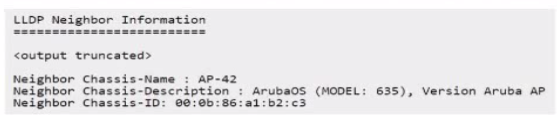
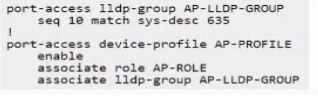
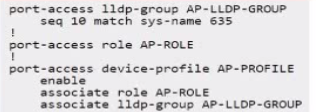
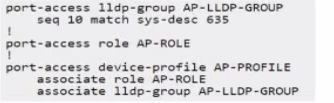
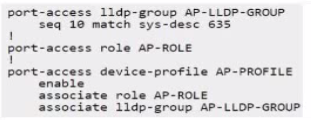
Which set of commands will apply the device profile 'AP' to the device shown in the LLDP neighbor output below?
A)
B)
C)
D)
Correct answer: A

The goal is to configure the switch to automatically apply a specific device profile (named AP-PROFILE in the options) to ports where an Aruba AP Model 635 connects, using LLDP information for detection.

LLDP Information: The LLDP neighbor output shows:

Neighbor Chassis-Description: ArubaOS (MODEL: 635), Version Aruba AP

Neighbor Chassis-Name: AP-42

Device Profile Mechanism: This involves creating an LLDP group that matches specific attributes of the desired device, creating a device profile containing the desired port configurations (VLAN, PoE, QoS, Role, etc.), associating the profile with the LLDP group, and enabling the feature globally.

Analyzing Configuration Options: All options configure an LLDP group AP-LLDP-GROUP and a device profile AP-PROFILE. The key is the matching condition within the LLDP group and the completeness of the profile configuration.

Matching Condition:

Options A, C, D use seq 10 match sys-desc 635. This condition checks if the LLDP System Description contains the string '635'. Based on the output (...MODEL: 635...), this condition will match the target AP.

Option B uses seq 10 match sys-name 635. This checks if the LLDP System Name contains '635'. The output shows Neighbor Chassis-Name: AP-42. This condition will not match.

Question 2

An OSPF router has teamed a path to an external network oy both an El and an E2 advertisement, both routes having the same path cost. Which path -will the router prefer?

Correct answer: D

The question involves an OSPF router receiving both an E1 (External Type 1) and an E2 (External Type 2) advertisement for an external network with the same path cost. The task is to determine which path the router will prefer.

Analysis of Options:

Option A (ECMP): Equal-Cost Multi-Path (ECMP) is used when multiple paths have the same total cost, but E1 and E2 routes have different metric calculations, so ECMP does not apply here.

Option B (Prefer E2): Incorrect, as E2 routes are preferred only when E1 routes are not present or have a higher total cost.

Option C (Suppressed): OSPF does not suppress routes due to path conflicts; it selects the best path based on metrics.

Option D (Prefer E1): Correct. OSPF prefers E1 routes over E2 routes because E1 routes include the internal cost to the ASBR (Autonomous System Boundary Router) plus the external cost, providing a more accurate total cost.

Why Option D is Correct: In OSPF, external routes are advertised as E1 or E2. E1 routes include both the external cost (advertised by the ASBR) and the internal cost to reach the ASBR, making them more precise for path selection. E2 routes only consider the external cost and are the default for redistributed routes unless explicitly configured as E1. When an OSPF router receives both E1 and E2 routes with the same external cost, it prefers the E1 route because it accounts for the total path cost, including internal network topology. This is per OSPF standards (RFC 2328).

Relevance to Certification Objectives:

Routing (16%): Involves designing and troubleshooting OSPF routing topologies, including external route types (E1 vs. E2).

Troubleshooting (10%): Includes analyzing OSPF path selection to resolve routing issues.


HPE Aruba Networking AOS-CX Configuration Guide: OSPF Configuration, detailing E1 and E2 route types.

HPE7-A06 Study Guide: Covers OSPF external route selection and path preference.

RFC 2328: OSPF Version 2, explaining E1 and E2 route metrics and preference.

Question 3

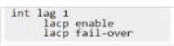
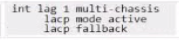
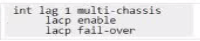
With the configuration of two CX 8325 switches in the VSX cluster, how would you prepare a link-aggregation for a 7000 gateway for a zero-touch provision to support protocol-based port redundancy?

A)

B)

C)

D)

Correct answer: B

The goal is to configure a Link Aggregation Group (LAG) on a VSX cluster (pair of CX 8325 switches) that connects to an Aruba 7000 series gateway undergoing Zero Touch Provisioning (ZTP). The LAG needs to support 'protocol-based port redundancy' (LACP) and allow connectivity during ZTP.

VSX Requirement: Since the LAG connects to two separate physical switches operating as a VSX pair, the LAG must be configured as a Multi-Chassis LAG (MC-LAG) on the switches. This allows the gateway to form a single LAG across both upstream devices. The command multi-chassis under the interface lag context enables this.

Protocol Redundancy Requirement: 'Protocol-based port redundancy' indicates that Link Aggregation Control Protocol (LACP) should be used to dynamically negotiate and manage the LAG bundle between the switches and the gateway. The command lacp mode active enables LACP in active negotiation mode.

ZTP Requirement: During ZTP, the gateway might not have its full configuration, including LACP settings, enabled immediately. To ensure the gateway can establish basic IP connectivity for ZTP (e.g., reach Activate/Central via DHCP/DNS), the switch ports should allow traffic even if LACP negotiation hasn't completed. The lacp fallback feature enables this, allowing individual LAG member ports to become active if LACP PDUs are not received from the peer.

Analyzing the Options:

A) Configures lacp mode active and lacp fallback but lacks the multi-chassis command required for VSX.

B) Correctly configures the LAG as multi-chassis, enables lacp mode active, and enables lacp fallback. This meets all requirements.

C) Configures multi-chassis but uses potentially older or less standard syntax lacp enable and lacp fail-over instead of lacp mode active and lacp fallback.

D) Lacks the multi-chassis command and uses potentially older/less standard syntax.

Conclusion: Option B provides the complete and correct configuration using standard AOS-CX syntax to create an MC-LAG on the VSX pair with LACP enabled for redundancy and LACP fallback enabled to support gateway connectivity during ZTP.


Question 4

Acme is having BGP issues with its AOS-CX switch and has asked you to help troubleshoot the issue You have access to the CLI of the switch. Which command can you use to begin troubleshooting?

Correct answer: D

The question involves troubleshooting BGP issues on an AOS-CX switch, and the task is to identify the appropriate CLI command to begin the troubleshooting process.

Analysis of Options:

Option A (show run | route destination): Incorrect syntax; the show running-config command with a filter is not specific to BGP troubleshooting.

Option B (show debug start): Incorrect; AOS-CX does not use show debug start for initiating debugging.

Option C (show buffer | debug): Incorrect; this is not a valid AOS-CX command for BGP troubleshooting.

Option D: Correct. The show debug destinations command displays the current debug settings, including whether BGP debugging is enabled, which is a critical first step in troubleshooting BGP issues.

Why Option D is Correct: To troubleshoot BGP issues, the first step is to verify if debugging is enabled for BGP events, as this provides detailed logs of session states, messages, and errors. The show debug destinations command on AOS-CX switches shows which debug types (e.g., BGP) are active and where logs are sent (e.g., console, syslog). If BGP debugging is not enabled, the administrator can enable it using debug bgp to capture relevant information, making this the ideal starting point for BGP troubleshooting.

Relevance to Certification Objectives:

Troubleshooting (10%): Involves performing advanced troubleshooting of routing protocols like BGP.

Routing (16%): Includes diagnosing BGP session and configuration issues.


HPE Aruba Networking AOS-CX Configuration Guide: Debugging and Logging, detailing debug commands.

HPE7-A06 Study Guide: Covers BGP troubleshooting workflows.

HPE Aruba Networking Technical Documentation: AOS-CX CLI Reference, explaining show debug destinations.

Question 5

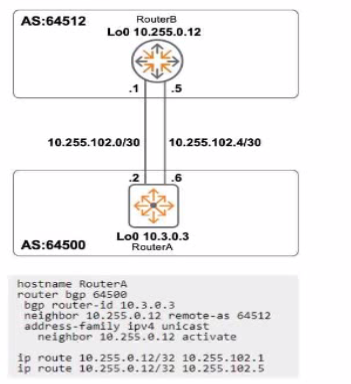
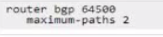
Review the diagram and existing configuration of RouterA above. Which configuration changes are necessary to permit load balancing between RouterA and RouterB? (Select two)

Exhibit.

A)

B)

C)

D)

E)

Correct answer: B, D

Analyze Topology and Existing Configuration:

RouterA (AS 64500) peers with RouterB (AS 64512) using eBGP.

Peering is configured between loopback interfaces (RouterA Lo0 10.3.0.3 to RouterB Lo0 10.255.0.12).

Two parallel physical links connect the routers (10.255.102.0/30 and 10.255.102.4/30).

RouterA has two static routes pointing to RouterB's loopback (10.255.0.12/32), one via each physical link's next hop (10.255.102.1 and 10.255.102.5). This provides reachability to the BGP peer address over both paths.

RouterA's BGP config activates the neighbor 10.255.0.12 for IPv4 unicast but is missing key commands for stable loopback peering and load balancing.

Goal: Permit load balancing for traffic exchanged via BGP between RouterA and RouterB. This requires BGP ECMP (Equal Cost Multi-Path).

Requirements for eBGP ECMP over Loopbacks:

Stable Peering: Peering must use loopback addresses. This requires:

update-source loopback : To source BGP TCP packets from the loopback IP.

ebgp-multihop <ttl>: Because loopbacks are not directly connected (TTL > 1 needed).

ECMP Enabled: BGP must be configured to allow multiple paths in the routing table. This requires:

maximum-paths <n> (or maximum-paths ebgp <n>): To allow more than the default 1 path.

Equal Paths: BGP must see multiple paths to the same prefix learned from RouterB that are considered equal based on BGP path selection attributes (Weight, Local_Pref, AS_Path, Origin, MED, etc.). Since routes are learned from the same neighbor IP (RouterB's loopback), these attributes will likely be identical for routes learned via this peering. RouterA already has equal static routes to the BGP next hop (10.255.0.12).


Unlock all HP HPE7-A06 questions

Full exam access, validated answers, and unlimited practice with no download limits.

Frequently Asked Questions

Who should take the HP HPE7-A06 exam?

This exam is intended for networking professionals pursuing the HPE Aruba Networking Certified Expert,Campus Access Switching certification and validating advanced campus access switching skills.

Is the HP HPE Campus Access Switching Expert Written Exam difficult?

Yes, it is an expert-level written exam, so candidates should expect a challenging assessment that covers switching, security, troubleshooting, and related campus access topics in depth.

Can I pass HPE7-A06 with only braindumps?

Braindumps alone are not the best approach. You should combine the Exam PDF and Online Practice Test with practical understanding of the topics to improve your chances of passing.

Do I need hands-on experience for this exam?

Hands-on experience is highly beneficial because the exam covers practical campus access switching concepts, troubleshooting, and operational knowledge.

How do QA4Exam.com dumps and practice tests help me pass in first attempt?

They help by giving you real exam simulation, verified answers, current question coverage, and timed practice that improves confidence and time management before exam day.

What format do I get from QA4Exam.com?

QA4Exam.com provides an Exam PDF with questions and answers and an Online Practice Test designed to mirror the exam experience and support effective preparation.

Should I use other resources besides the dumps?

Using additional study support is a smart choice because it helps reinforce the concepts behind the answers and improves overall exam readiness.