
Trusted Worldwide Questions & Answers
Huawei H12-811_V2.0 Dumps - Pass HCIA-Datacom V2.0 Exam in First Attempt 2026
The Huawei H12-811_V2.0 exam is part of the Huawei Certified ICT Associate certification path and focuses on core datacom knowledge for entry-level networking professionals. It is designed for candidates who want to build a strong foundation in network concepts, switching, routing, WLAN, security, and campus networking. This certification matters because it validates practical networking skills that are widely used in real-world enterprise environments. For beginners and aspiring network engineers, it is a valuable step toward stronger technical confidence and career growth.
Exam Topics and Approximate Weightage
| # | Exam Topics | Sub-Topics | Approximate Weightage (%) |
|---|---|---|---|
| 1 | Data Communication Network Basics | Network models and protocols, transmission media, common network devices | 12% |
| 2 | Ethernet Technology Basics | Ethernet frame structure, MAC addressing, switching principles | 14% |
| 3 | IP Technology Basics | IPv4 and IPv6 concepts, subnetting basics, routing fundamentals | 18% |
| 4 | Network Security and Services | Access control basics, DHCP, NAT, common security concepts | 12% |
| 5 | Data Center Network Basics | Data center architecture, virtualization concepts, basic network design | 10% |
| 6 | WLAN Technology Basics | Wireless standards, WLAN components, SSID and basic configuration | 12% |
| 7 | Network O&M and Troubleshooting | Fault diagnosis steps, command tools, link and connectivity troubleshooting | 14% |
| 8 | Typical Campus Networking Solution | Campus network design, hierarchical architecture, deployment scenarios | 8% |
| Total | 100% | ||
The exam tests whether candidates understand essential networking concepts and can apply them in practical scenarios. It checks knowledge depth across switching, routing, WLAN, security, and troubleshooting, with an emphasis on how these technologies work together in a campus network. Candidates should be prepared to identify correct answers quickly and demonstrate solid foundational ability rather than memorization alone.
How QA4Exam.com Helps You Pass
QA4Exam.com provides the Exam PDF with actual questions and answers plus an Online Practice Test for the Huawei H12-811_V2.0 exam. These resources help you study with up-to-date questions, verified answers, and a format that closely matches the real exam experience. The practice test is especially useful for building time management skills and getting comfortable with exam pressure before test day. With realistic simulation and focused revision, you can prepare more efficiently and improve your chances of passing on the first attempt.
Frequently Asked Questions
1. Who should take the Huawei H12-811_V2.0 HCIA-Datacom V2.0 exam?
This exam is suitable for candidates pursuing the Huawei Certified ICT Associate path and for beginners who want to validate core datacom and networking knowledge.
2. Is the Huawei HCIA-Datacom V2.0 exam difficult?
The difficulty depends on your preparation, but it covers multiple networking areas, so candidates should study concepts, not just memorize terms.
3. Can I pass with only braindumps?
Braindumps alone are not the best approach. They work better when combined with concept review and practice so you understand why each answer is correct.
4. Do I need hands-on experience for H12-811_V2.0?
Hands-on experience is helpful because the exam includes practical networking knowledge, but focused study and practice can still prepare many candidates effectively.
5. Are QA4Exam.com dumps enough, or should I use other resources too?
The Exam PDF and Online Practice Test are strong preparation tools, especially for review and simulation, and many candidates also use them alongside theory study for best results.
6. How do the QA4Exam.com practice test and PDF help with first-attempt success?
They help you study updated questions, verify answers, and practice under timed conditions, which improves accuracy and confidence before the real exam.
7. What format do the QA4Exam.com materials come in?
QA4Exam.com offers an Exam PDF with questions and answers and an Online Practice Test that simulates the exam environment for efficient preparation.
The questions for H12-811_V2.0 were last updated on Sep 30, 2026.
- Viewing page 1 out of 12 pages.
- Viewing questions 1-5 out of 60 questions
R1 has four static routes, each of which has a reachable next hop. Given the following static route configuration, what is the next hop of the route to 20.0.0.0/30 in R1's routing table?
[R1] ip route-static 20.0.0.0 30 10.1.1.2
[R1] ip route-static 20.0.0.0 30 10.1.2.2 preference 70
[R1] ip route-static 20.0.0.0 30 10.1.3.2 preference 50
[R1] ip route-static 20.0.0.0 30 10.1.4.2 preference 100
When multiple static routes exist to the same destination prefix and all next hops are reachable, the device selects the route with the highest priority, which on Huawei devices means the lowest preference value. In this question, all four static routes point to the same destination network 20.0.0.0/30, but they have different preference values.
The route through 10.1.1.2 uses the default static route preference, which is 60 on Huawei devices. The route through 10.1.2.2 has a preference of 70, the route through 10.1.3.2 has a preference of 50, and the route through 10.1.4.2 has a preference of 100. Since 50 is the lowest value among them, the route via 10.1.3.2 is preferred and installed in the routing table. Therefore, option D is correct. HCIA-Datacom emphasizes that when prefix length is identical, route preference determines which route is active. This principle is widely used in route backup design, where primary and floating backup static routes are configured using different preference values to control failover behavior.
The figure shows the simplified topology of an enterprise campus network. On this network, the aging time of dynamic MAC address entries on switches is 300 seconds.
The administrator connects PC1 to GE1/0/1 of SW1 and successfully pings the IP address of PC2 from PC1. Then, the administrator disconnects the Ethernet cable of PC1
from GE1/0/1 of SW1, immediately connects the cable to GE1/0/2 of SW1, and pings the IP address of PC2 from PC1. Which of the following operations does SW1
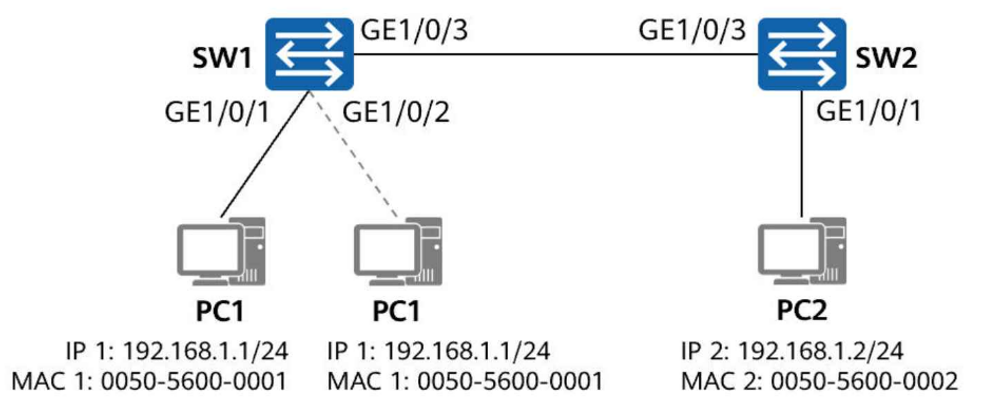
An Ethernet switch learns MAC address entries dynamically by examining the source MAC address of incoming frames. When SW1 first receives frames from PC1 on GE1/0/1, it creates a MAC address table entry mapping PC1's MAC address to that port. If PC1 later sends frames that arrive on GE1/0/2, SW1 updates the learned entry to reflect the new incoming interface. Therefore, option B is correct: SW1 saves the mapping between PC1's MAC address and GE1/0/2 and removes or overwrites the old mapping associated with GE1/0/1.
Option A is incorrect because a single dynamic MAC address is not normally maintained on two different ports within the same VLAN at the same time; that would cause forwarding ambiguity. Option C is incorrect because a normal move of one MAC address does not require clearing the entire MAC table. Option D is also incorrect because switches update MAC learning dynamically upon receiving new source traffic and do not have to wait for the previous entry to age out. HCIA-Datacom uses this principle to explain MAC address learning, migration, and troubleshooting of loops or host movement in switched Ethernet networks.
On the network shown in the figure, GE1/0/1 and GE1/0/2 of SW1 are access interfaces, and their PVIDs are VLAN 2 and VLAN 3 respectively. GE1/0/1 of SW2 is also an access interface, and its PVID is VLAN 4. Which of the following configurations on SW1 and SW2 can ensure that data packets sent from PC1 and PC2 can reach PC3?
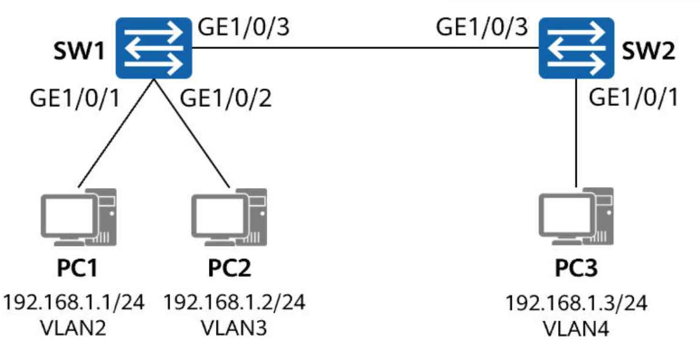
PC1 and PC2 are in different VLANs on SW1, while PC3 is in VLAN 4 on SW2. To allow traffic from VLAN 2 and VLAN 3 users to reach PC3 through the inter-switch link, SW1 must be able to send frames from PC1 and PC2 toward SW2 in a form that SW2 can place into VLAN 4.
Option B is valid because a hybrid interface on SW1 can send frames from VLAN 2 and VLAN 3 untagged, and setting the PVID to VLAN 4 allows untagged inbound frames on the peer side to be associated appropriately when matched with the SW2 configuration. Option C is also valid because configuring SW2's GE1/0/3 as a trunk allowing VLAN 4 and setting its PVID to VLAN 4 means untagged frames arriving from SW1 are treated as belonging to VLAN 4 and can then be forwarded to PC3 through its access interface.
Option A is incomplete because only configuring SW2 does not solve the VLAN handling on SW1. Option D is incorrect because a trunk on SW1 would send VLAN 2 and VLAN 3 frames tagged, which would not match the VLAN 4-only expectation on SW2 in this scenario.
On the OSPF network shown in the figure, all IP addresses can communicate with each other. Then the following configurations are added on R1:
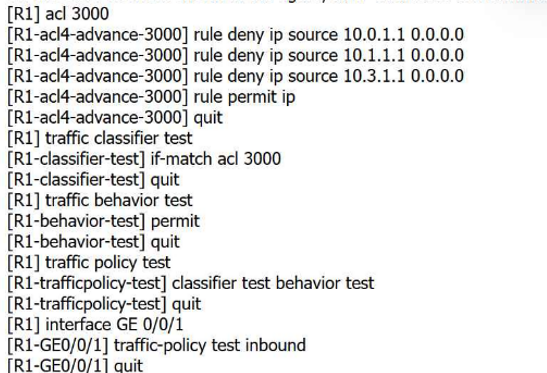
Which IP address of S1 can successfully ping 10.2.23.3?
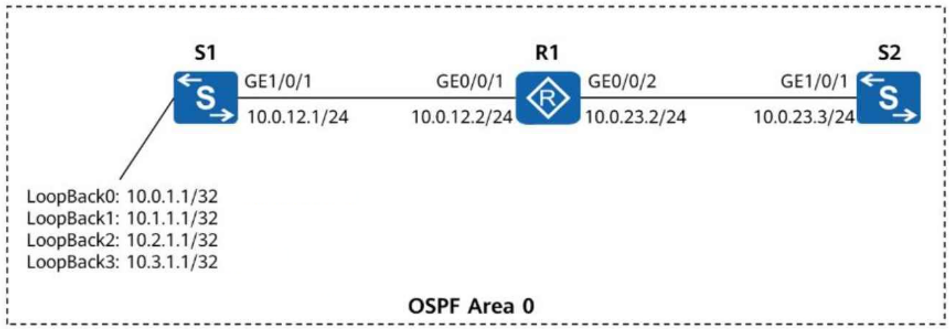
According to the topology and the original question scenario, the correct answer is 10.2.1.1, so option B is selected. In HCIA-Datacom troubleshooting questions of this type, the goal is usually to identify the correct management address, next-hop interface address, or testing destination based on the addressing design shown in the figure.
The answer depends on the role of the device and the direction of the connectivity verification. In such topologies, each interface belongs to a specific network segment, and the selected address must match the intended test target on that segment. If the test is being performed toward the neighboring device or a specific reachable interface, using the correct IP on the proper subnet is essential. An incorrect address may still look familiar from the topology but would not represent the right test endpoint. HCIA-Datacom places strong emphasis on reading topology labels carefully, matching interface addresses to subnet assignments, and choosing the correct destination when using tools such as ping, tracert, or service-specific connectivity tests. This question mainly checks address recognition accuracy in a troubleshooting context.
On the switched network shown in the figure, STP is enabled on all devices. SW1 is the root bridge. The port costs are shown in the figure. Other parameters retain the default values. After the network is stable, which of the following paths is used by SW1 to send traffic to SW4?
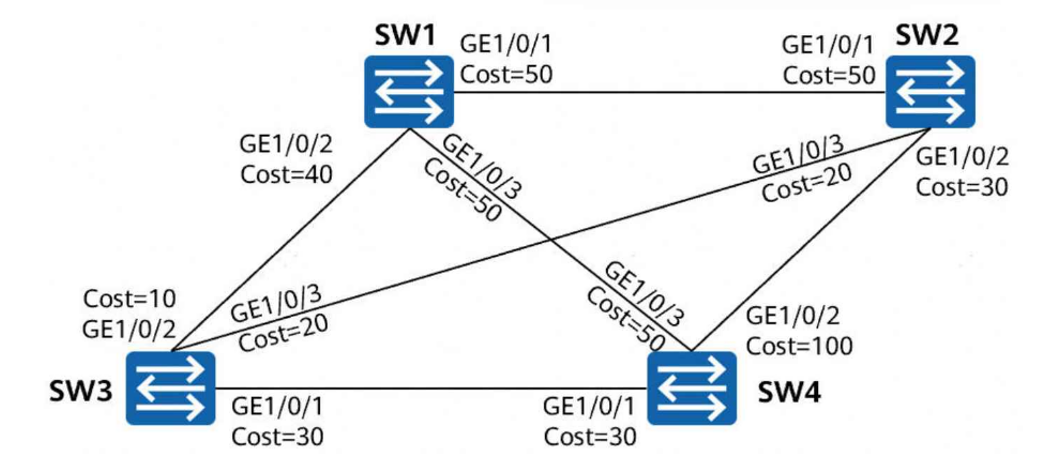
After STP convergence, only ports in the forwarding state participate in active traffic forwarding, while redundant ports may be placed into the blocking or discarding state to eliminate loops. According to the topology and STP role election shown in the question, the valid forwarding path from SW1 to SW4 is SW1 SW3 SW4, so option B is correct.
This means that the direct alternative path or the path through SW2 is not the active spanning-tree forwarding path after election and state transition. STP selects paths based on the root bridge, path cost, bridge ID, and port ID. Once the root bridge and port roles are determined, some links remain active and others are blocked to ensure a loop-free Layer 2 topology. HCIA-Datacom emphasizes that the resulting forwarding topology is a tree, not a mesh, even if the physical topology contains redundant links. Understanding the actual forwarding path after STP convergence is important for troubleshooting connectivity, predicting traffic behavior, and verifying whether bridge priority and path-cost settings have produced the intended design outcome in campus switching networks.
Unlock All Questions for Huawei H12-811_V2.0 Exam
Full Exam Access, Actual Exam Questions, Validated Answers, Anytime Anywhere, No Download Limits, No Practice Limits
Get All 60 Questions & Answers