
Trusted Worldwide Questions & Answers
Most Recent Huawei H12-831_V1.0 Exam Dumps
Prepare for the Huawei HCIP-Datacom-Advanced Routing & Switching Technology V1.0 exam with our extensive collection of questions and answers. These practice Q&A are updated according to the latest syllabus, providing you with the tools needed to review and test your knowledge.
QA4Exam focus on the latest syllabus and exam objectives, our practice Q&A are designed to help you identify key topics and solidify your understanding. By focusing on the core curriculum, These Questions & Answers helps you cover all the essential topics, ensuring you're well-prepared for every section of the exam. Each question comes with a detailed explanation, offering valuable insights and helping you to learn from your mistakes. Whether you're looking to assess your progress or dive deeper into complex topics, our updated Q&A will provide the support you need to confidently approach the Huawei H12-831_V1.0 exam and achieve success.
The questions for H12-831_V1.0 were last updated on Apr 22, 2026.
- Viewing page 1 out of 31 pages.
- Viewing questions 1-5 out of 156 questions
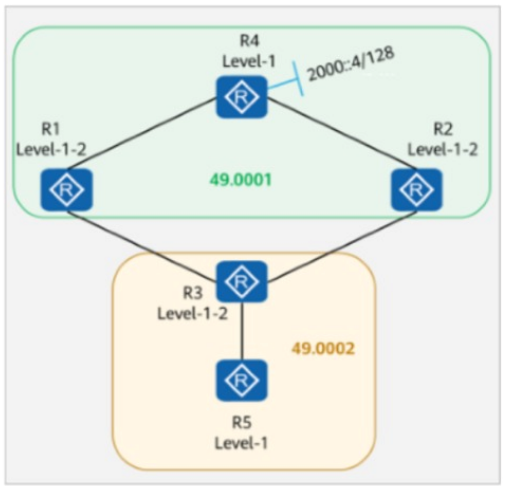
On the IS-IS IPv6 network shown in the figure, multi-topology is enabled on all routers. The IPv6 address of Loopback0 on R4 is 2000::/128. The IPv6 summary 2000::/64 level-1-2 command is configured in the IS-IS processes of R2 and R1. Which of the following statements is false?
Comprehensive and Detailed In-Depth
To determine which statement is false, we need to analyze the IS-IS topology, the role of multi-topology, the IPv6 summary configuration, and the level-1-2 behavior of IS-IS routers. Let's break it down step by step:
Understanding the IS-IS Topology and Levels:
IS-IS supports multiple levels: Level-1 (L1) for intra-area routing, Level-2 (L2) for inter-area routing, and Level-1-2 (L1-2) routers that can operate in both levels and connect L1 and L2 areas.
In the figure, R1 and R2 are configured as Level-1-2 routers, R3 is a Level-1-2 router, R4 is a Level-1 router, and R5 is a Level-1 router. The area borders are indicated by the system IDs (49.0001 for R4's area and 49.0002 for R3 and R5's area).
R4's Loopback0 has the IPv6 address 2000::/128, which is a host route (a /128 prefix, representing a single address).
Multi-Topology IS-IS for IPv6:
Multi-topology IS-IS allows separate topologies for IPv4 and IPv6, ensuring that IPv6 routes are handled independently. Since multi-topology is enabled on all routers, IPv6 routes (like 2000::/128 on R4) are advertised and processed within the IPv6 topology.
This means that IPv6 routes, including the Loopback0 address of R4 (2000::/128), can be advertised across the IS-IS domain, subject to the level and summary configurations.
IPv6 Summary Configuration (2000::/64 level-1-2):
The command ipv6 summary 2000::/64 level-1-2 is configured in the IS-IS processes of R1 and R2. This command instructs R1 and R2 (as Level-1-2 routers) to summarize the IPv6 prefix 2000::/64 and advertise it to both Level-1 and Level-2 areas.
Summarization means that instead of advertising the more specific route (e.g., 2000::/128 from R4), R1 and R2 advertise the less specific summary route 2000::/64. This summary route covers the 2000::/128 address of R4's Loopback0.
Since R1 and R2 are Level-1-2 routers, they can advertise this summary to both their Level-1 neighbors (like R4 and R3) and Level-2 neighbors (across areas).
Analyzing Each Statement:
A . The routing table of R1 contains the route 2000::/64.
True. R1 is a Level-1-2 router with the ipv6 summary 2000::/64 level-1-2 command configured. It advertises and installs the summary route 2000::/64 in its routing table, covering the more specific 2000::/128 from R4. Additionally, as a Level-1-2 router, R1 can learn and retain this route from its IS-IS neighbors.
B . The routing table of R2 contains the route 2000::/64.
True. Similar to R1, R2 is also a Level-1-2 router with the same summary command. It advertises and installs the 2000::/64 summary route in its routing table, covering R4's 2000::/128.
C . The routing table of R3 contains the route 2000::/128.
False. R3 is a Level-1-2 router in area 49.0002, but it receives routes from R2 (a Level-1-2 router in area 49.0001). Because R1 and R2 are configured with the ipv6 summary 2000::/64 level-1-2 command, they advertise the summary route 2000::/64 to their neighbors, including R3. IS-IS prefers the most specific route, but the summary configuration ensures that the more specific 2000::/128 from R4 is not advertised beyond R1 and R2 unless explicitly allowed. Since R3 is in a different area and receives the summary 2000::/64 from R2, it does not have the more specific 2000::/128 route in its routing table. Therefore, this statement is false.
D . The routing table of R2 contains the route 2000::/128.
True. R2, as a Level-1-2 router, is directly connected to R4 (a Level-1 router) via the IS-IS topology. R4 advertises its Loopback0 address 2000::/128 to R2. Even though R2 is configured to summarize 2000::/64, it can still retain the more specific 2000::/128 route in its routing table because IS-IS allows routers to keep both summary and more specific routes, with the more specific route taking precedence for routing decisions.
Conclusion:
The false statement is C, as R3 does not contain the route 2000::/128 in its routing table. Instead, R3 receives the summary route 2000::/64 from R2 due to the summary configuration on R1 and R2.
Reference to HCIP-Datacom-Advanced Routing & Switching Technology Documents:
HCIP-Datacom-Advanced Routing & Switching Technology V1.0, Section on IS-IS: Multi-Topology IS-IS for IPv6, Level-1 and Level-2 Operations, and Route Summarization.
HCIP-Datacom-Advanced Routing & Switching Technology V1.0, Chapter on IPv6 Routing Protocols: IS-IS Configuration and Behavior, Including Summary Address Commands and L1/L2 Interactions.
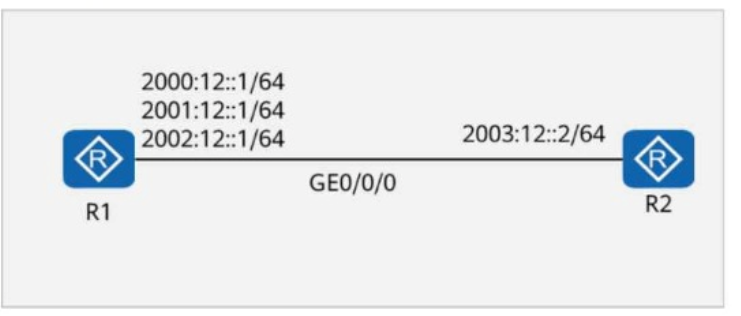
OSPFv3 runs on R1 and R2, and the IPv6 addresses configured for the interfaces are marked in the figure.
The router IDs of R1 and R2 are 10.0.1.1 and 10.0.2.2, respectively.
Which of the following statements is true?
Comprehensive and Detailed In-Depth
Understanding Intra-Area-Prefix-LSA (Type 9) in OSPFv3
OSPFv3 uses the Intra-Area-Prefix-LSA (Type 9) to advertise IPv6 prefixes associated with either:
A Router-LSA (Type 1) Describes links and interfaces.
A Network-LSA (Type 2) Advertises multi-access networks (if a Designated Router exists).
Each router generates one Intra-Area-Prefix-LSA to advertise its own IPv6 prefixes.
Prefix Analysis for Each Router
R1's IPv6 Prefixes:
2000:12::1/64
2001:12::1/64
2002:12::1/64
2003:12::/64 (Shared link with R2)
Total Prefixes in R1's Intra-Area-Prefix-LSA = 4
R1 advertises four prefixes in its Intra-Area-Prefix-LSA.
R2's IPv6 Prefixes:
2003:12::2/64 (Shared link with R1)
Total Prefixes in R2's Intra-Area-Prefix-LSA = 1
R2 advertises only one prefix in its Intra-Area-Prefix-LSA.
Checking Each Option:
A. The Intra-Area-Prefix-LSA generated by R2 describes three prefixes. ( False, R2 only has one prefix).
B. The Intra-Area-Prefix-LSA generated by R1 describes four prefixes. ( True, R1 has four prefixes).
C. The Intra-Area-Prefix-LSA generated by R2 describes four prefixes. ( False, R2 only has one prefix).
D. The Intra-Area-Prefix-LSA generated by R1 describes three prefixes. ( False, R1 has four prefixes).
Final Conclusion:
B. The Intra-Area-Prefix-LSA generated by R1 describes four prefixes.
Thus, the correct answer is: B. The Intra-Area-Prefix-LSA generated by R1 describes four prefixes.
HCIP-Datacom-Advanced Routing & Switching Technology V1.0 -- OSPFv3 LSAs and IPv6 Prefix Advertisement
Huawei Official HCIP-Datacom Study Guide -- OSPFv3 Intra-Area-Prefix-LSA and Router-LSA Relationship
Huawei Documentation on OSPFv3 Prefix Propagation Mechanisms
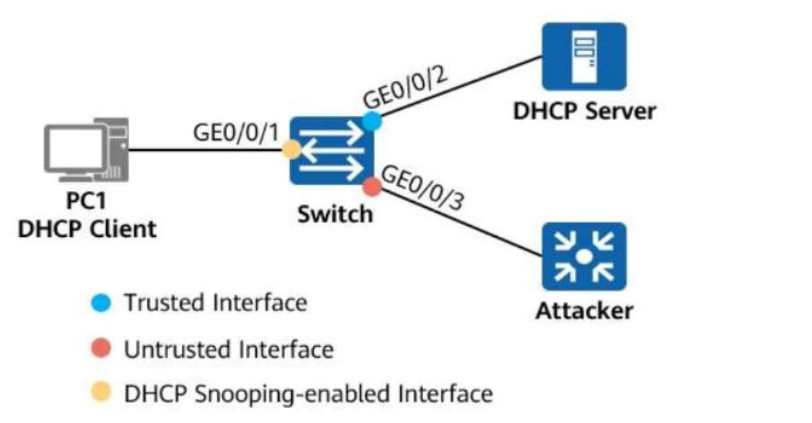
On the network shown in the figure, the network administrator configures the DHCP snooping trust function on the switch.
GE0/0/2 is a trusted interface (connected to the DHCP Server).
GE0/0/3 is an untrusted interface (potential attacker).
Which of the following statements are true about the two interfaces?
Options:
Comprehensive and Detailed In-Depth
1. Understanding DHCP Snooping
DHCP Snooping is a security feature that filters untrusted DHCP messages to prevent attacks such as:
Rogue DHCP servers distributing incorrect IP addresses.
DHCP starvation attacks.
In DHCP Snooping, switch ports are classified as:
Trusted Interfaces: Allow both DHCP requests and DHCP responses to pass through.
Untrusted Interfaces: Allow only DHCP requests but drop DHCP responses (to prevent rogue DHCP servers).
2. Analyzing Each Answer Option
Option A: 'When receiving a DHCP response packet on GE0/0/2, the switch forwards the packet through GE0/0/1.'
Correct.
GE0/0/2 is a trusted interface (connected to the DHCP server).
DHCP responses (ACK, NAK, OFFER) come from the DHCP Server.
Since DHCP responses are allowed on trusted interfaces, the switch forwards them to the client (PC1) via GE0/0/1.
Option B: 'When receiving a DHCP request packet on GE0/0/2, the switch forwards the packet through GE0/0/3.'
Incorrect.
DHCP requests originate from clients (PC1, attackers, etc.), not from the DHCP server.
The DHCP request should be forwarded to the DHCP server via a trusted interface (not GE0/0/3, which is untrusted).
Option C: 'When receiving a DHCP response packet on GE0/0/3, the switch forwards the packet through GE0/0/1.'
Incorrect.
GE0/0/3 is an untrusted interface (connected to the attacker).
DHCP responses (ACK, OFFER) from untrusted interfaces are dropped to prevent rogue DHCP attacks.
The switch will not forward the packet.
Option D: 'When receiving a DHCP request packet on GE0/0/3, the switch forwards the packet through GE0/0/2.'
Correct.
DHCP requests originate from clients (PC1 or attacker).
Since DHCP requests are allowed on untrusted interfaces, the switch forwards them to the DHCP server via the trusted interface (GE0/0/2).
Final Answer:
A and D are correct.
HCIP-Datacom-Advanced Routing & Switching Technology Reference:
DHCP Snooping and Port Trust Classification
How Trusted and Untrusted Ports Handle DHCP Packets
Preventing Rogue DHCP Servers Using DHCP Snooping
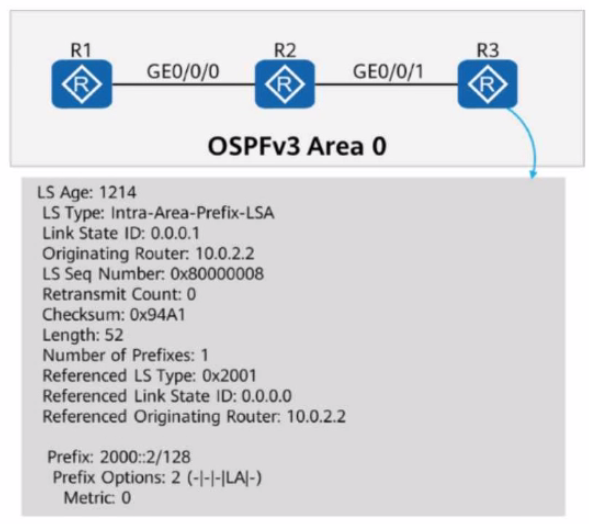
On the OSPFv3 network shown in the figure, OSPFv3 is enabled on the interfaces connecting R1, R2, and R3. The router ID of each router is 10.0.X.X, where X is the number of the router. If you check detailed information about an LSA on R3, the command output shows that the LSA is generated by R2 and describes the IPv6 prefix address associated with the Router-LSA.
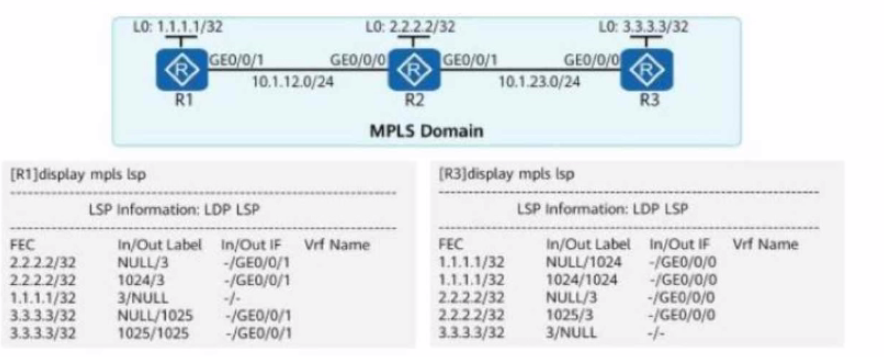
The figure shows the LSP information of R1 and R3 on an MPLS network. An administrator runs the ping -a 1.1.1.1 3.3.3.3 command on R1. Given this, which of the following statements is true?
Unlock All Questions for Huawei H12-831_V1.0 Exam
Full Exam Access, Actual Exam Questions, Validated Answers, Anytime Anywhere, No Download Limits, No Practice Limits
Get All 156 Questions & Answers