Prepare for the Huawei HCIE Carrier IP (Written) V1.0 exam with our extensive collection of questions and answers. These practice Q&A are updated according to the latest syllabus, providing you with the tools needed to review and test your knowledge.
QA4Exam focus on the latest syllabus and exam objectives, our practice Q&A are designed to help you identify key topics and solidify your understanding. By focusing on the core curriculum, These Questions & Answers helps you cover all the essential topics, ensuring you're well-prepared for every section of the exam. Each question comes with a detailed explanation, offering valuable insights and helping you to learn from your mistakes. Whether you're looking to assess your progress or dive deeper into complex topics, our updated Q&A will provide the support you need to confidently approach the Huawei H31-161 exam and achieve success.
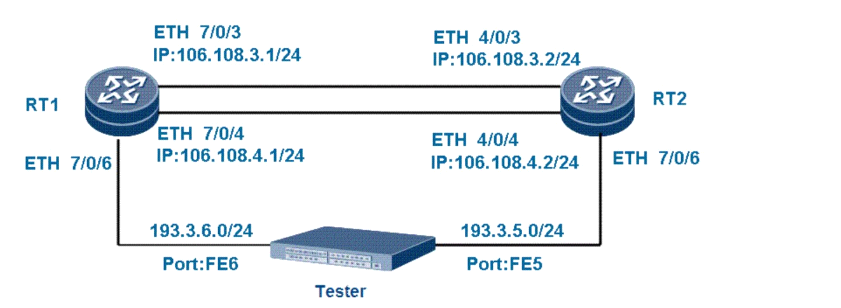
Refer to the exhibit.

As shown in the figure, DUT stands for the device under test and RTA is
used to support the test.What is the correct procedure of a fast convergence test? ( )
1. Read data from the tester, record the numbers of sent and received packets, and count the
number of lost packets.2. Switch the DUT-to-RTA background traffic to the link whose metric value
is 100.3. DUT-to-RTA background traffic is forwarded along the link whose metric value is 10.4. Use
the tester to advertise 10K routes to RTA and inject 10K flows to the DUT (each flow takes one
route).5. Remove the optical fiber (providing a link whose metric value is 10) from the tester.6.
Calculate the convergence time based on the number of lost packets and packet sending rate.7.
Stop forwarding traffic when the packet receiving rate is equal to the packet sending rate.
On a router, HQoS parameter are configured for the users. The CURP of user 1 is Mbit/s. The CUR and PIR of user 2 are 0 Mbit/s and 10 Mbit/s, respectively. The CIR and PR of user 3 are 0 Mbit and 20 Mbit/s respectively. These three users join group with a bandwidth of 10 Mbit/s.
Which statements is true?
multicast routing-enable
#
acl number 2000
rule 5 permit source 225.0.0.0 0.0.0.255
#
interface Ethernet6/1/0
ip address 10.1.1.1 255.255.255.0
igmp enable
pim sm
#
igmp
#
pim
ssm-policy 2000
#
return
The preceding are partial multicast router configurations. Which of the following configurations
are required to configure the SSM Mapping on Ethernet 6/1/0 and map IGMPv2 Report messages for multicast group 225.0.0.1 to multicast source 2.2.2.2?
Full Exam Access, Actual Exam Questions, Validated Answers, Anytime Anywhere, No Download Limits, No Practice Limits
Get All 180 Questions & Answers