Supercar is an online vehicle sales website specialising in a single manufacturer's Sports Utility Vehicles (SUVs) and saloons. A vehicle has two key elements, power unit and body style. The manufacturer offers three choices of power unit: petrol, diesel and hybrid. There are 3 mam body styles Saloon, Hatchback and SUV SUVs only come as petrol and diesel options Hybrid is available for Hatchback only. The site will allow an order to be processed if at least one of the chosen vehicle configurations is in stock, otherwise a message will be displayed asking the user to try again later As a Test Analyst you are asked to review the Supercar specification before starting to design the corresponding usability test cases. Which of the comments below should you make?

Trusted Worldwide Questions & Answers
Exam dumps demo
CTAL-TA_Syll2019 Exam Dumps and Practice Questions
Preview page 1 of 16 with real questions 1 to 5 from the full 80-question iSQI set.
Most Recent iSQI CTAL-TA_Syll2019 Exam Dumps
Prepare for the iSQI ISTQB Certified Tester Advanced Level - Test Analyst (Syllabus 2019) exam with our extensive collection of questions and answers. These practice Q&A are updated according to the latest syllabus, providing you with the tools needed to review and test your knowledge.
QA4Exam focus on the latest syllabus and exam objectives, our practice Q&A are designed to help you identify key topics and solidify your understanding. By focusing on the core curriculum, These Questions & Answers helps you cover all the essential topics, ensuring you're well-prepared for every section of the exam. Each question comes with a detailed explanation, offering valuable insights and helping you to learn from your mistakes. Whether you're looking to assess your progress or dive deeper into complex topics, our updated Q&A will provide the support you need to confidently approach the iSQI CTAL-TA_Syll2019 exam and achieve success.
Actual iSQI CTAL-TA_Syll2019 Exam Questions
You have been assigned to design test cases to be used by an experienced team to test software that controls the braking mechanism for commuter trains. Before the software can be released, the test evidence will be reviewed by an external safety team to ensure that test coverage is sufficient and that risk mitigation has achieved the appropriate level.
What level of test cases should be written for this application?
You have been given a test charter to conduct exploratory testing for accepting credit and debit cards for an e-commerce system. You started with the credit cards and you have found that, valid or
invalid, they are never accepted. You have logged this as a defect. What should you do now?
The correct answer is D) Automate the testing for the credit card exploratory tests so they can be used for confirmation testing after the defect is fixed.
A) Enter your exploratory test cases with detailed test steps into the Test Management System
This is incorrect because entering the test cases into the Test Management System is not enough to document and track the exploratory testing process. The test cases should also include the expected results, actual results, and defects found during the testing. Moreover, the test cases should be organized into a clear and logical structure that reflects the test charter and scope.
B) Close the session and start a new session with a new charter
This is incorrect because closing and starting a new session with a new charter would mean losing all the information and data collected during the previous session. This would make it difficult to resume and continue the testing process from where it left off. Instead, it would be better to use a consistent and stable session with a single charter that covers all the requirements and features of the system.
C) Continue the session and conduct the testing for debit cards
This is incorrect because continuing the session and conducting only one type of card (debit) would not provide a comprehensive coverage of all possible scenarios and outcomes of accepting credit cards. It would also limit the scope of testing to only one aspect of payment processing, which may not reflect all the business rules, validations, exceptions, or integrations involved in this domain.
D) Automate the testing for the credit card exploratory tests so they can be used for confirmation testing after the defect is fixed
Based on the tax system specification as described below, using boundary value analysis, which would be the best test set to explicitly test on single boundary value fully?
Tax system
A tax system needs to be updated due to new legislation. For a person with a salary of less than 20 000 and who is married, the tax needs to be recalculated.
If a person has at least three and less than six children, an additional 10% reduction is applicable.
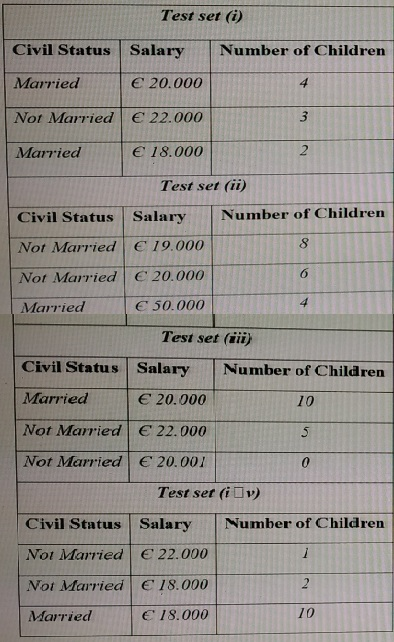
Test set (i) is the best option as it tests the boundary condition of a salary of less than 20,000 and being married, with a varying number of children including the boundary value of three children. This test set covers the minimum and maximum values for the salary and the number of children, as well as the nominal values. The other test sets do not test the boundary value of the salary or the number of children fully, as they either omit or repeat some values.Reference=
ISTQB Certified Tester Advanced Level Syllabus Technical Test Analyst1, page 2
Boundary Value Analysis and Equivalence Partitioning Testing2, section ''Boundary Value Analysis''
Equivalence Partitioning Method3, section ''Example 1: Equivalence and Boundary Value''
You have been assigned to test an application that allows users to conduct banking online. You have been asked to verify the various installation environments for the product. According to the specification the product supports four browsers (Edge, Chrome, FireFox and Safari), three operating systems (Windows, Mac, Unix), and four languages (English, Spanish, French, German). As you are reviewing the specifications you realize that the actual operating system names and versions were not included, only the major category. From this, you conclude that if you pick one from each of these sets (for example, select Windows 10 for the Windows OS), that testing should be sufficient.
You have researched the product and determined that there should be no interaction between these three characteristics that would affect the operation of the system. However, you do want to exercise representative set of these options while conducting the other functional testing for the product.
If you decide to test pairs of combinations, how many combinations will you need to test?
Testing pairs of combinations is a technique that reduces the number of test cases by testing only two factors at a time, instead of testing all possible combinations. Testing pairs of combinations is based on the assumption that most defects are caused by interactions of at most two factors. Testing pairs of combinations can be applied to this problem using the installation environments, which are the browsers, the operating systems, and the languages. By using testing pairs of combinations, the number of test cases will be lower than exhaustive testing, which would require testing every combination of factors. The formula for calculating the number of test cases for testing pairs of combinations is:
N = P * (P - 1) / 2
where N is the number of test cases, and P is the number of values for each factor. In this problem, P is 4, as there are four browsers, four operating systems, and four languages. Therefore, the number of test cases for testing pairs of combinations is:
N = 4 * (4 - 1) / 2 N = 4 * 3 / 2 N = 12Reference=
ISTQB Certified Tester Advanced Level Syllabus Technical Test Analyst1, page 2
Pairwise Software Testing - GeeksforGeeks2, section ''Introduction''
Pairwise Testing: A Best Practice That Isn't3, section ''Pairwise Testing''
Unlock all iSQI CTAL-TA_Syll2019 questions
Full exam access, validated answers, and unlimited practice with no download limits.