Question 1
Exhibit
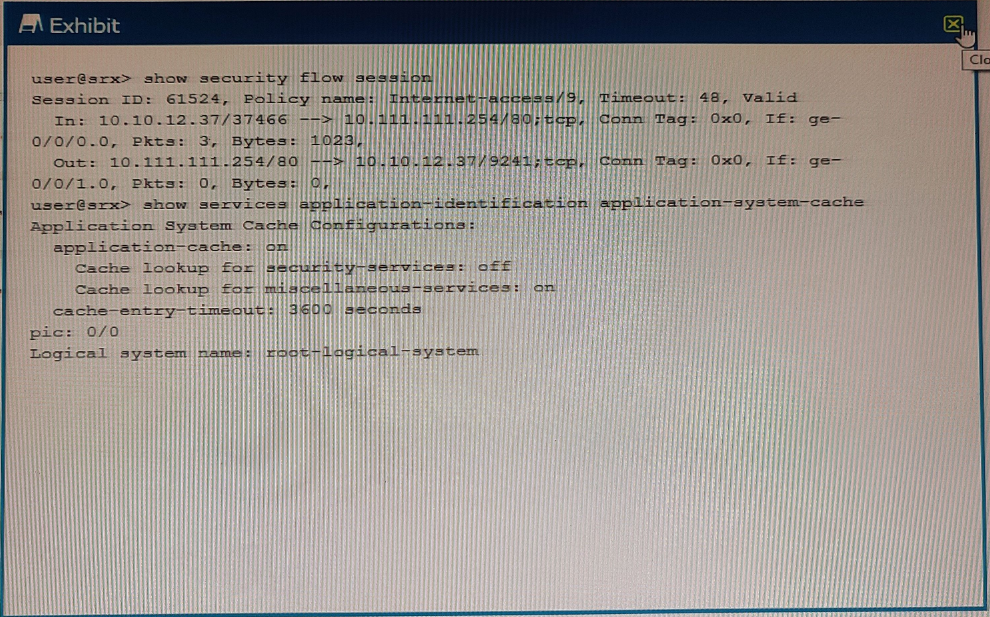
Referring to the exhibit which statement is true?
Correct answer:
D

Exam dumps demo
Preview page 1 of 20 with real questions 1 to 5 from the full 98-question Juniper set.
Prepare for the Juniper Security, Specialist Exam exam with our extensive collection of questions and answers. These practice Q&A are updated according to the latest syllabus, providing you with the tools needed to review and test your knowledge.
QA4Exam focus on the latest syllabus and exam objectives, our practice Q&A are designed to help you identify key topics and solidify your understanding. By focusing on the core curriculum, These Questions & Answers helps you cover all the essential topics, ensuring you're well-prepared for every section of the exam. Each question comes with a detailed explanation, offering valuable insights and helping you to learn from your mistakes. Whether you're looking to assess your progress or dive deeper into complex topics, our updated Q&A will provide the support you need to confidently approach the Juniper JN0-335 exam and achieve success.
Exhibit
Referring to the exhibit which statement is true?
How does Juniper ATP Cloud protect a network from zero-day threats?
Juniper ATP Cloud is a cloud-based service that provides advanced threat prevention and detection for your network. It integrates with SRX Series firewalls and MX Series routers to analyze files and network traffic for signs of malicious activity. Juniper ATP Cloud protects a network from zero-day threats by using dynamic analysis, which is a method of executing files in a sandbox environment and observing their behavior and network interactions. Dynamic analysis can uncover unknown malware that may evade static analysis or signature-based detection methods.
Which sequence does an SRX Series device use when implementing stateful session security policies using Layer 3 routes?
The sequence that an SRX Series device uses when implementing stateful session security policies using Layer 3 routes is:
An SRX Series device will conduct a longest-match Layer 3 route table lookup before performing a security policy search: When an SRX Series device receives a packet, it first looks up the destination IP address in the routing table and finds the longest matching route to forward the packet. Then, it performs a security policy search based on the source zone, destination zone, source address, destination address, protocol, and application of the packet. If there is a matching policy that allows the packet, it creates or updates a session entry for the packet and applies any security services configured in the policy.
Which two statements are true about Juniper ATP Cloud? (Choose two.)
Two statements that are true about Juniper ATP Cloud are:
Juniper ATP Cloud uses multiple antivirus software packages to analyze files: Juniper ATP Cloud is a cloud-based service that provides advanced threat prevention and detection for your network. It integrates with SRX Series firewalls and MX Series routers to analyze files and network traffic for signs of malicious activity. Juniper ATP Cloud uses multiple antivirus software packages from different vendors to scan files for known malware signatures and provide a comprehensive verdict based on their results.
Juniper ATP Cloud does not use antivirus software packages to protect against zero-day threats: Juniper ATP Cloud protects against zero-day threats by using dynamic analysis, not antivirus software packages. Dynamic analysis is a method of executing files in a sandbox environment and observing their behavior and network interactions. Dynamic analysis can uncover unknown malware that may evade static analysis or signature-based detection methods.
Which solution enables you to create security policies that include user and group information?
The solution that enables you to create security policies that include user and group information is JIMS (Juniper Identity Management Service). JIMS collects and maintains a large database of user, device, and group information from Active Directory domains or syslog sources, and enables SRX Series devices to rapidly identify thousands of users in a large, distributed enterprise. With JIMS, you can create security policies that include user and group information, and enforce user-based access control policies to protect network resources.
Full exam access, validated answers, and unlimited practice with no download limits.