Prepare for the Juniper Enterprise Routing and Switching, Professional (old) exam with our extensive collection of questions and answers. These practice Q&A are updated according to the latest syllabus, providing you with the tools needed to review and test your knowledge.
QA4Exam focus on the latest syllabus and exam objectives, our practice Q&A are designed to help you identify key topics and solidify your understanding. By focusing on the core curriculum, These Questions & Answers helps you cover all the essential topics, ensuring you're well-prepared for every section of the exam. Each question comes with a detailed explanation, offering valuable insights and helping you to learn from your mistakes. Whether you're looking to assess your progress or dive deeper into complex topics, our updated Q&A will provide the support you need to confidently approach the Juniper JN0-649 exam and achieve success.
You are asked to configure 802.1X on your access ports to allow only a single device to authenticate.
In this scenario, which configuration would you use?
Single supplicant mode authenticates only the first end device that connects to an authenticator port. All other end devices connecting to the authenticator port after the first has connected successfully, whether they are 802.1X-enabled or not, are permitted access to the port without further authentication. If the first authenticated end device logs out, all other end devices are locked out until an end device authenticates. Single-secure supplicant mode authenticates only one end device to connect to an authenticator port. No other end device can connect to the authenticator port until the first logs out.
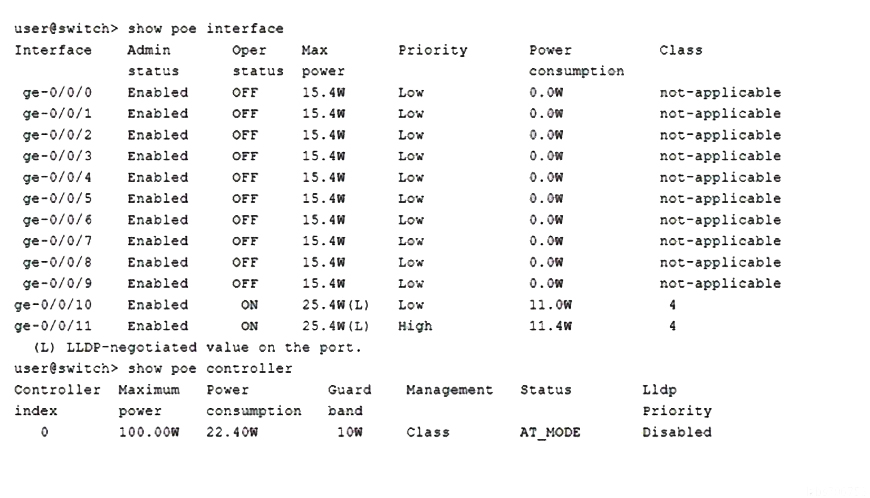
Referring to the exhibit, which two statements are correct? (Choose two.)

Your EX Series switch has IP telephones and computers connected to a single switch port. You are considering implementing the voice VLAN feature to help with this setup.
In this scenario, which two statements are correct? (Choose two.)
Referring to the exhibit, which LSA type is used to advertise 192.168.1.0/24 to R5?

Area-1 has no external connections. However, Area-1 has static route (172.16.31.0/24) that are not internal OSPF route. You can limit the external route advertisements to the area and advertise the static routes by designating the area an NSSA. In an NSSA, the ASBR (vMX1) generates NSSA external (Type 7) LSAs and floods them into the NSSA, where they are contained.
Type-7 LSAs allow an NSSA to support the presence of ASBR and their corresponding external routing information. The ABR (vMX2) converts Type-7 LSAs into Type-5 External LSAs and leaks them to the other areas, but external routes from other areas are not advertised within the NSSA.
An admin should check this and change it
https://www.packetswitch.co.uk/configuring-junos-ospf-stub-and-nssa-areas/
A BGP network has been designed to provide resiliency and redundancy to a multihomed customer network.
Which two statements are correct in this scenario? (Choose two.)

Full Exam Access, Actual Exam Questions, Validated Answers, Anytime Anywhere, No Download Limits, No Practice Limits
Get All 65 Questions & Answers