Question 1
What is the correct order of packet flow through configurable components in the Junos OS CoS features?

Exam dumps demo
Preview page 1 of 19 with real questions 1 to 5 from the full 96-question Juniper set.
The Juniper JN0-664 - Service Provider Routing and Switching, Professional Exam is part of the Juniper Service Provider Routing & Switching Certification path. It is designed for networking professionals who work with service provider routing and switching environments and need strong command of core protocols and VPN technologies. This exam matters because it validates practical knowledge in building, operating, and troubleshooting service provider networks using Juniper technologies. Passing it demonstrates readiness for advanced routing and switching responsibilities in real-world deployments.
| # | Exam Topics | Sub-Topics | Approximate Weightage (%) |
|---|---|---|---|
| 1 | OSPF | Area types, neighbor adjacencies, route summarization, troubleshooting | 15% |
| 2 | IS-IS | Levels and adjacency formation, metrics, route leaking, operational verification | 14% |
| 3 | BGP | Peering, path selection, policy control, route advertisement and filtering | 18% |
| 4 | Class of Service (CoS) | Classification, marking, queuing, scheduling and traffic prioritization | 12% |
| 5 | IP Multicast | Multicast forwarding, group management, rendezvous concepts, troubleshooting flows | 12% |
| 6 | Layer 3 VPNs | VRF concepts, route exchange, MPLS integration, service verification | 15% |
| 7 | Layer 2 VPNs | VPLS behavior, pseudowires, encapsulation, connectivity validation | 14% |
This exam tests more than memorization. Candidates must understand how routing protocols, multicast, CoS, and VPN technologies work together in service provider networks, and they should be able to analyze behavior, apply concepts, and troubleshoot scenarios with confidence. Strong practical knowledge and the ability to interpret exam-style questions are essential.
What is the correct order of packet flow through configurable components in the Junos OS CoS features?
Which statement is true regarding BGP FlowSpec?
Your network is receiving the 203.0.113.0/24 network using EBGP from AS 64500 and AS 64501. Both of these advertisements have identical local-preference values, AS-path lengths, and BGP origin codes. You want to influence the way your AS sends traffic to the 203.0.113.0/24 network.
In this scenario, which attribute would you consider next when selecting the best path?
To determine the correct answer, let's analyze the BGP path selection process and identify which attribute would be considered next in this scenario.
Background on BGP Path Selection
When multiple paths to the same destination are received via BGP, the router uses a step-by-step process to select the best path. The order of attributes considered is as follows (simplified for this scenario):
Highest Local Preference : The path with the highest local preference is preferred.
Shortest AS Path : The path with the shortest AS path length is preferred.
Lowest Origin Code : Paths with an origin code of IGP are preferred over EGP, and EGP is preferred over Incomplete.
Lowest MED (Multi-Exit Discriminator) : If the first three attributes are identical, the path with the lowest MED value is preferred.
eBGP over iBGP : eBGP paths are preferred over iBGP paths.
IGP Metric to Next Hop : The path with the lowest IGP metric to the next-hop router is preferred.
Router ID : If all else is equal, the path from the router with the lowest Router ID is preferred.
Peer IP Address : As a last tiebreaker, the path from the peer with the lowest IP address is preferred.
Scenario Analysis
In this scenario:
You are receiving the 203.0.113.0/24 network via EBGP from two different autonomous systems (AS 64500 and AS 64501).
Both advertisements have identical local-preference values , AS-path lengths , and BGP origin codes .
Given that the first three attributes in the BGP path selection process are identical, the next attribute to consider is the MED (Multi-Exit Discriminator) value.
Analysis of the Options
Option A: Router ID
Incorrect : The Router ID is considered much later in the BGP path selection process, only after other attributes like MED and IGP metric have been evaluated. Since MED is still relevant here, Router ID is not the next attribute to consider.
Option B: MED value
Correct : The MED value is used to influence inbound traffic from neighboring ASes. When local preference, AS path length, and origin code are identical, the path with the lowest MED value is preferred. This makes MED the next attribute to consider in this scenario.
Option C: Peer IP Address
Incorrect : The peer IP address is a tiebreaker used only at the very end of the BGP path selection process, after all other attributes have been evaluated. It is not relevant here because MED has not yet been considered.
Option D: IGP Metric
Incorrect : The IGP metric to the next-hop router is considered after MED. Since MED is still relevant in this scenario, IGP metric is not the next attribute to evaluate.
Final Answer
The correct answer is:
B . MED value
Summary
When local preference, AS path length, and origin code are identical, the MED value is the next attribute considered in the BGP path selection process.
MED is used to influence how traffic enters your AS from neighboring ASes.
Exhibit
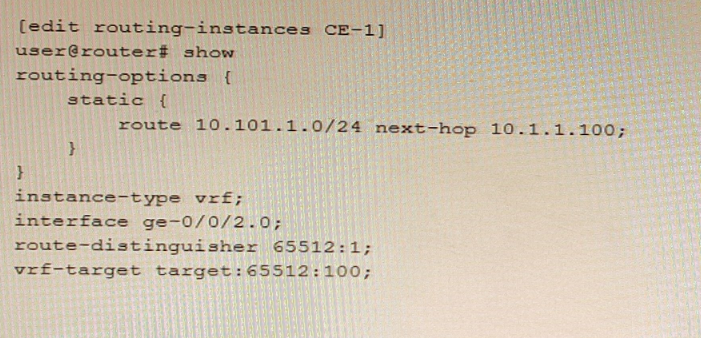
Referring to the exhibit, which statement is true?
The auto-export parameter is a routing option that allows a routing instance to share routes with other routing instances or the master routing table. The auto-export parameter automatically exports routes from one routing instance to another based on the route target communities attached to the routes. In this scenario, the 10.101.1.0/24 route will be shared if the auto-export parameter is configured under [edit routing-options] hierarchy level.
You are responding to an RFP for a new MPLS VPN implementation. The solution must use LDP for signaling and support Layer 2 connectivity without using BGP The solution must be scalable and support multiple VPN connections over a single MPLS LSP The customer wants to maintain all routing for their Private network
In this scenario, which solution do you propose?
AToM (Any Transport over MPLS) is a framework that supports various Layer 2 transport types over an MPLS network core. One of the transport types supported by AToM is LDP Layer 2 circuit, which is a point-to-point Layer 2 connection that uses LDP for signaling and MPLS for forwarding. LDP Layer 2 circuit can support Layer 2 connectivity without using BGP and can be scalable and efficient by using a single MPLS LSP for multiple VPN connections. The customer can maintain all routing for their private network by using their own CE switches.
Full exam access, validated answers, and unlimited practice with no download limits.
QA4Exam.com offers the JN0-664 Exam PDF with actual questions and answers, plus an Online Practice Test that helps you prepare in a focused way. The practice test gives you a real exam simulation so you can get comfortable with the format, timing, and question style before test day. You also get up-to-date questions and verified answers, which helps reduce guesswork and improves confidence. With repeated practice, you can strengthen weak areas, improve time management, and increase your chances of passing the Juniper JN0-664 exam on the first attempt.
The JN0-664 exam is the Service Provider Routing and Switching, Professional Exam in the Juniper Service Provider Routing & Switching Certification path.
It is intended for networking professionals who work with service provider routing and switching technologies and want to validate advanced Juniper skills.
Yes, it can be challenging because it covers multiple routing, VPN, multicast, and CoS topics and expects practical understanding, not just theory.
Braindumps alone are not the best strategy. You should combine them with hands-on study and review of the exam topics to build real understanding.
Hands-on experience is strongly recommended because the exam focuses on practical routing and switching scenarios, troubleshooting, and applied knowledge.
They are very effective preparation tools, especially when used with topic review and practice. The Exam PDF and Online Practice Test help reinforce knowledge and identify weak areas.
They help you study with real exam-style questions, verified answers, and timed practice, which improves confidence, speed, and accuracy before the actual test.
The Exam PDF provides questions and answers for offline review, and the Online Practice Test offers interactive exam simulation for timed preparation.