Prepare for the Juniper Data Center, Professional exam with our extensive collection of questions and answers. These practice Q&A are updated according to the latest syllabus, providing you with the tools needed to review and test your knowledge.
QA4Exam focus on the latest syllabus and exam objectives, our practice Q&A are designed to help you identify key topics and solidify your understanding. By focusing on the core curriculum, These Questions & Answers helps you cover all the essential topics, ensuring you're well-prepared for every section of the exam. Each question comes with a detailed explanation, offering valuable insights and helping you to learn from your mistakes. Whether you're looking to assess your progress or dive deeper into complex topics, our updated Q&A will provide the support you need to confidently approach the Juniper JN0-682 exam and achieve success.
What are two streaming data formats supported for network analytics? (Choose two.)
A) GPB (Google Protocol Buffers) and C. JSON are two common formats supported for streaming network analytics data.
A company wants to expect their hosting business and is seeking solutions to supported multiple tenants. Each tenant should be able to configure their own logical interfaces. Also, based on customer needs, all routing features must be supported.
What will satisfy the customer's requirements?
Logical systems allow each tenant to configure their own logical interfaces and support all routing features. This setup is ideal for hosting businesses looking to provide independent networking environments to multiple tenants.
You are asked to enable visibility into your EVPN-VXLAN network traffic by monitoring traffi
continuously. Which two statements are correct in this scenario? (Choose two.)
For enabling visibility into EVPN-VXLAN network traffic through continuous monitoring:
You must enable sFlow monitoring on each interface individually (Option C): sFlow is a sampling technology used for monitoring network traffic. In a Juniper environment, sFlow needs to be enabled on individual interfaces to start collecting traffic samples. This allows for granular control over which interfaces are monitored.
You cannot enable sFlow monitoring on each interface individually (Option A): This statement is incorrect, contradicting the above explanation. sFlow can and should be enabled on specific interfaces as needed.
The option stating that the sFlow agent needs to be manually installed on QFX Series switches (Option D) is inaccurate, as the sFlow feature is typically integrated into the Junos OS running on QFX Series switches. The statement about the sFlow agent being installed by default on QFX Series switches (Option B) is partially true but does not directly address the question of enabling visibility into network traffic.
Reference
Juniper Networks: Configuring sFlow Technology for Network Monitoring
You have configured a new MC-LAG connection to a host. After committing the configuration, the
MC-LAG link is not functioning properly.

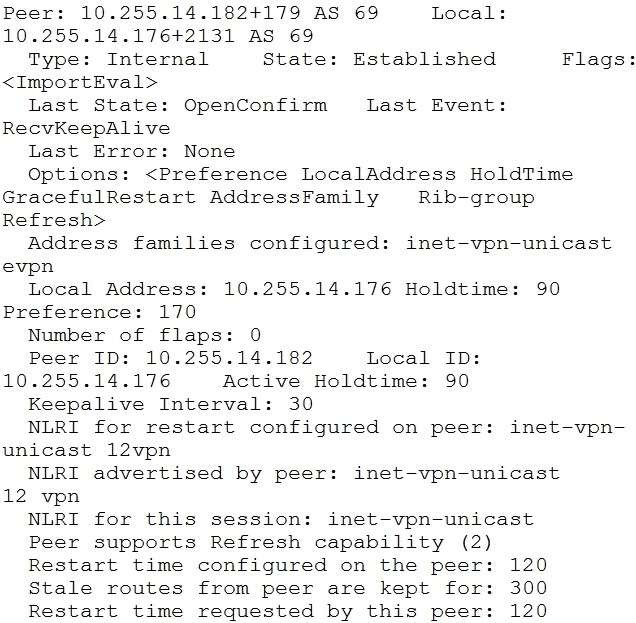
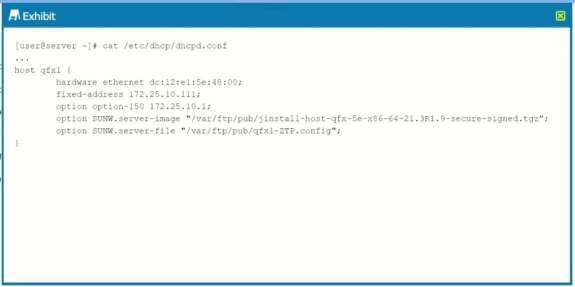
Referring to the exhibit, how would you solve this problem?
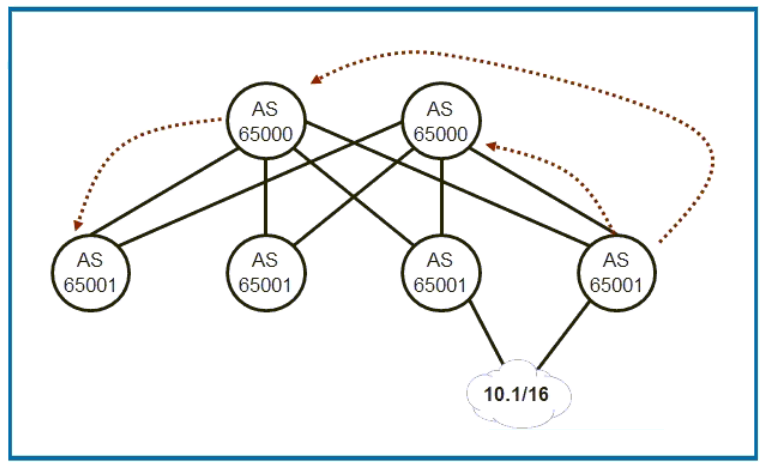
Referring to the exhibit, you must advertise the Io0.12 interface as a type-5 route.
Which configuration parameter would be used to accomplish this task?

Full Exam Access, Actual Exam Questions, Validated Answers, Anytime Anywhere, No Download Limits, No Practice Limits
Get All 154 Questions & Answers