
Trusted Worldwide Questions & Answers
Most Recent Linux Foundation Cilium-Associate Exam Dumps
Prepare for the Linux Foundation Cilium Certified Associate (CCA) exam with our extensive collection of questions and answers. These practice Q&A are updated according to the latest syllabus, providing you with the tools needed to review and test your knowledge.
QA4Exam focus on the latest syllabus and exam objectives, our practice Q&A are designed to help you identify key topics and solidify your understanding. By focusing on the core curriculum, These Questions & Answers helps you cover all the essential topics, ensuring you're well-prepared for every section of the exam. Each question comes with a detailed explanation, offering valuable insights and helping you to learn from your mistakes. Whether you're looking to assess your progress or dive deeper into complex topics, our updated Q&A will provide the support you need to confidently approach the Linux Foundation Cilium-Associate exam and achieve success.
The questions for Cilium-Associate were last updated on Sep 22, 2026.
- Viewing page 1 out of 12 pages.
- Viewing questions 1-5 out of 60 questions
As a Kubernetes user, you have deployed the following Cilium Network Policy:
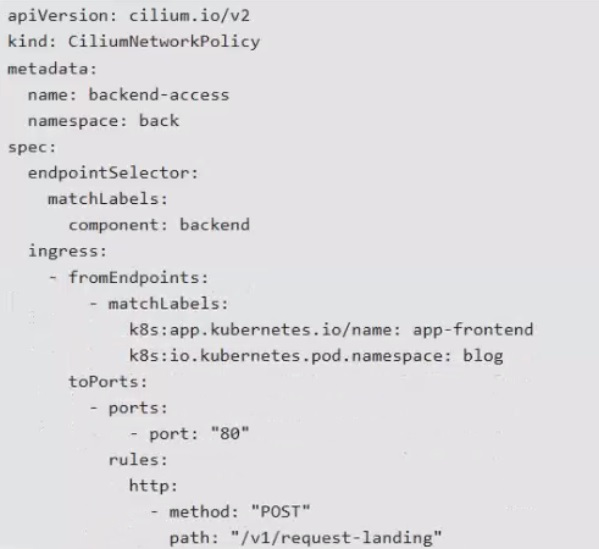
Cilium Layer 7 network policy exhibit
The network policy is not having any effect. What Is the Issue?
The policy attaches an HTTP Layer 7 rule to port 80 but omits protocol: TCP from the associated ports entry. HTTP policy is layered on a Layer 4 TCP rule, and the documented Cilium form explicitly identifies TCP before specifying the HTTP method and path. D therefore identifies the configuration defect intended by the question.
The cross-namespace source selection is valid. The policy resides in namespace back and selects backend pods there. Its fromEndpoints selector explicitly includes k8s:io.kubernetes.pod.namespace: blog, allowing it to select matching app-frontend endpoints in that other namespace. Option A is consequently not an error.
The k8s: source prefix in k8s:app.kubernetes.io/name is also valid Cilium label syntax and identifies the Kubernetes label source, making B false. Port 80 may be used in a Cilium policy; the privileged-port restriction concerns which processes may bind low-numbered ports under operating-system permissions, not whether a network policy can reference them.
The corrected port entry should contain port: "80" together with protocol: TCP.
Official references
Cilium Layer 7 Policies, Kubernetes Constructs in Cilium Policy
Study Guide topic: Combining Layer 4 port rules with Layer 7 HTTP policies.
Cilium status exhibit
Based on the cilium status output above, what is correct about the Cilium deployment?
For accessibility, the output of the command has been edited.
The status output reports Operator: OK, followed by Deployment cilium-operator Desired: 1, Ready: 1/1, Available: 1/1. This establishes that the Cilium Operator is deployed and healthy, making B the intended answer. Cilium uses Kubernetes CustomResourceDefinitions as its default mechanism for storing and propagating cluster state, while the operator performs cluster-wide duties that should be handled once centrally rather than independently on every node.
Option A is contradicted by the exhibit: both hubble-ui and hubble-relay appear as ready deployments and running containers. Option C is incorrect because the resource is explicitly identified as a Deployment; the cilium agents, by contrast, are shown as a DaemonSet. Option D incorrectly treats the displayed desired replica count as a permanent restriction. A desired count of one describes this installation's current configuration, not a universal maximum.
The exhibit also shows embedded Envoy mode and three healthy Cilium agent instances, but neither detail changes the operator conclusion.
Official references
Cilium Component Overview, Setting up Hubble Observability
Study Guide topic: Cilium components, Cilium Operator, CRD-backed state, and status interpretation.
a requirement to achieve service discovery and load balancing across clusters with Cluster Mesh?
Every cluster participating in a Cilium Cluster Mesh must have a unique cluster name and numeric cluster ID. The numeric ID becomes part of Cluster Mesh security identities and allows Cilium to distinguish identities originating in different clusters. Reusing an ID would create ambiguity in endpoint identity, policy enforcement, and synchronized service information. Current documentation permits IDs from 1 through 255 under the default scaling configuration.
Geographical colocation is not required. Cluster Mesh is specifically designed to extend connectivity, policy, service discovery, and load balancing across clusters that may reside in different regions, clouds, or premises, provided the documented network-connectivity requirements are satisfied. The clusters also do not need to use an identical Kubernetes distribution or exact Kubernetes version.
Option C is unnecessarily strict. Current Cilium documentation permits connected clusters to differ by no more than one minor Cilium release; exact version equality is not mandatory. Other prerequisites include unique and non-conflicting PodCIDRs, compatible datapath modes, node connectivity, and appropriate inter-cluster communication.
The supplied bank incorrectly marks A. The verified answer is D.
Official references
Setting up Cluster Mesh.
Study Guide topic: Cluster Mesh.
In which use case can the Cilium Service Mesh exclusively utilize eBPF without requiring a proxy such as Envoy?
Cilium can implement Layer 3 and Layer 4 forwarding exclusively through its eBPF datapath. IP, TCP, and UDP traffic can be routed, load-balanced, filtered, and redirected through eBPF programs attached to Linux networking hooks. These operations depend on network-layer addresses, protocols, ports, identities, and connection state; they do not require application-protocol parsing by a userspace proxy.
Application-layer operations are different. Cilium's official Service Mesh architecture uses a proxy such as Envoy to parse HTTP, gRPC, and DNS when Layer 7 policy, observability, or traffic management requires understanding individual requests. The eBPF datapath transparently redirects selected traffic to the node-local proxy and retains identity context, while Envoy performs the protocol-aware operation.
Kafka parsing is also an application-layer activity rather than ordinary Layer 3 or Layer 4 forwarding. Moreover, current Cilium releases removed the former Envoy Go extension mechanism used for Kafka and generic proxylib rules, further reinforcing that it is not an eBPF-only forwarding case.
Therefore, D accurately identifies the scenario in which the Service Mesh datapath can remain entirely in the kernel without requiring Envoy.
Official references
Cilium Service Mesh; eBPF Datapath Introduction.
Study Guide topic: Service Mesh.
Which command is used to enable logging at the debug log level of Cilium agents7
cilium config set debug true follows the supported Cilium CLI configuration syntax and sets the debug configuration key to true. The cilium config set command accepts a key/value pair and, by default, restarts the Cilium pods so that the changed configuration is applied. The Cilium configuration documentation defines debug as the setting that enables full debug mode. This increases agent logging verbosity and causes eBPF programs to emit additional visibility events for diagnostic use.
Options A, B, and D do not match documented Cilium CLI command structures. There is no cilium log level --set=debug command in the Cilium CLI hierarchy, and neither cilium logging.level=debug nor cilium logging debug is valid configuration syntax. A Helm-managed installation may also enable debugging through the chart value debug.enabled=true, but that does not make any of the alternative commands correct.
Debug mode should be enabled deliberately because it increases log volume and may generate additional datapath visibility information. After troubleshooting, operators should normally restore the previous setting to avoid unnecessary operational overhead.
The supplied answer key incorrectly identifies B. The verified answer is C.
Official references
Cilium configuration; Cilium CLI `config set`; Helm values.
Study Guide topic: Installation and Configuration.
Unlock All Questions for Linux Foundation Cilium-Associate Exam
Full Exam Access, Actual Exam Questions, Validated Answers, Anytime Anywhere, No Download Limits, No Practice Limits
Get All 60 Questions & Answers