Limited-Time Offer: Enjoy 50% Savings! - Ends In 0d 00h 00m 00s Coupon code: 50OFF
Welcome to QA4Exam
Logo

- Trusted Worldwide Questions & Answers

Most Recent Microsoft DP-100 Exam Dumps


Prepare for the Microsoft Designing and Implementing a Data Science Solution on Azure exam with our extensive collection of questions and answers. These practice Q&A are updated according to the latest syllabus, providing you with the tools needed to review and test your knowledge.

QA4Exam focus on the latest syllabus and exam objectives, our practice Q&A are designed to help you identify key topics and solidify your understanding. By focusing on the core curriculum, These Questions & Answers helps you cover all the essential topics, ensuring you're well-prepared for every section of the exam. Each question comes with a detailed explanation, offering valuable insights and helping you to learn from your mistakes. Whether you're looking to assess your progress or dive deeper into complex topics, our updated Q&A will provide the support you need to confidently approach the Microsoft DP-100 exam and achieve success.

The questions for DP-100 were last updated on Apr 19, 2026.
  • Viewing page 1 out of 101 pages.
  • Viewing questions 1-5 out of 506 questions
Get All 506 Questions & Answers
Question No. 1

You create a batch inference pipeline by using the Azure ML SDK. You run the pipeline by using the following code:

from azureml.pipeline.core import Pipeline

from azureml.core.experiment import Experiment

pipeline = Pipeline(workspace=ws, steps=[parallelrun_step])

pipeline_run = Experiment(ws, 'batch_pipeline').submit(pipeline)

You need to monitor the progress of the pipeline execution.

What are two possible ways to achieve this goal? Each correct answer presents a complete solution.

NOTE: Each correct selection is worth one point.

Show Answer Hide Answer
Correct Answer: D, E

A batch inference job can take a long time to finish. This example monitors progress by using a Jupyter widget. You can also manage the job's progress by using:

Azure Machine Learning Studio.

Console output from the PipelineRun object.

from azureml.widgets import RunDetails

RunDetails(pipeline_run).show()

pipeline_run.wait_for_completion(show_output=True)


https://docs.microsoft.com/en-us/azure/machine-learning/how-to-use-parallel-run-step#monitor-the-parallel-run-job

Question No. 2

Note: This question is part of a series of questions that present the same scenario. Each question in the series contains a unique solution that might meet the stated goals. Some question sets might have more than one correct solution, while others might not have a correct solution.

After you answer a question in this section, you will NOT be able to return to it. As a result, these questions will not appear in the review screen.

You have a Python script named train.py in a local folder named scripts. The script trains a regression model by using scikit-learn. The script includes code to load a training data file which is also located in the scripts folder.

You must run the script as an Azure ML experiment on a compute cluster named aml-compute.

You need to configure the run to ensure that the environment includes the required packages for model training. You have instantiated a variable named aml-compute that references the target compute cluster.

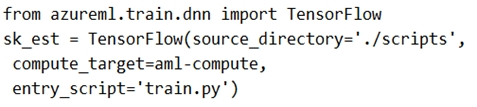
Solution: Run the following code:

Does the solution meet the goal?

Show Answer Hide Answer
Correct Answer: A

The scikit-learn estimator provides a simple way of launching a scikit-learn training job on a compute target. It is implemented through the SKLearn class, which can be used to support single-node CPU training.

Example:

from azureml.train.sklearn import SKLearn

}

estimator = SKLearn(source_directory=project_folder,

compute_target=compute_target,

entry_script='train_iris.py'

)


https://docs.microsoft.com/en-us/azure/machine-learning/how-to-train-scikit-learn

Question No. 3

Note: This question is part of a series of questions that present the same scenario. Each question in the series contains a unique solution that might meet the stated goals. Some question sets might have more than one correct solution, while others might not have a correct solution.

After you answer a question in this section, you will NOT be able to return to it. As a result, these questions will not appear in the review screen.

You are analyzing a numerical dataset which contains missing values in several columns.

You must clean the missing values using an appropriate operation without affecting the dimensionality of the feature set.

You need to analyze a full dataset to include all values.

Solution: Calculate the column median value and use the median value as the replacement for any missing value in the column.

Does the solution meet the goal?

Show Answer Hide Answer
Question No. 4

You use Azure Machine Learning Designer lo load the following datasets into an experiment:

Dataset1:

Dataset2:

You need to create a dataset that has the same columns and header row as the input datasets and contains all rows from both input datasets.

Solution: Use the Add Rows component.

Does the solution meet the goal?

Show Answer Hide Answer
Correct Answer: B

Question No. 5

You create an Azure Machine Learning workspace. The workspace contains a dataset named sample.dataset, a compute instance, and a compute cluster. You must create a two-stage pipeline that will prepare data in the dataset and then train and register a model based on the prepared data. The first stage of the pipeline contains the following code:

You need to identify the location containing the output of the first stage of the script that you can use as input for the second stage. Which storage location should you use?

Show Answer Hide Answer
Correct Answer: C

Unlock All Questions for Microsoft DP-100 Exam

Full Exam Access, Actual Exam Questions, Validated Answers, Anytime Anywhere, No Download Limits, No Practice Limits

Get All 506 Questions & Answers