
Limited-Time Offer: Enjoy 50% Savings! - Ends In 0d 00h 00m 00s Coupon code: 50OFF
Welcome to QA4Exam
Logo

- Trusted Worldwide Questions & Answers

Exam dumps demo

4A0-112 Exam Dumps and Practice Questions

Preview page 1 of 8 with real questions 1 to 5 from the full 40-question Nokia set.

Nokia 4A0-112 Dumps - Pass Nokia IS-IS Routing Protocol Exam in First Attempt 2026

The Nokia 4A0-112 exam, "Nokia IS-IS Routing Protocol", is part of the Nokia Network Routing Specialist II certification path. It is designed for networking professionals who want to validate their understanding of routing fundamentals and the IS-IS protocol in real-world environments. This exam matters because it confirms practical knowledge that supports reliable routing design, configuration, and troubleshooting in enterprise and service provider networks.

Exam Topics and Approximate Weightage

# Exam Topics Sub-Topics Approximate Weightage (%)
1 IP routing review Routing basics, packet forwarding, route selection, routing table concepts 20
2 Static routes Static route configuration, next-hop selection, default routes, route verification 20
3 Interior gateway protocols IGP concepts, routing protocol comparison, metrics, convergence behavior 25
4 Intermediate system-to-intermediate system routing protocol (IS-IS) IS-IS architecture, areas and levels, adjacency formation, LSPs and SPF operation 35

Actual Nokia 4A0-112 Exam Questions

Question 1

For a link-state routing protocol, which of the following statements about link-state updates is FALSE?

Correct answer: A

When a link-state update reaches its maximum age, it is removed from the router's link-state database, not flooded to its neighbors. This prevents outdated information from continuing to affect the routing decisions. The router does not flood the aged update; instead, it will typically request a new link-state advertisement from the original source router if the information is still needed.
Question 2

Refer to the exhibit.

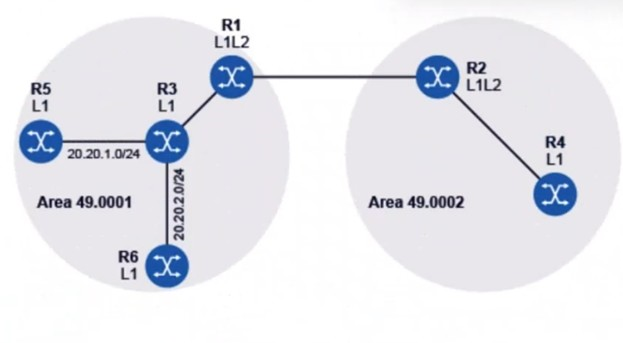
In the IS-IS network shown, router R1 has been configured to summarize subnetworks 20.20.1.0/24 and 20.20.2.0/24 as 20.20.0.0/16. Which routers' routing tables will be reduced, compared to their routing tables before the summarization?

Correct answer: B

Router R1 is the one that performs the summarization of the two subnets (20.20.1.0/24 and 20.20.2.0/24) into the summarized route 20.20.0.0/16. However, R1 itself will not see any change in its routing table because it is directly connected to both subnets and already knows about them.

Router R2, which is in Area 49.0002, will benefit from this summarization because it previously had separate routes for both 20.20.1.0/24 and 20.20.2.0/24. After the summarization, R2 will only need to maintain a single route to 20.20.0.0/16, reducing the size of its routing table.

Router R4 does not directly benefit from the summarization because it is only connected to the Level 1 network and has no need for the summarized routes from R1. Thus, the summarization does not affect R4's routing table.


Question 3

Refer to the exhibit.

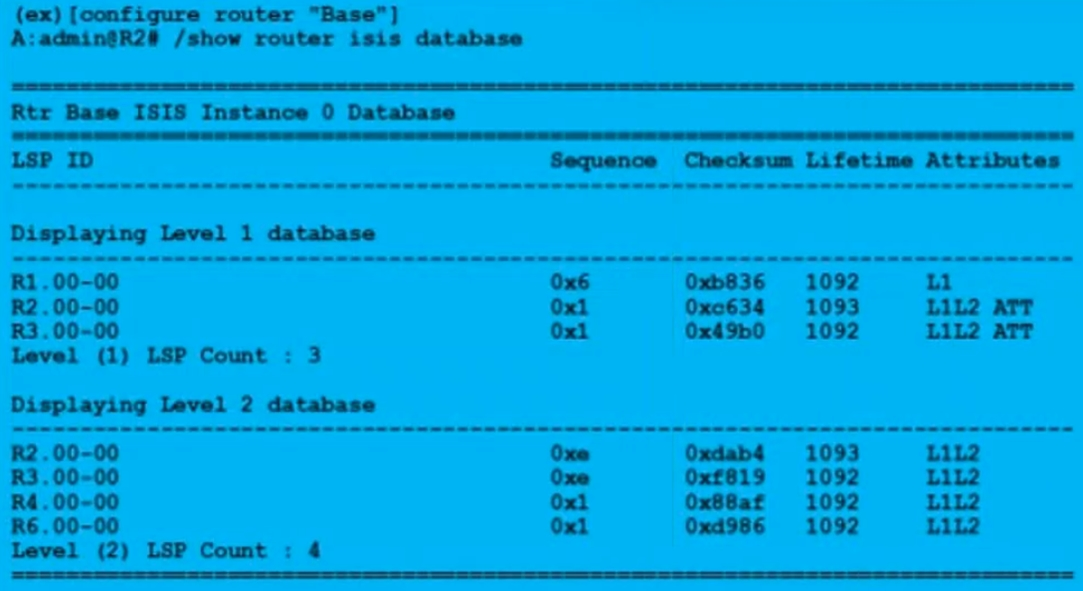
Which of the following statements best describes the IS-IS domain to which the command output corresponds?

Correct answer: D

The output shows two levels of IS-IS databases: Level 1 (L1) and Level 2 (L2). This indicates that the domain is multi-area, as L1 routers are confined to a single area, while L2 routers can route between different areas. The presence of Level 1/Level 2 (L1/L2) routers also suggests that the domain spans multiple areas.

The LSP (Link-State PDU) entries show L1/L2 ATT attributes, which typically indicate that these routers are capable of routing both within their own area (Level 1) and across areas (Level 2), suggesting a multi-area design.

The IS-IS domain likely includes broadcast interfaces, as indicated by the 'ATT' attribute (typically referring to the type of interface) and common IS-IS configuration practices on broadcast networks like Ethernet.


Question 4

Refer to the exhibit.

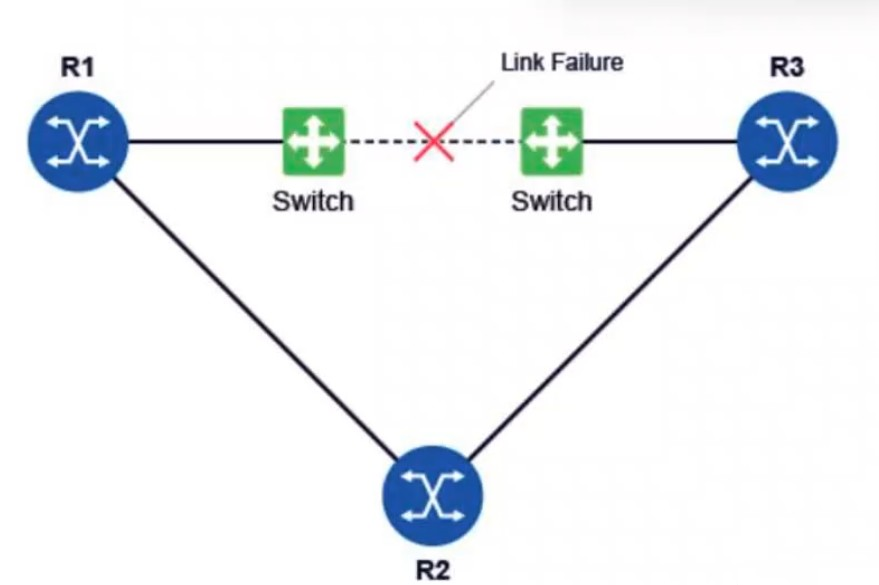
All routers in the diagram are running a link-state routing protocol. Before the link failure, all routers have operational adjacencies with each other and there is a BFD session between routers R1 and R3. After the link failure, which of the following affects the routing protocol's convergence time?

Correct answer: C

BFD (Bidirectional Forwarding Detection) is used to detect link failures quickly and helps improve convergence time in link-state routing protocols. The BFD session between routers R1 and R3 allows them to detect the failure of the link between them more quickly than the regular routing protocol hello timers. The transmit interval, receive interval, and multiplier settings determine how fast BFD detects a failure and triggers the routing protocol to converge, which directly impacts the convergence time.


Question 5

A routing domain is using a single-area link-state routing protocol. Which of the following is NOT information that a router can share with other routers in the domain using protocol-specific messages?

Correct answer: C

In a single-area link-state routing protocol (such as OSPF), routers share specific information about the network topology, not their entire routing table. They exchange link-state advertisements (LSAs) that contain information about their directly connected interfaces and their state, allowing other routers to build a consistent view of the network.


Unlock all Nokia 4A0-112 questions

Full exam access, validated answers, and unlimited practice with no download limits.

This exam tests both conceptual understanding and practical routing knowledge. Candidates should be able to explain routing behavior, identify how static routes and IGPs work, and understand IS-IS operation at a deeper level. It also checks your ability to interpret protocol behavior, verify configurations, and apply routing concepts in realistic scenarios.

How QA4Exam.com Helps You Pass

QA4Exam.com offers the Nokia 4A0-112 Exam PDF with actual questions and answers, plus an Online Practice Test that helps you prepare with confidence. The practice format gives you a real exam simulation so you can get familiar with question style, pacing, and time management. You also benefit from up-to-date questions and verified answers that support efficient revision before exam day. With focused preparation materials, you can strengthen weak areas and improve your chances of passing the Nokia IS-IS Routing Protocol exam on your first attempt.

Frequently Asked Questions

1. What is the Nokia 4A0-112 exam about?

It is the Nokia IS-IS Routing Protocol exam and is part of the Nokia Network Routing Specialist II certification path.

2. Who should take this exam?

It is intended for networking professionals who want to validate routing knowledge, especially around IP routing, static routes, IGPs, and IS-IS.

3. Is the Nokia 4A0-112 exam difficult?

The difficulty depends on your routing background and hands-on exposure. Candidates with a solid understanding of IS-IS and routing fundamentals are usually better prepared.

4. Can I pass with only braindumps?

Braindumps alone are not the best approach. You should use them as part of a broader study plan that includes understanding the concepts and reviewing practical routing behavior.

5. Do I need hands-on experience for this exam?

Hands-on experience is very helpful because the exam covers routing concepts and IS-IS behavior that are easier to understand through real configuration and troubleshooting practice.

6. Are the QA4Exam.com dumps and practice test enough to prepare?

They are strong preparation tools because they provide actual questions and answers, verified content, and realistic practice. For best results, combine them with topic review and concept study.

7. How do the QA4Exam.com materials help with first-attempt success?

The Exam PDF and Online Practice Test help you learn the question style, improve time management, and focus on the most relevant exam areas, which can increase your confidence on exam day.

8. What is included in the QA4Exam.com format?

The offering includes an Exam PDF with actual questions and answers and an Online Practice Test that simulates the exam environment for focused preparation.