Question 1
A Layer-3 EVPN service is configured to use the interface-ful unnumbered forwarding model. Which of the following statements is FALSE?

Exam dumps demo
Preview page 1 of 8 with real questions 1 to 5 from the full 40-question Nokia set.
The Nokia 4A0-115 exam, "Nokia Ethernet Virtual Private Network Services," is part of the Nokia Service Routing Architect certification track. It is designed for networking professionals who want to validate their knowledge of EVPN services and related deployment concepts. This exam matters for engineers working with modern carrier and enterprise network designs that use Ethernet VPN technologies. Preparing well for it can help you demonstrate strong skills in EVPN service architecture and implementation.
| # | Exam Topics | Sub-Topics | Approximate Weightage (%) |
|---|---|---|---|
| 1 | Module 1 - Introduction to EVPN | EVPN concepts, control plane basics, service overview | 15% |
| 2 | Module 2 - EVPN for ELAN services | ELAN service model, forwarding behavior, service configuration concepts | 20% |
| 3 | Module 3 - EVPN for Layer-3 services | Layer-3 integration, routing concepts, interconnect design | 18% |
| 4 | Module 4 - Multi-Homing in EVPN | Redundancy models, multi-homing operation, failover behavior | 17% |
| 5 | Module 5 - EVPN for ELINE services | Point-to-point services, service instantiation, operational considerations | 15% |
| 6 | Module 6 - EVPN and traditional MPLS services | Comparison with MPLS services, migration concepts, coexistence scenarios | 15% |
The exam tests how well candidates understand EVPN service concepts, service types, and deployment behavior across different scenarios. It also checks practical knowledge of multi-homing, Layer-2 and Layer-3 services, and how EVPN works alongside traditional MPLS services. Candidates should be ready to interpret service designs and apply core concepts with confidence.
A Layer-3 EVPN service is configured to use the interface-ful unnumbered forwarding model. Which of the following statements is FALSE?
Based upon the exhibit, how many MAC-VRFs are there?
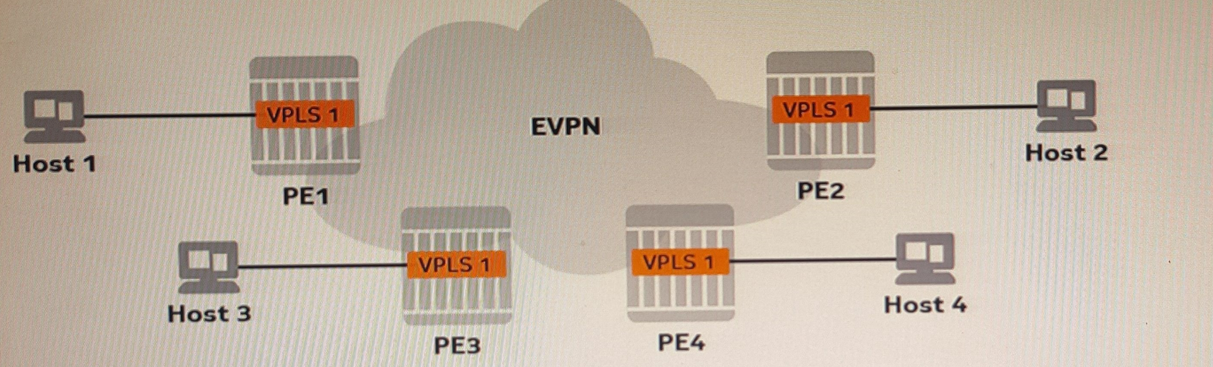
In the exhibit, the EVPN-IRB is using the interface-ful unnumbered model and is fully operational. Which of the following statements is FALSE?

A. Proxy-ARP/ND is operational for a VPLS. Which of the following statements is FALSE?
When the PE learns a local host IP address, it does not add an entry into its proxy-ARP table. The proxy-ARP table is populated by snooping IP packets received from remote PEs. The PE advertises a MAC/IP route that includes the MAC and IP address of a local host.
Which of the following best describes the operation of a non-designated forwarder (non-DF) in a single-active Ethernet segment?
A non-designated forwarder (non-DF) in a single-active Ethernet segment blocks Tx unicast, allows Rx unicast, blocks Tx BUM, and allows Rx BUM. This prevents traffic duplication and ensures that only the DF forwards traffic to and from the CE.
Full exam access, validated answers, and unlimited practice with no download limits.
QA4Exam.com provides Exam PDF content with actual questions and answers, plus an Online Practice Test built to help you prepare for the Nokia 4A0-115 exam efficiently. The practice test gives you a real exam simulation so you can get used to the question style and pacing before test day. Our updated questions and verified answers help you focus on the most relevant exam content. You can also improve time management skills and identify weak areas before the real exam. With the right preparation tools, you can approach the Nokia Ethernet Virtual Private Network Services exam with more confidence and a better chance of passing on the first attempt.
This exam is for networking professionals pursuing the Nokia Service Routing Architect certification and those who want to validate their EVPN service knowledge.
It can be challenging if you are new to EVPN, but candidates with a solid understanding of service concepts, routing, and multi-homing usually handle it better.
Using dumps alone is not the best approach. They are most effective when combined with study and review so you understand the concepts behind the questions.
Hands-on experience is very helpful because the exam covers practical EVPN service topics. Real-world exposure makes it easier to understand design and behavior questions.
The Exam PDF helps you review actual questions and answers, while the Online Practice Test trains you under exam-like conditions. Together they improve confidence, speed, and accuracy.
QA4Exam.com offers an Exam PDF and an Online Practice Test. These formats make it easy to study offline and also practice interactively before the exam.
The materials are presented as updated question and answer resources so you can prepare with content aligned to the exam focus.