Limited-Time Offer: Enjoy 50% Savings! - Ends In 0d 00h 00m 00s Coupon code: 50OFF
Welcome to QA4Exam
Logo

- Trusted Worldwide Questions & Answers

Nokia 4A0-116 Dumps - Pass Nokia Segment Routing Exam in First Attempt 2026

The Nokia 4A0-116 - Nokia Segment Routing exam is part of the Nokia Service Routing Architect certification path. It is designed for networking professionals who want to validate their knowledge of segment routing concepts, configuration, and traffic engineering. This exam matters for candidates who work with modern routing architectures and need practical skills in segment routing deployment and optimization.

# Exam Topics Sub-Topics Approximate Weightage (%)
1 Module 1 - Introduction to segment routing
  • Segment routing fundamentals
  • Architecture and key concepts
  • Benefits for modern IP networks
10%
2 Module 2 - Basic segment routing configuration and operation
  • Basic configuration steps
  • SID assignment and operation
  • Verification and troubleshooting
20%
3 Module 3 - Segment routing tunnels with traffic engineering constraints
  • Traffic engineering constraints
  • Tunnel setup and path control
  • Policy-based routing behavior
18%
4 Module 4 - SR-TE with a path computation element
  • SR-TE concepts with PCE
  • Path computation workflows
  • Controller-assisted routing decisions
17%
5 Module 5 - Segment routing fast re-route
  • Fast re-route principles
  • Protection and failover behavior
  • Resiliency validation
17%
6 Module 6 - Flexible algorithms (flex-algo)
  • Flex-algo purpose and usage
  • Algorithm selection and policy behavior
  • Path diversity and routing objectives
18%
Total 100%

This exam tests how well candidates understand segment routing concepts and how to apply them in real network scenarios. It focuses on configuration knowledge, operational verification, traffic engineering, path computation, fast re-route, and flex-algo behavior. Strong candidates should be able to interpret routing objectives, understand how features interact, and troubleshoot practical deployment situations.

Frequently Asked Questions

1. What is the Nokia 4A0-116 exam about?

It is the Nokia Segment Routing exam for the Nokia Service Routing Architect certification path, covering segment routing fundamentals, configuration, SR-TE, fast re-route, and flex-algo.

2. Who should take the Nokia 4A0-116 exam?

It is intended for networking professionals who want to validate practical knowledge of Nokia segment routing concepts and routing architecture skills.

3. Is the Nokia Segment Routing exam difficult?

It can be challenging because it tests both theory and practical understanding. Candidates should be comfortable with configuration, operation, and troubleshooting concepts.

4. Can I pass with only braindumps?

Braindumps alone are not the best approach. You should also understand the concepts, review the exam topics, and practice enough to apply the knowledge correctly.

5. Do I need hands-on experience for 4A0-116?

Hands-on experience is very helpful because the exam covers configuration and operational topics. Practical familiarity makes it easier to understand how the features work.

6. How do QA4Exam.com dumps and the practice test help with first-attempt success?

The Exam PDF and Online Practice Test help you review actual-style questions, verify answers, and practice under exam-like conditions. This can improve confidence, speed, and accuracy before the real exam.

7. Are the QA4Exam.com questions and answers useful for time management practice?

Yes, the Online Practice Test is useful for timing yourself and getting used to the exam flow, which helps you manage your time more effectively on test day.

The questions for 4A0-116 were last updated on Jun 5, 2026.
  • Viewing page 1 out of 8 pages.
  • Viewing questions 1-5 out of 40 questions
Get All 40 Questions & Answers
Question No. 1

Which of the following is an advantage of enabling label stack reduction for a CSPF-calculated path, as compared to using plain CSPF?

Show Answer Hide Answer
Correct Answer: A

Once a path is associated with an LSP, it cannot be used by other LSPs is False. A path can be used by multiple LSPs, but each LSP can have different attributes like bandwidth, priority and other constraints.


Question No. 2

Which of the following list of SR-TE attributes has to be advertised among routers?

Show Answer Hide Answer
Correct Answer: A

In SR-TE, routers need to advertise certain attributes of their links to other routers in the network in order to calculate traffic-engineered paths. These attributes include:

Administrative groups that each link belongs to: This information is used to restrict the use of certain links to specific traffic types or groups.

TE metric of links: This information is used to calculate the cost of using a particular link for a traffic-engineered path.

Bandwidth availability of each link: This information is used to control the amount of traffic that can be sent over a particular link.

SRLG that each link belongs to: This information is used to avoid routing over the same physical link. Link status up/down is not needed to be advertised as it is part of the IGP protocol and is used to check the reachability of a link.


Question No. 3

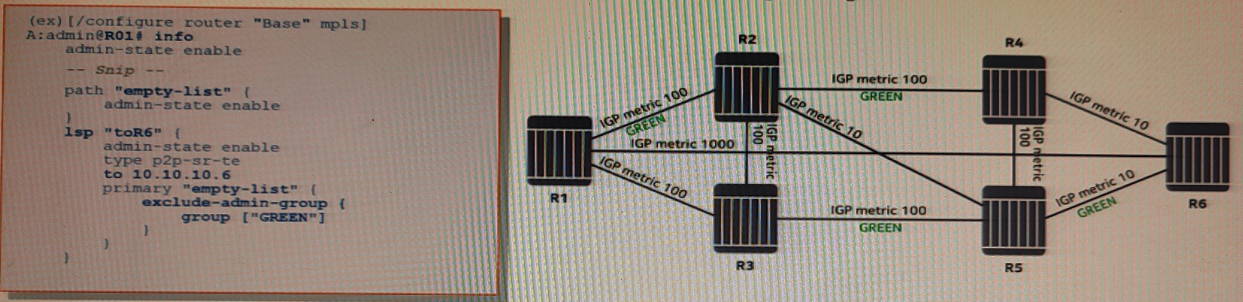
Examine the exhibit. Based upon the configuration, which routers will the LSP go through?

Show Answer Hide Answer
Correct Answer: C

Question No. 4

An SR-TE LSP with a path definition that includes router R4 as a loose hop and for which Seamless-BFD has been enabled is following the path shown in the exhibit. What happens after router R4 fails if the routers along the path follow the default behavior?

Show Answer Hide Answer
Correct Answer: C

When an SR-TE LSP with Seamless-BFD enabled, the BFD sessions are established between the routers along the path to detect any failures quickly. If a failure happens in the path, the router will stop forwarding the traffic and send a BFD control packet to the head-end router. In this case, R4 failed, BFD sessions will detect the failure and send a message to the head-end router, but since R4 is a loose hop, the path doesn't have to be re-calculate. The head-end router will continue forwarding traffic to the current next-hop, R2, which will be discarded at the point of failure (R4) as it doesn't know about the failure. And the traffic will not be redirected to R3 after IGP reconvergence.


Question No. 5

Examine the exhibit.

An LSP is being configured to start at R1 and end at R6 using local CSPF. The LSP has the following constraints. Include admin-group GREEN, use the TE metric and hop-limit 3. What routers will be included in the LSP path?

Show Answer Hide Answer
Correct Answer: C

Unlock All Questions for Nokia 4A0-116 Exam

Full Exam Access, Actual Exam Questions, Validated Answers, Anytime Anywhere, No Download Limits, No Practice Limits

Get All 40 Questions & Answers