The Palo Alto Networks XSOAR-Engineer - Palo Alto Networks XSOAR Engineer exam is part of the Palo Alto Networks Certified XSOAR Engineer certification path. It is designed for professionals who work with Cortex XSOAR and need to prove practical skills in building, managing, and maintaining automation-driven security operations. This certification matters because it validates the knowledge needed to support real-world SOC workflows, incident handling, and threat intelligence processes.
| # | Exam Topics | Sub-Topics | Approximate Weightage (%) |
|---|---|---|---|
| 1 | Planning, Installation, and Maintenance | System planning, deployment setup, platform maintenance, updates and troubleshooting | 20% |
| 2 | Use Case Planning and Development | Use case analysis, workflow design, automation objectives, integration planning | 20% |
| 3 | Playbook Development | Playbook creation, task automation, conditions and loops, testing and refinement | 25% |
| 4 | Incident Interactions and Reporting | Incident handling, incident fields, response actions, reporting and dashboards | 20% |
| 5 | Threat Intelligence Management | Indicators, feeds, enrichment, context management, threat intelligence workflows | 15% |
The exam tests more than basic product familiarity. Candidates must understand how to plan and maintain an XSOAR environment, develop use cases and playbooks, manage incidents, and work with threat intelligence in practical scenarios. It also checks the ability to apply knowledge in a way that reflects real operational tasks and hands-on platform usage.
QA4Exam.com offers Exam PDF material with actual questions and answers, along with an Online Practice Test that helps you prepare in a focused way for the Palo Alto Networks XSOAR-Engineer exam. The practice test gives you a realistic exam simulation so you can get comfortable with the question style and pacing before test day. Updated questions and verified answers help you study with confidence and reduce the risk of learning outdated content. By practicing under timed conditions, you can improve time management and build the speed needed to finish the exam efficiently. These tools are designed to support first-attempt success through targeted and practical preparation.
This exam is for professionals who want to validate skills related to Cortex XSOAR planning, playbook development, incident handling, and threat intelligence management.
It can be challenging because it tests practical knowledge and platform usage, not just definitions. Candidates should be comfortable with real workflow and automation concepts.
Braindumps alone are not the best approach. You should use them as part of a broader study plan that includes understanding the topics and reviewing how the platform works in practice.
Hands-on experience is very helpful because the exam focuses on practical skills such as playbook development, incident interactions, and threat intelligence workflows.
They are strong preparation tools because they provide actual questions and answers, verified content, and exam-like practice. Many candidates also review the topic areas to strengthen understanding.
They help you study efficiently, practice with realistic questions, and improve time management. This combination can increase confidence and reduce surprises on exam day.
The Exam PDF provides actual questions and answers, and the Online Practice Test offers a simulated exam experience that helps you prepare in a structured way.
What determines the current verdict for an indicator when multiple sources provide different reliability scores and verdicts?.
The Threat Intelligence section specifies that XSOAR determines an indicator's verdict by selecting the verdict from the source that has the highest reliability score.
Only when two sources have equal reliability does XSOAR choose the most severe (worst) verdict between them.
What is the correct definition regarding integration parameters and command arguments?
Which two statements describe how timers are configured to start and stop automatically in a playbook? (Choose two.)
What are the three ways to add/mark entries as evidence inside the Evidence Board? (Choose three.)
What must happen before a pre-process rule can be applied to a potential incident?.
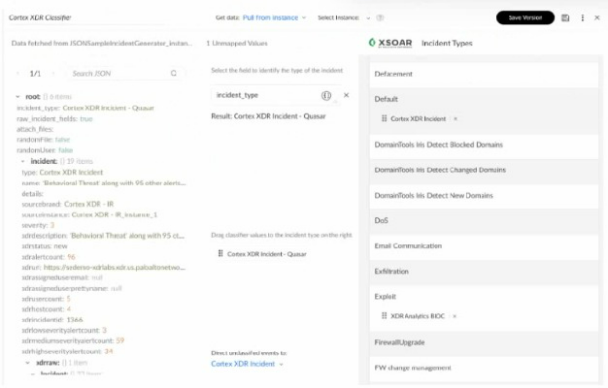
The XSOAR event-to-incident pipeline is clearly defined in the admin documentation: Ingestion Classification Pre-Processing Incident Creation Playbook Execution. Classification must occur before pre-process rules because the system must determine an incident type (or classification result) before evaluating any pre-process logic that may drop, merge, link, or modify the incoming incident.
Pre-process rules use fields created during the classification stage---including incident type, normalized values, and extracted fields---to determine whether an incident should be suppressed, modified, or related to an existing incident. Without classification completing first, the rule engine would not have the necessary structured data.
Mapping, which transforms raw event fields into incident fields, occurs after classification but during incident creation, meaning it also precedes playbook execution but not pre-process evaluation.
Therefore, option D (Classification) is the only correct prerequisite. Pre-process rules cannot run at ingestion time (option C). Playbook execution (option B) happens after the incident is created. Mapping (option A) is not a prerequisite for pre-process rules.
Full Exam Access, Actual Exam Questions, Validated Answers, Anytime Anywhere, No Download Limits, No Practice Limits
Get All 156 Questions & Answers