
Limited-Time Offer: Enjoy 50% Savings! - Ends In 0d 00h 00m 00s Coupon code: 50OFF
Welcome to QA4Exam
Logo

- Trusted Worldwide Questions & Answers

Most Recent PeopleCert ITIL-SOA Exam Dumps


Prepare for the PeopleCert ITIL Service Offerings and Agreements exam with our extensive collection of questions and answers. These practice Q&A are updated according to the latest syllabus, providing you with the tools needed to review and test your knowledge.

QA4Exam focus on the latest syllabus and exam objectives, our practice Q&A are designed to help you identify key topics and solidify your understanding. By focusing on the core curriculum, These Questions & Answers helps you cover all the essential topics, ensuring you're well-prepared for every section of the exam. Each question comes with a detailed explanation, offering valuable insights and helping you to learn from your mistakes. Whether you're looking to assess your progress or dive deeper into complex topics, our updated Q&A will provide the support you need to confidently approach the PeopleCert ITIL-SOA exam and achieve success.

The questions for ITIL-SOA were last updated on Apr 22, 2026.
  • Viewing page 1 out of 3 pages.
  • Viewing questions 1-5 out of 14 questions
Get All 14 Questions & Answers
Question No. 1

Scenario

An internet banking organization plans to expand operations outside of its current market. Whilst the exact details have yet to be established, it is clear that the IT organization must expand its service offerings within the current portfolio in order to support this growth. It is equally apparent that external customer needs for banking will vary from market to market and that consequently this will require development of completely new service offerings.

You are the head of service within the IT organization. You helped the organization adopt the ITIL framework some years ago and now have most processes in place. Service owners are allocated for the main IT services. Mature service portfolio, service catalogue and service level management processes are in place.

The expansion requires ownership of a business relationship management process and you are considering the role profile for this post.

Refer to the Scenario.

Which one of the following options provides the BEST overview of the business relationship manager's (BRM) responsibilities which will be key to support the expansion?

Show Answer Hide Answer
Correct Answer: B

Question No. 2

Scenario

A flower delivery company introduced ITIL-based service management processes 12 months ago.

One major benefit of the associated service improvement initiatives was that the service availability of the business critical on-line flower ordering IT service increased from 97% to 98.9% over the last quarter. This exceeds the service availability target of 98.5%. Last month, reports were circulated showing the availability improvement.

The service level manager is chairing a service review meeting to review the progress and report upon this achievement. The customer managers acknowledge the improvement but despite the reports of improved service availability, a major service outage occurred during the busiest week of the year when over 25% of the annual business revenue is normally earned. Although IT dealt with the outage satisfactorily, the loss of revenue and credibility in this mission critical, high-visibility trading period are serious concerns. The customer managers are concerned that the reporting does not seem to reflect this or their actual perception of the service.

Agreement is reached at the meeting to address two primary concerns:

1. Service availability targets for the mission critical periods are to be revised.

2. Amended and more representative business reports are to be produced.

Refer to the Scenario.

Which one of the following options will BEST ensure that the primary concerns related to the revision and reporting of targets are addressed?
Show Answer Hide Answer
Correct Answer: C

Question No. 3

Refer to Scenario

An IT services company has been providing hosted and managed IT services to a number of major customers for over 20 years. It has invested heavily in ITIL-based service management processes over the last five years, which has resulted in an increase in the quality of the IT services and an increase in customer satisfaction with the services. This activity has led to a significant growth in the number of customers that the company serves.

The company has implemented all of the service design, service transition and service operation processes to some extent, and is now developing other processes based on ITIL service strategy. As a result of this latest activity they have recognized that their existing service management tool is limited in its ability to support several existing processes, and all of the planned new ones. The supplier of the existing tool is reducing its investment in future development of the tool and is, therefore, unwilling to commit to any additional new facilities or functionality. This has now become an issue for the company and, as a result, they are looking to replace the existing tool with a more comprehensive alternative.

The company plans to develop a requirements specification for the replacement tool and is redwing the areas that need to be considered, including its deployment throughout the organization. The budget for the new tool is limited, therefore it is essential that the new tool can be implemented and used as quickly as possible in order to obtain maximum return on investment (ROI).

Which one of the following options provides the BEST description of the areas that should be addressed by the requirements specification for the new tool?

Show Answer Hide Answer
Correct Answer: D

Question No. 4

Scenario

An IT services company provides IT services to many customers. The company has grown rapidly over the last three years and has recognized the need to implement service management processes to ensure that they continue to provide services that meet their customer's needs. A service management implementation project was set up a year ago and most processes are now in place including service level management and service catalogue management. In addition a business relationship manager has been allocated.

An opportunity has arisen to engage a new customer, which could lead to a very large contract. Contact has been made with the potential customer and a meeting arranged. This will be the first time that these processes have been used to engage a new customer and the IT service manager wishes to make sure that all concerned are clear of their roles.

Refer to Scenario

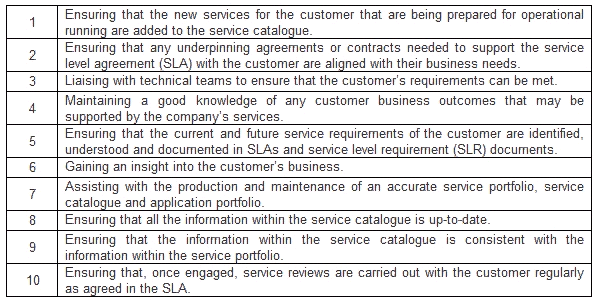
Which one of the following options CORRECTLY assigns the responsibilities to the service level manager, service catalogue manager and the business relationship manager?

Responsibilities:

Show Answer Hide Answer
Correct Answer: D

Question No. 5

Scenario

A large, privately owned company has an internal IT organization that runs most of its IT operations from the head office. There has been a history of confusion about what is required from the services and what has actually been achieved, particularly from a warranty perspective. This has resulted in a strained relationship between the business units and the IT organization.

Some service-based agreements exist between IT and the customers, where all levels of response to incidents were set to the same targets. Availability targets have not been reviewed for at least two years. There have been a number of complaints by key customers claiming that the IT staff have been resolving incidents and implementing change requests based on operational ease rather than business priority. This is despite operationally robust processes being in place for incident, change and problem management.

A plan has been put in place to improve the level of the IT service delivered to the organization.

Retirement of the post-holder meant that the first action was to appoint a new IT director. The opportunity was taken to select a candidate from an external organization, who was committed to the ITIL framework. The new IT director believes that good IT service management practices are essential.

The IT director plans to implement many of the service management processes and has already overseen the creation of a basic service catalogue. The IT director is sure that many of the current issues can be rectified through the implementation of service level management (SLM) and has therefore directed that service level agreements (SLA) be introduced for the services provided before moving onto other areas. You have been asked to lead the project to establish SLAs for the IT services.

Refer to the Scenario.

Which one of the following sequence of activities would be the BEST approach to establishing service levels agreements (SLA) in the organization?

Show Answer Hide Answer
Correct Answer: A

Unlock All Questions for PeopleCert ITIL-SOA Exam

Full Exam Access, Actual Exam Questions, Validated Answers, Anytime Anywhere, No Download Limits, No Practice Limits

Get All 14 Questions & Answers