The Salesforce Analytics-DA-201 exam belongs to the Salesforce Data Analyst Certifications track and leads to the Salesforce Certified Tableau Data Analyst credential. It is designed for candidates who work with data, dashboards, and analytics in Tableau and want to prove their ability to prepare, explore, and present data effectively. This certification matters because it validates practical skills that are useful for turning raw data into clear business insights. If you are preparing for a data analyst role or strengthening your Tableau knowledge, this exam is an important milestone.
| # | Exam Topics | Sub-Topics | Approximate Weightage (%) |
|---|---|---|---|
| 1 | Connect To and Transform Data | Data connections, data source setup, joins and unions, basic data cleaning and shaping | 30% |
| 2 | Explore and Analyze Data | Field selection, aggregations, filtering, sorting, identifying trends and patterns | 30% |
| 3 | Create Content | Worksheets, dashboards, visual design, chart selection, formatting and interactivity | 25% |
| 4 | Publish and Manage Content on Tableau Server and Tableau Cloud | Publishing workbooks, permissions, sharing, content management, refresh and access basics | 15% |
This exam tests both conceptual understanding and hands-on Tableau skills. Candidates must be able to connect to data, transform it for analysis, create useful visual content, and manage published content in Tableau environments. Success depends on practical ability, attention to detail, and familiarity with common analytics workflows rather than memorizing theory alone.
QA4Exam.com offers Exam PDF content with actual questions and answers, plus an Online Practice Test for the Salesforce Analytics-DA-201 exam. These resources help you study with up-to-date questions, verified answers, and a format that mirrors the real exam experience. The practice test also helps you improve time management and get comfortable with the question style before test day. With focused preparation and realistic exam simulation, you can approach the Salesforce Certified Tableau Data Analyst exam with more confidence. This makes it easier to target a first-attempt pass.
This exam is for candidates pursuing the Salesforce Certified Tableau Data Analyst certification and for people who want to prove their Tableau data analysis skills.
It can be challenging if you are not familiar with Tableau workflows, data preparation, and content creation. With focused practice, it becomes much more manageable.
Braindumps alone are not the best preparation method. You should also understand the concepts and practice the skills so you can answer questions confidently in different formats.
Hands-on experience is very helpful because the exam focuses on practical tasks like connecting data, analyzing it, creating content, and managing published assets.
They are strong preparation tools because they provide actual questions and answers, verified content, and exam-style practice. Using them consistently can improve your chances of passing on the first attempt.
QA4Exam.com provides an Exam PDF and an Online Practice Test. The PDF helps with study and review, while the practice test helps you simulate the exam, manage time, and check your readiness.
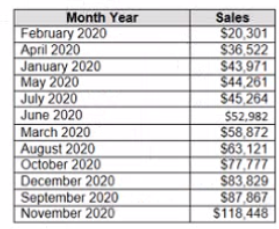
A Data Analyst has a dataset that contains the fallowing rows of sales data.

The analyst needs to return a value of TRUE if a month has sales greater than $50,000; otherwise, the formula must return a value of FALSE.
Which two formulas achieve this goal? (Choose two.)
SIMULATION
Open the link to Book1 found on the desktop. Open Disciplines worksheet.
Filter the table to show the members of the Top10 set and the members of the Bottom10 set. There should be a total of 20 rows.

To filter the table to show the members of the Top10 set and the Bottom10 set, you need to do the following steps:
Open the link to Book1 found on the desktop. This will open the Tableau workbook that contains the Disciplines worksheet.
Click on the Disciplines tab at the bottom of the workbook to open the worksheet. You will see a table that shows the disciplines, sales, and profit for each salesperson.
Click on the drop-down arrow next to Salesperson on the Filters shelf. This will open a menu that allows you to filter by different criteria.
Select Set from the menu. This will show you the sets that are available for the Salesperson field. You will see Top10 and Bottom10 as two sets that have been created based on the sales ranking.
Check the boxes next to Top10 and Bottom10. This will filter the table to show only the members of these two sets. You can also click on All to deselect all other values.
Click OK to apply the filter. You will see that the table now shows 20 rows, 10 for each set.
A Data Analyst has a website that displays data in a table format.
The analyst wants to connect to the data of the website by using the least amount of effort.
What should the analyst use to connect to the data?
You have the following primary data source that contains a dimension named Dorm_Code.

You receive the following secondary data source that contains updated dorm codes.

You need to bring the updated dorm codes into Tableau and use the codes in existing visualizations. The new dorm codes must use the existing field name of Dorm_Code.
What should you do?
Using relationships: You can use relationships to link the secondary data source with the primary data source based on a common field. This will allow you to use fields from both data sources in your visualization without creating new fields or duplicating data. You can then replace references to update the dimension values. For example, you can use relationships to link the updated dorm codes with the primary data source and then replace Dorm_Code with Dorm_Code_New in your visualization.
https://community.tableau.com/s/question/0D54T00000C5ldZSAR/update-data-view-based-on-dimension
To update existing visualizations with new codes without changing the field name, using relationships to bring in the secondary data source is appropriate. Then using Replace Reference allows you to update the references from the old dorm codes to the new ones while maintaining the existing field name.
A Data Analyst has the following chart that shows the sum of sales made in different cities.

The analyst wants to show the average sale amount for a city when users hover their mouse over any of the bars.
What should the analyst do?
Full Exam Access, Actual Exam Questions, Validated Answers, Anytime Anywhere, No Download Limits, No Practice Limits
Get All 174 Questions & Answers