Limited-Time Offer: Enjoy 50% Savings! - Ends In 0d 00h 00m 00s Coupon code: 50OFF
Welcome to QA4Exam
Logo

- Trusted Worldwide Questions & Answers

Most Recent The Open Group OGA-032 Exam Dumps


Prepare for the The Open Group ArchiMate 3 Part 2 Exam exam with our extensive collection of questions and answers. These practice Q&A are updated according to the latest syllabus, providing you with the tools needed to review and test your knowledge.

QA4Exam focus on the latest syllabus and exam objectives, our practice Q&A are designed to help you identify key topics and solidify your understanding. By focusing on the core curriculum, These Questions & Answers helps you cover all the essential topics, ensuring you're well-prepared for every section of the exam. Each question comes with a detailed explanation, offering valuable insights and helping you to learn from your mistakes. Whether you're looking to assess your progress or dive deeper into complex topics, our updated Q&A will provide the support you need to confidently approach the The Open Group OGA-032 exam and achieve success.

The questions for OGA-032 were last updated on Apr 21, 2026.
  • Viewing page 1 out of 2 pages.
  • Viewing questions 1-5 out of 12 questions
Get All 12 Questions & Answers
Question No. 1

Please read this scenario prior to answering the question

ArchiSurance has decided to leverage its financial expertise by offering defined contribution retirement plans. Each trading day, ArchiSurance submits consolidated mutual fund trading transactions to a stock exchange on behalf of its retirement

plan participants.

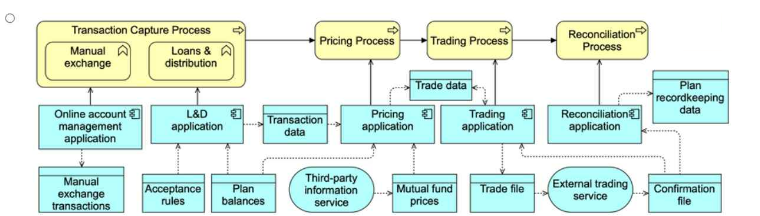
The daily mutual fund trading cycle consists of four key processes: Transaction capture, pricing, trading and reconciliation. Transaction capture consists of two sub-processes: manual exchange and loans and distributions (L&D). For transaction

capture, retirement plan participants use an online account management application to enter manual fund exchange transactions. For L&D, plan participants use a separate application to enter requests. The L&D application determines whether

the request can be fulfilled based on the mutual fund balances held in each plan balances and a set of business rules. Each day's captured manual exchange transactions accumulate in a transaction database.

ArchiSurance contracts with a third-party information service to receive a file of mutual fund prices at the close of each trading day. The pricing application uses this file to convert captured transaction into trades, and then validates each trade

against the mutual fund balances held in each plan. The pricing application generates a trade file with the minimum number of trades necessary. The trading application sends this file to an external trading service. When the trading application

receives a confirmation file back from the trading service, it causes the reconciliation application to update the plan recordkeeping database.

The account management and L&D applications are hosted on separate application server clusters. Each cluster is a physically separate host that runs application server software on a set of virtualized hosts. All of these applications use a

database server infrastructure that is hosted on another separate cluster of virtualized servers also on a dedicated physical host. The pricing, consolidation, trading and reconciliation applications, however, are batch applications that run on the

ArchiSurance mainframe computer. All application hosts are connected via a converged data center network (DCN), which also connects them to a storage area network (SAN) as well as a wide area network (WAN) that is used to communicate

with the external trading service. The SAN includes two physically separate storage arrays, one of which holds data for all databases, and another that holds data for all files.

Refer to the Scenario

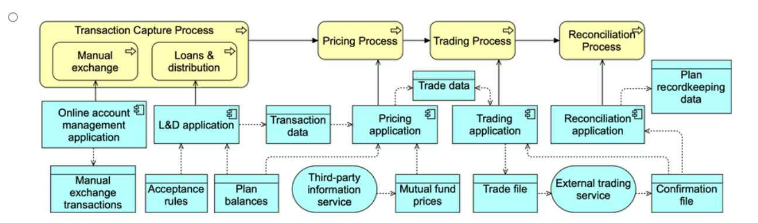
The systems analysts would like to better understand the business processes and applications for daily fund trading. You have been asked to describe the business processes and sub-processes, the applications that they use, the data objects

accessed by those applications, and the external application services that access some of those data objects.

Which of the following is the best answer? Note that you are not required to model the business actors/roles.

A.

B.

C.

D.

Show Answer Hide Answer
Correct Answer: B

In this scenario, the goal is to model the business processes, their sub-processes, the applications supporting these processes, and the data objects these applications access. Additionally, external services that access some of these data objects need to be shown. This includes capturing the key processes and their dependencies, as well as understanding how the applications interact with data and external services.

Key ArchiMate 3.2 Concepts Applied:

Business Processes and Sub-Processes:

Transaction Capture Process: Consists of two sub-processes:

Manual Exchange

Loans & Distribution (L&D) This process is responsible for capturing transactions from users through different applications (Online Account Management, L&D Application).

Pricing Process: This process uses the Mutual Fund Prices from a third-party service and the Plan Balances to validate and price trades.

Trading Process: This process generates a Trade File and interacts with an external Trading Service.

Reconciliation Process: This final process updates the Plan Recordkeeping Data after confirming trades from the External Trading Service.

Applications and Data:

Online Account Management Application and L&D Application: These capture user inputs for transactions and maintain Transaction Data and Plan Balances.

Pricing Application: Uses Mutual Fund Prices and Transaction Data to generate Trade Data.

Trading Application: Submits Trade Data and receives a Confirmation File from the external Trading Service.

Reconciliation Application: Uses the Confirmation File to update Plan Recordkeeping Data.

External Application Services:

Third-Party Information Service: Provides Mutual Fund Prices.

External Trading Service: Processes trades and returns a Confirmation File.

Data Objects:

Transaction Data: Captured by the transaction capture processes.

Mutual Fund Prices: Received from the third-party service.

Trade Data: Generated by the pricing and trading applications.

Plan Recordkeeping Data: Updated by the reconciliation process after trade confirmation.

Why Option B is Correct:

Option B provides the most complete and accurate representation of the scenario. It captures the business processes (Transaction Capture, Pricing, Trading, Reconciliation) and their sub-processes, while showing the appropriate connections to the applications that support these processes.

It clearly depicts the data objects (Transaction Data, Plan Balances, Trade File, Mutual Fund Prices, Plan Recordkeeping Data) and their flows between the processes and applications.

The model also includes the external services (Third-Party Information Service and External Trading Service), showing how these interact with the internal applications and data objects.

It accurately represents the flow of Trade Data from the Pricing Application to the Trading Application, and the use of Mutual Fund Prices by the Pricing Process.

Why Other Options Are Incorrect:

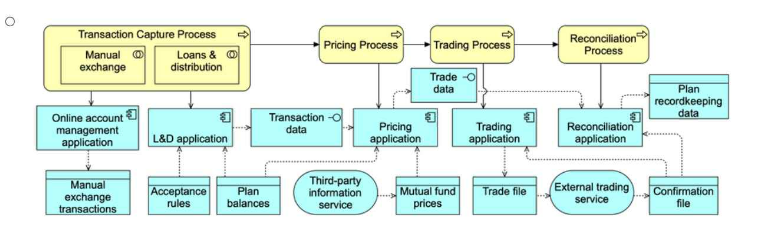
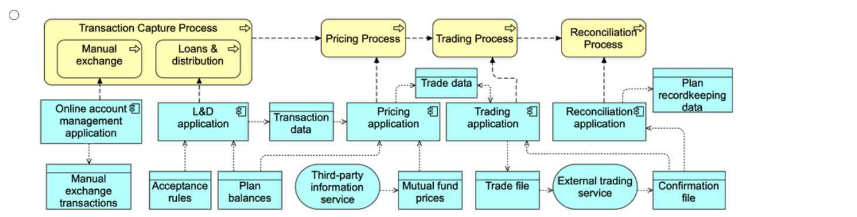
Option A and Option D miss some critical connections between the applications and the external services. They also lack clarity in how the data flows between the processes and applications.

Option C does not adequately represent the interaction between the applications and the external services (e.g., Third-Party Information Service), which is a key requirement in this scenario.

Conclusion:

Option B provides the best and most accurate description of the business processes, applications, data objects, and external services involved in ArchiSurance's daily fund trading operations, following ArchiMate 3.2 standards for modeling business processes and applications.


Question No. 2

Please read this scenario prior to answering the question

ArchiCar is a specialized company that focuses on manufacturing luxury electric cars and powertrain components, along with producing battery-charging equipment. With its own distribution network and showrooms, ArchiCar adopts a direct-to-

customer sales model through online channels.

The manufacturing of ArchiCar's electric cars is carried out on fully automated assembly lines. Leveraging a cutting-edge manufacturing process, the company boasts an impressive ability to sell and deliver a vehicle within just one month from the

time of order placement. Anticipating significant growth, the CEO has set ambitious plans to increase annual production from 100,000 to 500,000 vehicles within a three-year timeframe.

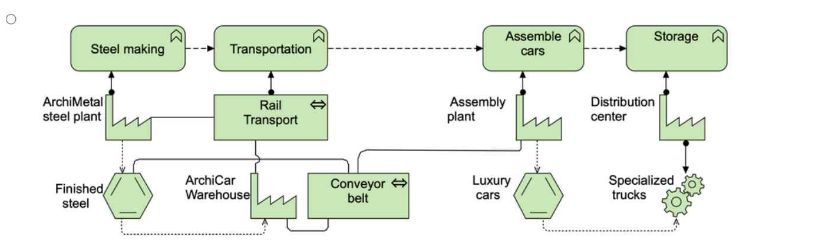
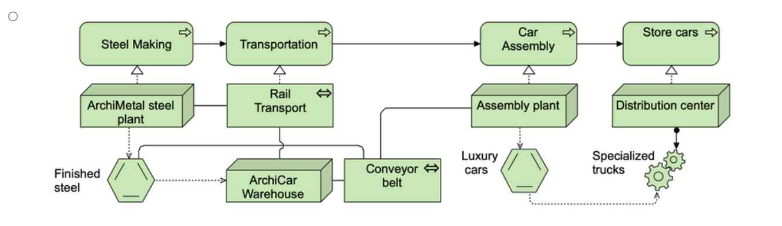
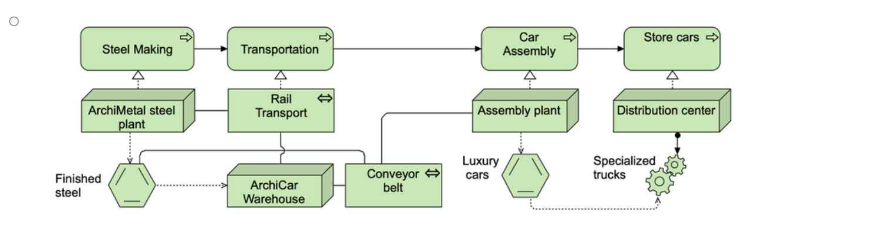
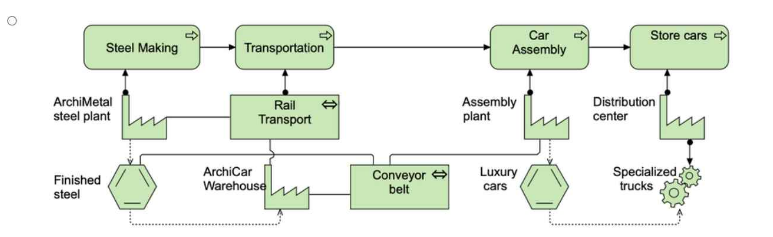
To ensure the highest quality standards, ArchiCar relies on locally manufactured finished steel from the renowned ArchiMetal plant. ArchiMetal specializes in lightweight steels that allow ArchiCar to achieve a reduced vehicle weight without

compromising strength and crash performance. The finished steel is efficiently transported by rail to ArchiCar's production plant, where it is stored in a dedicated warehouse until required for the automated car assembly process. Conveyor belts

facilitate the seamless transfer of the finished steel from the warehouse to the assembly plant.

At the ArchiCar assembly plant, an optimized and streamlined assembly process is implemented, resulting in the production of 12 vehicles per hour. Once assembled, the cars are transported to a nearby distribution center using specialized trucks.

These vehicles are then stored at the distribution center until they are ready for delivery to their eagerly awaiting new owners.

Refer to the Scenario

You are a consultant to the CIO. She has asked you to illustrate the end-to-end technology processes at ArchiCar from raw materials to assembled cars ready for delivery.

Which of the following answers provides the best description?

A.

B.

C.

D.

Show Answer Hide Answer
Correct Answer: D

In this scenario, the task is to model the end-to-end technology processes at ArchiCar, showing how raw materials (finished steel) are processed through the company's manufacturing, transportation, and distribution system, ultimately resulting in fully assembled cars ready for delivery.

Key ArchiMate 3.2 Concepts Applied:

Business Processes:

Steel Making: ArchiMetal manufactures finished steel, a key raw material for ArchiCar's production.

Transportation: The finished steel is transported by rail from the ArchiMetal steel plant to ArchiCar's warehouse.

Storage: The finished steel is stored in the ArchiCar Warehouse until it is required for the assembly process.

Car Assembly: The conveyor belt moves the steel from the warehouse to the assembly plant, where cars are assembled on automated lines.

Transportation (Specialized Trucks): Once assembled, the cars are transported to a distribution center using specialized trucks.

Storage (Distribution Center): The finished cars are stored in the distribution center, awaiting delivery to customers.

Application and Technology Components:

Conveyor Belt: The transfer of finished steel between the warehouse and assembly plant is automated via the conveyor belt.

Rail Transport and Specialized Trucks: Rail transport handles the movement of steel, and specialized trucks are used for car transportation to the distribution center.

End-to-End Flow:

The model needs to clearly depict the full process flow from the production of steel, through its transportation and storage, to the automated assembly of luxury cars and their eventual transportation to the distribution center.

The relationships between processes (e.g., steel making, transportation, car assembly, and storage) must be clear and follow the logical flow of operations.

Why Option D is Correct:

Option D provides a clear and accurate representation of the end-to-end process as described in the scenario.

It begins with the steel-making process at the ArchiMetal steel plant and follows through with the transportation of the finished steel to the warehouse by rail transport.

The process of moving steel via the conveyor belt from the warehouse to the assembly plant for car manufacturing is clearly depicted.

Once cars are assembled, they are transported to the distribution center using specialized trucks and are then stored until delivery, completing the end-to-end flow.

The relationships between processes and supporting components (e.g., conveyor belt, transportation methods) are clearly illustrated, following ArchiMate standards.

Why Other Options Are Incorrect:

Option A is incorrect because it misses some key elements of the process. It does not fully clarify the role of the warehouse or how the finished steel is transported between locations.

Option B misrepresents the process flow, particularly the storage and assembly process. The connection between steel production and car assembly is not as clearly illustrated.

Option C also lacks clarity in how the finished steel is moved from the warehouse to the assembly plant, and it does not accurately capture the flow of transportation and storage after car assembly.

Conclusion:

Option D is the best answer because it provides the most complete and clear description of the end-to-end technology processes at ArchiCar, from raw materials (finished steel) to assembled luxury cars ready for delivery. It aligns well with the scenario and adheres to ArchiMate 3.2 modeling standards, showing all necessary relationships between business processes and supporting components.


Question No. 3

Please read this scenario prior to answering the question

The IT Operations (IT Ops) department at ArchiSurance has five core responsibilities, each encompassing a dedicated business process: (1) Batch Operations (Batch Ops), (2) Online Operations (Online Ops), (3) Security Operations (Security

Ops), (4) User Support and (5) Continuous Improvement. Service level agreements (SLAs) are in place for Batch Ops and Online Ops, and each Ops process generates monitoring data that is utilized by the Continuous Improvement process.

The System Ops category consists of Batch Ops, Online Ops, and Security Ops, each having an incident management sub-process. These sub-processes are triggered by Batch, Online, and Security Incidents, respectively. In the initial stages of

the incident management sub-processes, an Incident Alert is shared with the other System Ops processes by posting it to the Alert Buffer.

Batch Ops relies on a schedule that outlines all batch jobs and their dependencies. This schedule serves two sub-processes: Batch Planning, which updates the schedule for use by the Execution Management sub-process.

The Batch Ops process relies on a suite of interconnected applications to facilitate its operations. Among these applications, the Batch Scheduler plays a vital role by allowing users to manage a comprehensive database of jobs, job schedules, and

dependencies. It effectively launches batch jobs according to the information stored in the database.

Working in conjunction with the Batch Scheduler, the Batch Monitor application utilizes the job schedules as a reference point to monitor job execution. It identifies any exceptional conditions that may arise during the execution process. To ensure

effective handling of these exceptions, the Batch Monitor communicates the information to both the Batch Scheduler and the Incident Handler applications through the previously mentioned Alert Buffer.

The Incident Handler application operates based on a defined set of business rules. It uses these rules to determine the relevant systems and individuals that need to be notified in the event of each incident. Subsequently, the Incident Handler

application generates appropriate notifications according to these determinations.

Recognizing the criticality of the Batch Scheduler, Batch Monitor, and Incident Handler applications, ArchiSurance has implemented redundant hosting arrangements across multiple geographically distributed data centers. In each data center,

these three applications are supported by fully redundant virtual server clusters. Each cluster is connected to two site local area networks, both of which are further linked to separate storage array hardware devices.

Refer to the scenario

As part of an IT service management initiative, you have been assigned the task to show how applications and technology support the Batch Ops process. This should show the relationships between the applications, their functions, the data

they access, and the technology that hosts the applications and data, along with the networks that connect the servers. It is only necessary to model a single data center.

Which of the following answers provides the most complete and accurate model?

A.

B.

C.

D.

Show Answer Hide Answer
Correct Answer: C

The correct answer is C as it provides the most complete and accurate model according to the ArchiMate 3 framework and the given scenario.

Here's why:

Business Processes and Sub-Processes:

Batch Operations (Batch Ops) is one of the core responsibilities in IT Operations, and its processes are modeled clearly. The Batch Scheduler is responsible for managing batch jobs, schedules, and dependencies.

The Batch Monitor is correctly shown to monitor the job execution and notify exceptions using the Alert Buffer.

The Incident Handler is used to notify relevant systems and individuals, triggered by the incident detection from Batch Monitor. This is modeled by the use of incident handling rules and notifications.

Application Layer (Application Components and Functions):

The Batch Scheduler, Batch Monitor, and Incident Handler are accurately depicted as the main applications. These applications are crucial for managing job scheduling, monitoring execution, and handling incidents.

These applications share the same virtual server cluster, which is an important detail reflecting redundancy and high availability, which was mentioned in the scenario.

The interrelationships between applications are accurately depicted: the Batch Scheduler launches jobs, the Batch Monitor checks their status, and Incident Handler deals with exceptions.

Data Access:

The Batch Scheduler accesses and updates batch jobs and schedules, and this is represented clearly.

The Incident data and Incident notifications are accurately modeled as being used by Incident Handler.

Technology Layer:

The Virtual server cluster, Storage arrays, and Site Local Area Networks are appropriately connected to support the application infrastructure.

Redundancy is shown through the use of multiple storage arrays and network connections, as described in the scenario.

Accuracy in Relationship Types (ArchiMate 3) Reference:

The relationships between components are modeled using ArchiMate 3 standards, such as flow relationships between the Batch Monitor and Alert Buffer or between the Incident Handler and storage components.

Triggering relationships exist between the applications that manage batch jobs and the monitoring/notification process, ensuring correct job execution and incident handling.

Conclusion: Answer C is the most complete model, as it accurately reflects the roles of the various applications, their interactions, and the underlying technology components in support of the Batch Ops process, following the guidelines and modeling standards of ArchiMate 3.


Question No. 4

Please read this scenario prior to answering the question

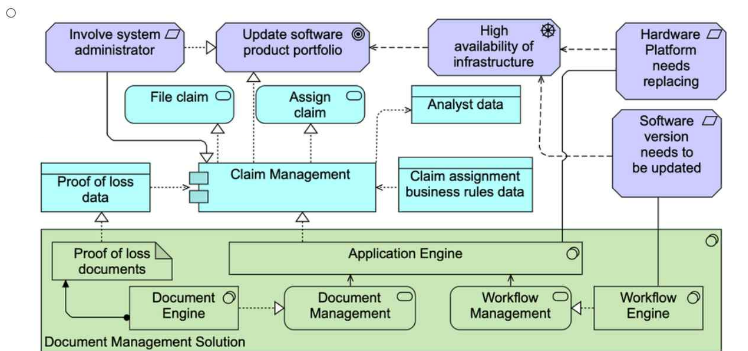
The ArchiSurance enterprise document management solution includes a sophisticated ecosystem of applications and technologies. Designed with a strong emphasis on high availability, it plays a vital role in providing support for a diverse range of

document types and managing a substantial volume of document-based transactions on a daily basis. Recognizing its importance to the business, the document management solution is redundantly hosted at two geographically separate data

center sites, both configured identically for seamless operations.

The system software at the core of the document management solution is comprised of three key modules. The Document Engine serves as a repository, facilitating document storage, retrieval, and various other operations. The Workflow Engine

acts as a host for document management applications, while the Application Engine powers the most advanced and sophisticated applications within the system.

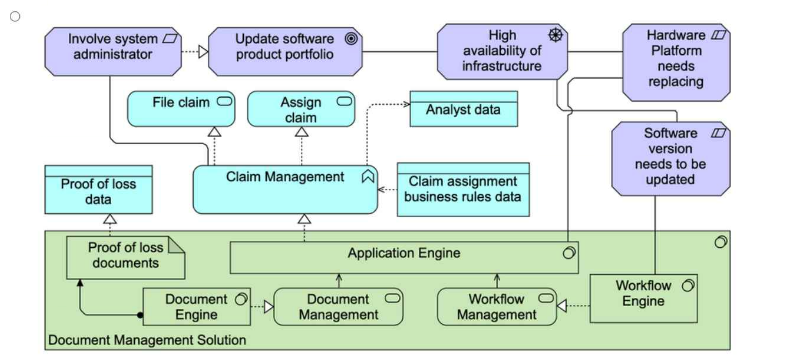
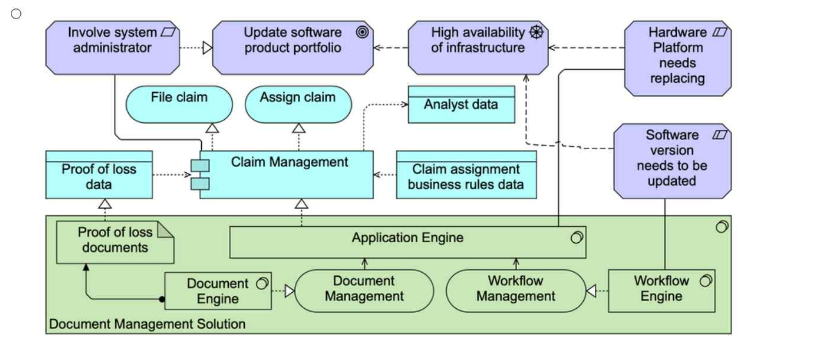
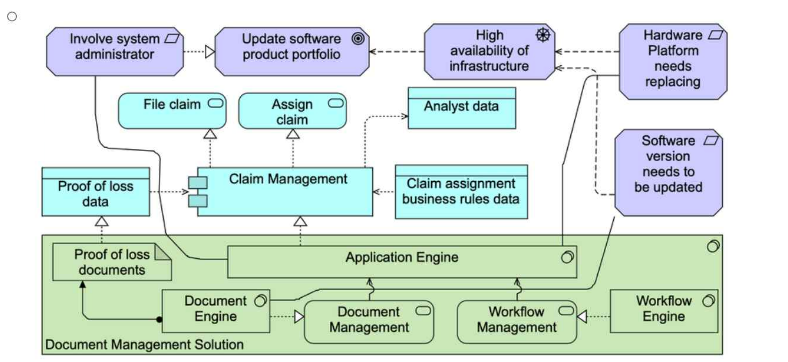
Two key factors have driven the Architecture Board's approval of a project aimed at updating this critical solution. Firstly, the supplier of the Workflow Engine has given notice of the end of support for the current software version, necessitating an

upgrade. Secondly, the system administrator responsible for the Application Engine has flagged the need for hardware replacement on the server where the software is currently running. Given that the Claim Management application shares

infrastructure with the Application Engine, the involvement of the system administrator responsible for this application is crucial in the project planning and execution.

Refer to the Scenario

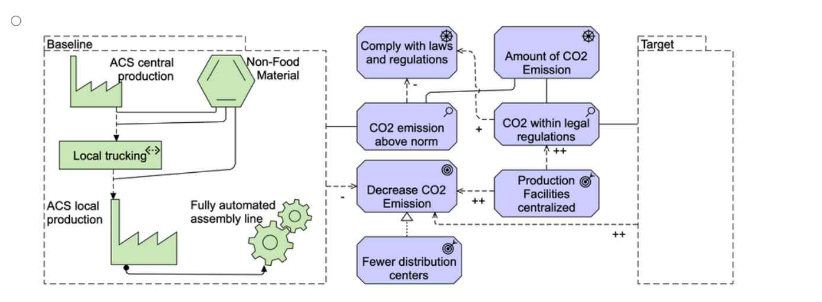
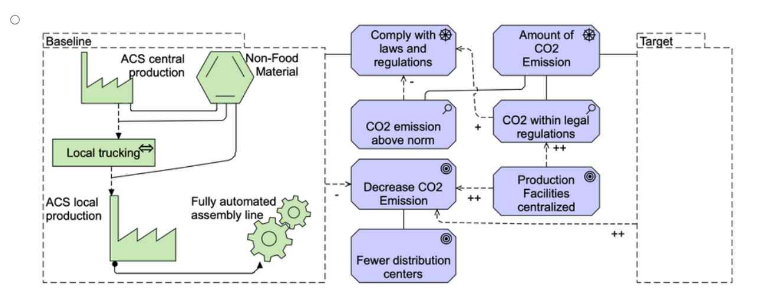
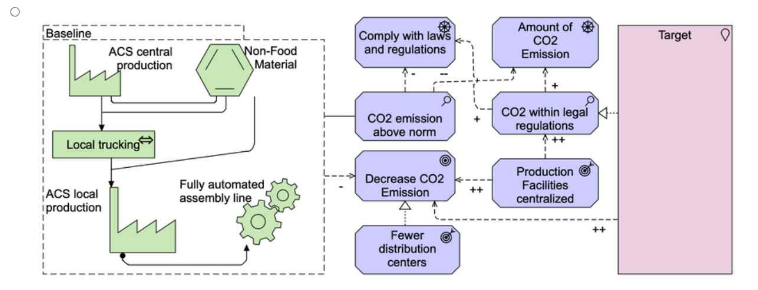
You are the Enterprise Architect within this organization. You have been assigned the task of modeling the applications and technology for this solution, as well as outlining the motivations driving the need for its update.

Based on the scenario, which answer provides the most complete and accurate description?

A.
B.
C.
D.
Show Answer Hide Answer
Correct Answer: D

This scenario revolves around ArchiSurance's document management solution and the motivations behind updating the solution due to software and hardware challenges. The task is to model both the applications and technology components involved, along with the motivations driving the need for an update.

Key ArchiMate 3.2 Concepts Applied:

Applications and Components:

Claim Management Application: This application handles key processes such as filing claims and assigning claims, and it shares infrastructure with the Application Engine.

Document Management Solution: Includes several subsystems such as:

Document Engine: Manages document storage, retrieval, and processing operations.

Workflow Engine: Facilitates document workflows and supports document-related operations.

Application Engine: Hosts sophisticated applications like Claim Management.

Data Objects:

Proof of Loss Documents and Proof of Loss Data are critical components managed by the Document Management Solution. This data is processed and handled by both the Document Engine and the Claim Management application.

Technology and Infrastructure:

Hardware Platform Needs Replacing: The Application Engine runs on hardware that needs replacement. This drives a part of the motivation for updating the infrastructure.

Software Version Needs to Be Updated: The Workflow Engine is running on outdated software, necessitating an upgrade to ensure continued support and functionality.

High Availability of Infrastructure: Given that the system is redundantly hosted across two data centers, high availability is crucial for seamless operations. This includes continuous availability for the document management processes.

Motivations and Drivers:

The end-of-support notice from the Workflow Engine supplier requires an upgrade to maintain operational continuity.

The system administrator responsible for the Application Engine has raised concerns about hardware needing replacement, adding urgency to the infrastructure upgrade.

Why Option D is Correct:

Option D provides the most comprehensive representation of the applications, infrastructure, and motivations for updating the solution.

It clearly shows the Claim Management Application and its interaction with the Claim Assignment Business Rules Data, as well as how it relies on the Application Engine.

The Document Management Solution and its subsystems (Document Engine, Workflow Engine, and Application Engine) are correctly depicted, with clear relationships to the data they manage (Proof of Loss Documents and Data).

The motivations for change---specifically, the need to update the Workflow Engine software and replace the hardware platform---are clearly shown, alongside their impact on the overall system.

The diagram shows the involvement of the system administrator in the update process, which is important for ensuring smooth project execution.

Why Other Options Are Incorrect:

Option A and Option B do not accurately capture all necessary relationships, particularly the connections between the Claim Management application and its reliance on the Application Engine infrastructure. They also miss some of the drivers related to the required hardware replacement.

Option C omits some key details regarding how the Claim Management Application and Document Management Solution components interact with the system, particularly the Claim Assignment Business Rules Data and Proof of Loss Data.

Conclusion:

Option D is the best answer because it offers the most complete and accurate representation of the applications, technology infrastructure, and drivers for the update project. It clearly illustrates how the Claim Management and Document Management systems work together, along with the necessary infrastructure updates, in line with ArchiMate 3.2 modeling standards.
Question No. 5

Please read this scenario prior to answering the question

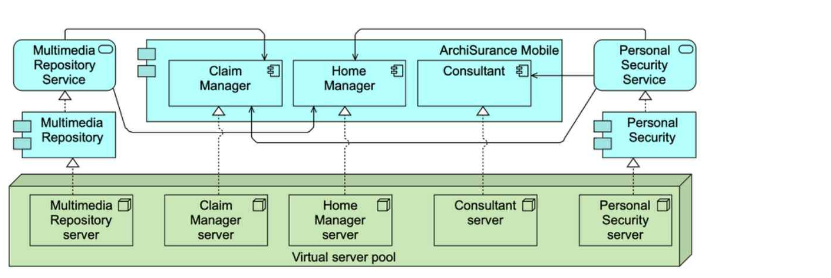
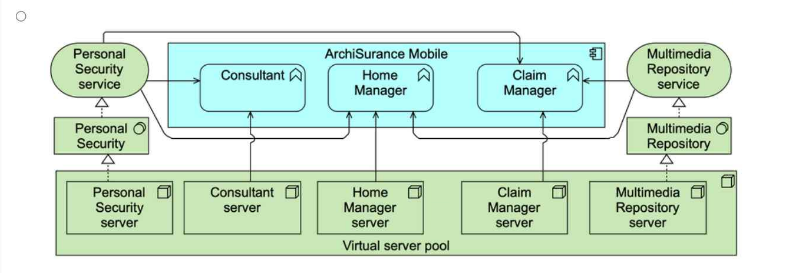
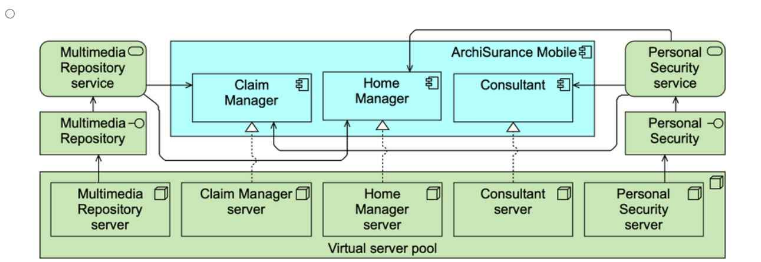
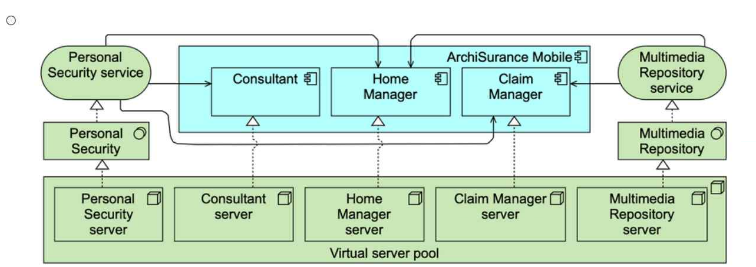
The ArchiSurance Mobile consumer solution is used for selling and renewing insurance products, providing customer service, enabling accurate and convenient home recordkeeping, and capturing and processing claims. The solution consists of

three applications. The Consultant application lets customers review their existing coverage, and update it based on common life events, such as getting a new car, moving into a new home, or having a family member move in or out. If necessary,

they can speak or chat with a customer service representative. The Home Manager application helps customers photograph and catalogue their valuable possessions in order to support the filing of accurate claims in case of loss or damage. The

Claim Manager application enables customers to quickly file a claim for loss or damage to an insured auto, home or possession. It enables customers to describe the incident by referencing information captured with the Consultant and the Home

Manager applications. In addition, it allows the customer to add photographs, audio, video and text to support a claim, submit the claim, and monitor its progress.

The ArchiSurance Mobile applications rely on a number of application services hosted by ArchiSurance. The first is an Auto Identification and Description (AID) service that the Consultant application uses to validate and complete auto information

entered by customers. The second service, Home Identification and Description (HID) performs the same function for home information, and is used by the Home Manager application. The Consultant application also uses the Virtual Agent

service to guide customers as they select coverage options, the Payment Processor service to arrange premium payments, and the Coverage Activator service to generate policies and put them in force.

ArchiSurance Mobile also relies on a number of technology services. The Home Manager application uses a Multimedia Repository service to store and retrieve information about insured homes. The Claim Manager application also uses this

service for claim information entered by customers. All three ArchiSurance Mobile applications use a Personal Security service to register and authenticate customers, and to manage their profiles.

Each application service is realized by an application component with the same name. Each technology service is realized by a system software environment, having the same name. ArchiSurance hosts both the application components and

system software environments in a virtualized server pool within its data center. Each service has its own virtual server. Each virtual server is connected to a data center network (DCN) which in turn connects to a commercial wide area network

(WAN).

Refer to the Scenario

You have been asked to show the applications that make up the ArchiSurance Mobile solution and the technology that supports these applications.

Which of the following answers provides the best description? Note that it is not necessary to model the networks.

A.

B.

C.

D.

Show Answer Hide Answer
Correct Answer: C

In this scenario, the focus is on modeling the ArchiSurance Mobile solution, showing the applications that make up this solution and the technology infrastructure that supports them. This includes applications, application services, and the system software environments (technology services) upon which the applications rely.

Key ArchiMate 3.2 Concepts Applied:

Application Components and Services:

Consultant Application: This allows customers to review, update coverage, and speak with customer service representatives. It uses the following application services:

Auto Identification and Description (AID) for validating auto information.

Virtual Agent for helping customers select options.

Payment Processor to arrange payments.

Coverage Activator to generate and activate policies.

Home Manager Application: This allows customers to catalogue possessions and use the Home Identification and Description (HID) service to validate home information.

Claim Manager Application: Enables filing of claims, referencing data from the Consultant and Home Manager applications and storing information (such as photos, videos) via the Multimedia Repository.

Technology Services:

Personal Security Service: Used for customer registration, authentication, and profile management across all three applications.

Multimedia Repository Service: Used to store and retrieve information related to home possessions and claim details, supporting both the Home Manager and Claim Manager applications.

Technology Infrastructure:

Each application component (Consultant, Home Manager, Claim Manager) is hosted on its own virtual server within a virtualized server pool.

Each technology service is realized by a corresponding system software environment (e.g., Multimedia Repository, Personal Security), each with its own virtual server.

The infrastructure is hosted in a data center, but the focus here is on the services rather than the network connections.

Why Option C is Correct:

Option C accurately represents the key applications (Consultant, Home Manager, Claim Manager) in connection with the appropriate technology services and their respective virtual servers.

The model shows the relationships between the applications and their dependencies on Personal Security and Multimedia Repository, aligning with the description provided.

The virtual server pool is depicted clearly, showing how the applications and services are realized within this infrastructure.

The relationships between applications and application services (AID, HID, Virtual Agent, Payment Processor, Coverage Activator) are not modeled in full detail here, but they are implicitly understood through the applications.

Why Other Options Are Incorrect:

Option A and Option D both incorrectly depict some relationships between the applications and their supporting technology services or servers, or miss certain dependencies.

Option B does not provide as clear a depiction of the virtualized infrastructure and how the applications relate to the Multimedia Repository and Personal Security services.

Conclusion:

Option C provides the most accurate and complete description of the ArchiSurance Mobile solution and the supporting technology, as required by the scenario. It correctly illustrates the relationships between the applications, the virtual servers, and the supporting technology services according to ArchiMate 3.2 principles.


Unlock All Questions for The Open Group OGA-032 Exam

Full Exam Access, Actual Exam Questions, Validated Answers, Anytime Anywhere, No Download Limits, No Practice Limits

Get All 12 Questions & Answers