Question 1
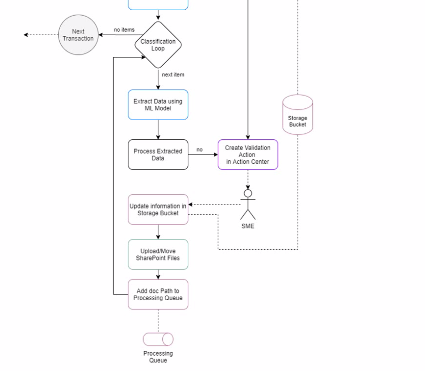
What type of automation is recommended for the following high-level solution diagram?
Correct answer:
D

Exam dumps demo
Preview page 1 of 30 with real questions 1 to 5 from the full 151-question UiPath set.
The UiPath UiPath-ASAPv1 - UiPath Automation Solution Architect Professional v1.0 Exam is part of the UiPath Certified Professional Automation Solution Architect Professional certification track. It is designed for professionals who want to validate their ability to design, build, test, deploy, and manage automation solutions using UiPath. This certification matters because it reflects practical solution architect knowledge that can support real automation projects and enterprise delivery.
For candidates aiming to prove advanced UiPath expertise, this exam is an important step toward demonstrating both technical understanding and solution design capability. It focuses on core platform knowledge and the ability to apply it in structured, reliable automation environments.
| # | Exam Topics | Sub-Topics | Approximate Weightage (%) |
|---|---|---|---|
| 1 | UiPath Studio Fundamentals | Studio interface and project setup, workflow basics, variables and arguments, packages and dependencies | 20% |
| 2 | Design and Development | Solution design principles, workflow structuring, reusable components, best practices for maintainability | 25% |
| 3 | UiPath Activities | Core automation activities, data handling, control flow activities, integrating common automation actions | 20% |
| 4 | Debugging and Testing | Debugging tools, error handling, test execution, validating workflow behavior and results | 20% |
| 5 | Deployment and Management | Publishing and deployment, environment management, orchestration basics, monitoring and maintenance | 15% |
This exam tests more than memorization. Candidates need a solid understanding of UiPath Studio, solution design, common activities, debugging methods, and deployment concepts. It also checks practical ability to choose the right approach for automation scenarios and manage solutions with an architect-level mindset.
What type of automation is recommended for the following high-level solution diagram?
Given the blowing diagram how on the process be optimized from the steps perspective?
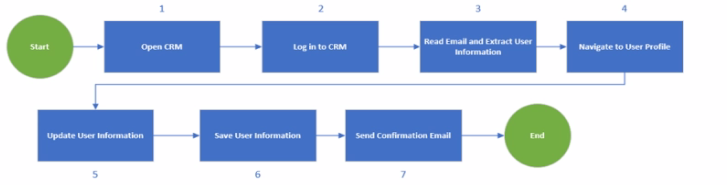
The process shown in the diagram can be optimized by reading the email as the first step and opening CRM and logging in only if there's an email. This way, the process can avoid unnecessary steps and save time and resources. If there is no email, the process can end without opening CRM. If there is an email, the process can extract the user information from the email and use it to log in to CRM and navigate to the user profile. This can also reduce the risk of errors and exceptions due to invalid or missing user information. Reading the email as the first step can also help the process to prioritize the emails based on their importance or urgency and handle them accordingly.Reference:
UiPath Process Mining: Use process monitoring and optimization to propel RPA
Optimizing Processes with UiPath Process Mining
Optimization maximum utilisation - UiPath Community Forum
What is the recommended UiPath Studio template to be used for long-running workflows?
Long-running workflows are processes that require logical fragmentation or human intervention (validations, approvals, exception handling) such as invoice processing and performance reviews. UiPath provides a dedicated project template in Studio called Orchestration Process, which enables the use of a set of activities to handle these scenarios. The Orchestration Process template allows the workflow to be suspended and resumed based on certain conditions, such as the completion of a job, a queue item, a form task, or an external task. The template also integrates with UiPath Action Center, which is a feature that enables human intervention in long-running unattended workflows. The Orchestration Process template is the recommended option for designing and developing long-running workflows in UiPath Studio.Reference:
Orchestrator - Working With Long-running Workflows
New Component - Long Running Workflow Template with UiPath Tasks
Long Running Workflow Template for Task Creation - UiPath Marketplace
What is the difference between OCR and UiPath Document Understating?
Optical Character Recognition (OCR) is a foundational technology that converts different types of documents, such as scanned paper documents or PDFs, into editable and searchable data by recognizing text within digital images. UiPath Document Understanding builds upon OCR technology but goes further by not only recognizing text but also understanding the structure, context, and semantics of documents. This enables the extraction of specific information, classification of documents, and interpretation of the document's meaning, facilitating the automation of complex document processing workflows that involve various document types and require contextual understanding.
UiPath Document Understanding Guide: Introduction to Document Understanding
UiPath OCR Activities Guide: OCR Activities
What is the purpose of UiPath Solution Accelerators?
Full exam access, validated answers, and unlimited practice with no download limits.
QA4Exam.com offers the Exam PDF with actual questions and answers plus the Online Practice Test to help you prepare for the UiPath UiPath-ASAPv1 exam efficiently. The practice format gives you a real exam simulation so you can become familiar with question style, pacing, and time management. Our updated questions and verified answers help you focus on the most relevant content and reduce uncertainty before exam day. With both study and practice options, you can strengthen your confidence and improve your chances of passing on the first attempt.
This exam is for professionals who want to validate advanced UiPath solution architecture knowledge within the UiPath Certified Professional Automation Solution Architect Professional track.
Yes, it is designed for candidates with strong knowledge of UiPath Studio, design, development, testing, and deployment concepts. It is more demanding than basic-level exams because it checks practical understanding.
Braindumps alone are not the best approach. You should use them with a proper understanding of the topics and practical UiPath knowledge so you can answer different question styles with confidence.
Hands-on experience is very helpful because the exam focuses on real UiPath concepts and practical application. Working with Studio, activities, debugging, and deployment makes preparation much stronger.
The Exam PDF and Online Practice Test from QA4Exam.com are strong preparation tools, but combining them with study of the exam topics gives you a better chance of success. This helps you build both recall and understanding.
It simulates the exam environment, helps you manage time, and lets you practice with updated questions and verified answers. That combination can improve confidence and readiness for the first attempt.
QA4Exam.com provides an Exam PDF and an Online Practice Test. These formats are built to support study, review, and exam-style practice for the UiPath UiPath-ASAPv1 exam.