Prepare for the WGU Applied Algebra FXO2 PFXP C957 exam with our extensive collection of questions and answers. These practice Q&A are updated according to the latest syllabus, providing you with the tools needed to review and test your knowledge.
QA4Exam focus on the latest syllabus and exam objectives, our practice Q&A are designed to help you identify key topics and solidify your understanding. By focusing on the core curriculum, These Questions & Answers helps you cover all the essential topics, ensuring you're well-prepared for every section of the exam. Each question comes with a detailed explanation, offering valuable insights and helping you to learn from your mistakes. Whether you're looking to assess your progress or dive deeper into complex topics, our updated Q&A will provide the support you need to confidently approach the WGU Applied-Algebra exam and achieve success.
The populations, in thousands, of two towns are shown in the graph, where the horizontal axis measures the time in years.

Which town's population is growing at a faster rate?
This question asks which town's population is growing at a faster rate.
Since both population graphs are straight lines, we compare their slopes.
The slope of a line represents the rate of change:
From the graph:
Town A starts at about thousand people and increases at a rate of about thousand people per year.
Town B starts at about thousand people and increases at a rate of about thousand people per year.
Even though Town A starts with a larger population, the question asks about the growth rate, not the starting population.
Compare the rates:
So Town B is growing faster than Town A.
The graph shows the number of customers visiting a bookstore, where the number of days since the beginning of the month is along the horizontal axis and the number of customers visiting the bookstore each day is along the vertical axis. More customers show up to the store on days when new releases are featured than on other days.

Which days likely featured new releases?
The graph shows customer visits by day.
To determine which days likely featured new releases, we should look for the days with unusually high customer counts.
From the graph:
Day 8 has about customers.
Day 11 also has about customers.
These are the highest values shown on the graph.
Since the problem says more customers show up on days when new releases are featured, the days with the highest customer counts are the most likely new-release days.
Therefore, the correct answer is:
A vehicle is traveling away from a town at a fixed rate. After 1 hours, the vehicle is 200 miles from the town. After 4 hours, the vehicle is 395 miles from the town.
Which function represents the distance, , between the vehicle and the town after hours?
Because the vehicle is traveling away from the town at a fixed rate, the distance can be modeled by a linear function:
where:
and
We are given two points:
and
These mean:
After hour, the vehicle is miles away.
After hours, the vehicle is miles away.
First, find the rate of change:
So the vehicle is moving away from the town at a rate of:
Now the function has the form:
Use the point to find :
Therefore, the function is:
Check using :
The figure shows the graph of , which represents the number of people, , at a gym hours after 7:00 a.m.

How should the concavity between and be interpreted?
The graph represents:
where:
The question asks about the concavity of the graph between:
and
On this interval, the graph is still going upward, so the number of people is increasing.
However, the graph is beginning to flatten as it approaches its highest point. That means the slope is positive, but the slope is getting smaller.
In other words:
This is called concave down behavior. For a concave down graph that is increasing, the correct interpretation is:
Therefore, the correct answer is:
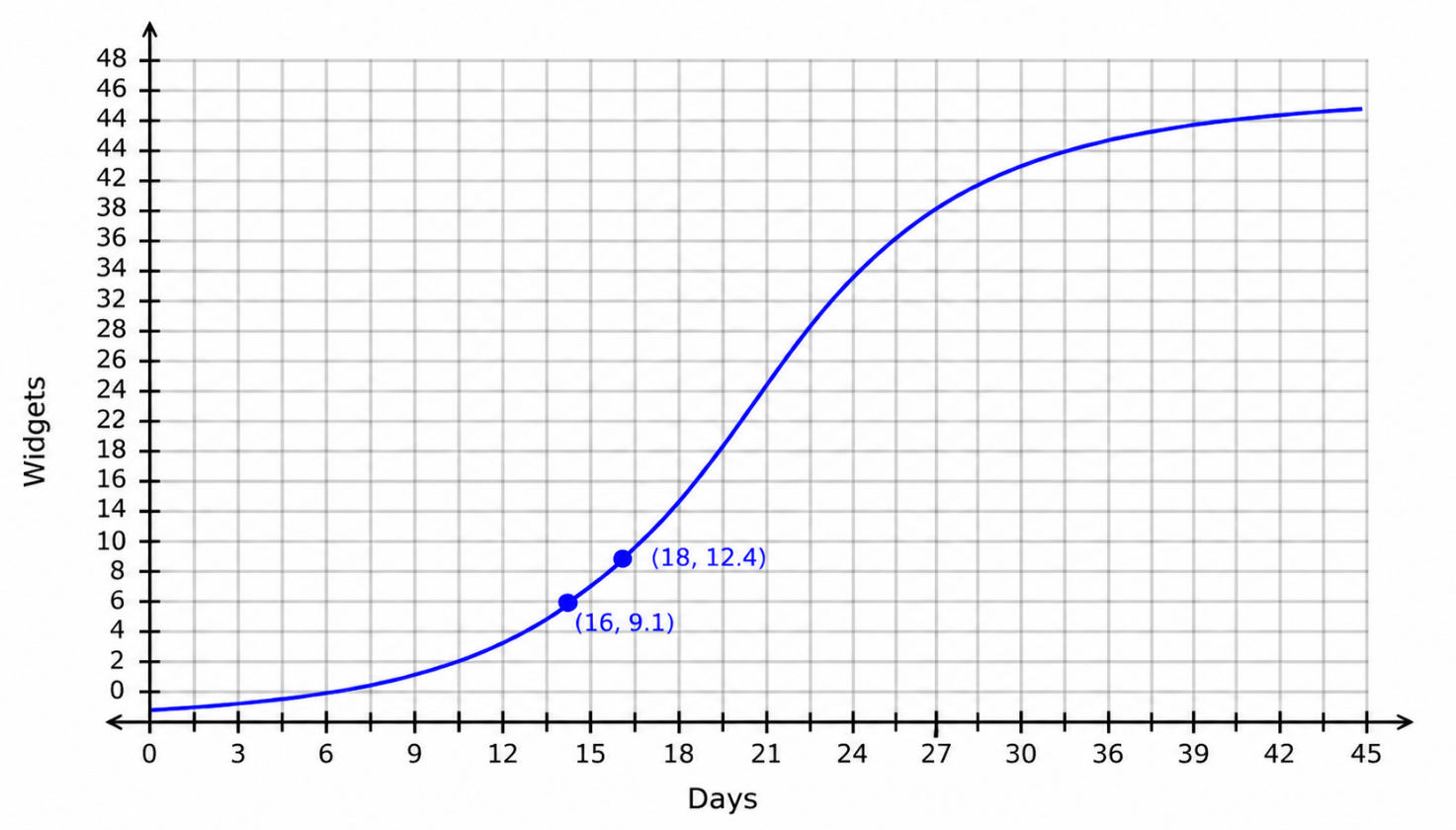
The logistic function , whose graph is shown, models the number of people who have created a website account, where represents the number of days since the website started and represents the number of people who have created an account.

What is one range of values for which the graph is concave down?
For a logistic graph, concavity changes at the inflection point.
Before the inflection point, the graph is usually concave up. This means the function is increasing faster and faster.
After the inflection point, the graph is concave down. This means the function is still increasing, but it is increasing slower and slower.
From the graph, the curve changes concavity around:
After , the graph begins to level off as it approaches its upper limit.
So one interval where the graph is concave down is:
Therefore, the correct answer is:
Full Exam Access, Actual Exam Questions, Validated Answers, Anytime Anywhere, No Download Limits, No Practice Limits
Get All 94 Questions & Answers