Question 1
Select which of the following is not a correct description regarding static context defined by XQuery I 0.
Correct answer:
B

Exam dumps demo
Preview page 1 of 8 with real questions 1 to 5 from the full 39-question XML set.
The XML I10-003 - XML Master Professional Database Administrator exam is part of the XML Master certification track. It is designed for candidates who want to validate their skills in XML database administration, query processing, and schema management. This exam matters for professionals who work with XML data and need proven knowledge to manage, manipulate, and structure XML content effectively.
| # | Exam Topics | Sub-Topics | Approximate Weightage (%) |
|---|---|---|---|
| 1 | Section 1 - Overview | XML database concepts, exam objectives, database administration basics | 20 |
| 2 | Section 2 - XQuery, XPath | XPath navigation, XQuery expressions, filtering and data retrieval | 30 |
| 3 | Section 3 - Manipulating XML Data | Insert, update, delete operations, XML data transformation, query-based modifications | 25 |
| 4 | Section 4 - Creating XML Schema and Other XML Database Objects | XML Schema creation, object definitions, database object management, validation structures | 25 |
The exam tests both conceptual understanding and practical ability across XML database administration tasks. Candidates should be able to work with queries, navigate XML documents, manipulate XML content, and create related schema objects with confidence and accuracy.
Select which of the following is not a correct description regarding static context defined by XQuery I 0.
Select which of the following is not a correct description regarding XML Schema data types or constraint definitions for values using restriction of simple types.
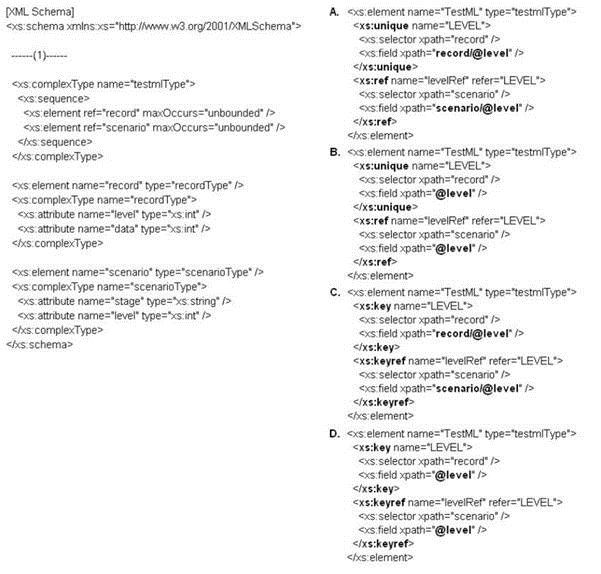
Assume that for [XML Document] referenced in a separate window, you wish to create an XML Schema document that defines that the value of the level attribute of the record element must be unique within the XML document, and further that the level attribute of the scenario element must reference the value of the level attribute of the record element.
[XML Document]
Select which answer correctly belongs in (1) of the [XML Schema] document below.
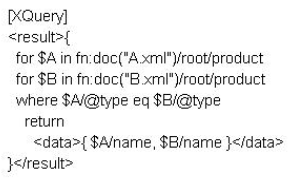
Consider the execution of [XQuery] as referenced in a separate window.
Assume that the following index is used when executing this [XQuery] on a certain XMLDB.
[Index Usage Standards] (assumed)
Use only the most efficient index when an index for both $A/@type and $B/@type is created.
If only one index is created, use that index.
Do not use an index if none is created.
Assume the following circumstances regarding the statistical values related to the execution of this [XQuery].
[Statistical Value] (assumed)
When creating an index for $A/@type, the response time when updating $A/@type data is one millisecond longeron average.
When creating an index for $B/@type. the response time when updating $B/@type data is one millisecond longeron average.
When creating an index for either $A/@type or$B/@type, or when creating an index for both, the response time of [XQuery] execution is at least two milliseconds shorter on average.
Of all of the values of $A/@type, the rate of inclusion of identical values is 1% on average. Of all of the values of $B/@type, the rate of inclusion of identical values is 2% on average. The ratio of $A/@type data update, $B/@type data update, and [XQuery] execution is 1:1:1 on average.
When the number of data items for both $A/@type and $B/@type are extremely large and almost identical, which is the most effective method for improving overall execution efficiency? Assume that this XMLDB has no other automated optimization functions than those described above. Assume that no other queries are executed.
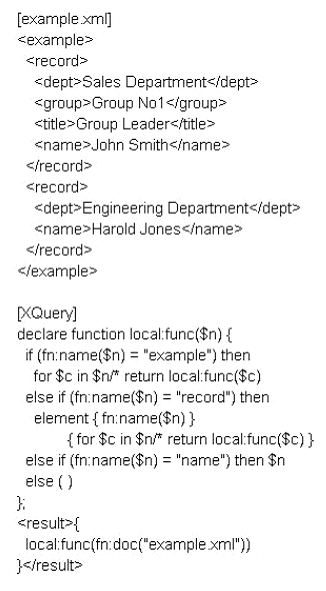
Select the correct result of executing the [XOuery] on [example xml] referenced in a separate window.
Full exam access, validated answers, and unlimited practice with no download limits.
QA4Exam.com offers Exam PDF materials with actual questions and answers for the XML I10-003 exam, helping you focus on the most relevant content. The Online Practice Test gives you a real exam simulation so you can become familiar with the format and pacing before test day. With up-to-date questions and verified answers, you can study with greater confidence and reduce surprises. The practice test also helps you build time management skills, which is essential for passing the XML Master Professional Database Administrator exam on your first attempt.
The XML I10-003 exam is the XML Master Professional Database Administrator certification exam in the XML Master track.
It is intended for candidates who want to validate their knowledge of XML database administration, XQuery, XPath, XML data manipulation, and XML schema objects.
Retake policy details are not provided here, so candidates should check the official exam guidelines before scheduling or rescheduling the test.
Braindumps alone are not the best approach. Using the Exam PDF and the Online Practice Test together gives you better understanding, verification, and readiness for the exam.
Hands-on practice is highly useful because the exam covers practical XML database tasks, query use, manipulation, and schema-related work.
They are designed to be a strong preparation tool because they provide real exam simulation, up-to-date questions, verified answers, and time management practice.
QA4Exam.com provides an Exam PDF with actual questions and answers plus an Online Practice Test that simulates the exam experience.