Limited-Time Offer: Enjoy 50% Savings! - Ends In 0d 00h 00m 00s Coupon code: 50OFF
Welcome to QA4Exam

Practice questions demo

Free HPE7-A10 Exam Dumps and Practice Questions

Questions 1 to 5 of the 75-question HPE7-A10 bank, each with its correct answer and an explanation. This is page 1 of 15.

1 / 15

Actual HP HPE7-A10 Exam Questions

Question 1

Single answer

You are assisting a company with designing role-based access control policies on HPE Aruba Networking AOS-10 gateways. The security policy dictates that traffic originating from authenticated corporate user roles must be inspected statefully, allowing client-initiated outbound flows to the data center while strictly dropping any unsolicited inbound connection attempts initiated from data center servers back toward the clients.

What design principle ensures this traffic flow behavior?

Correct answer: A

In HPE Aruba Networking AOS-10 architectures, the Policy Enforcement Firewall (PEF) is an application-aware, stateful Layer 4--7 firewall embedded directly within the datapath of gateways and access points.

When an Access Control Entry (ACE) is defined within a user role's session ACL (for example, permitting traffic with user host 10.20.1.50 svc-https permit), the PEF datapath dynamically constructs a bidirectional stateful session flow entry in its hardware session table upon observing the client's initial TCP SYN or UDP packet.

Because the firewall tracks protocol states (including TCP sequence/acknowledgment numbers and UDP pseudo-sessions), it automatically permits corresponding return traffic returning from the destination server back to the client. Crucially, this stateful tracking is unidirectional with respect to session establishment: external hosts, including data center servers, cannot initiate new, unsolicited connections toward the client because no matching stateful session exists in the reverse direction. Engineers do not need to configure inverse rules, inspect raw TCP ACK flags, or deploy secondary firewalls, as PEF enforces this stateful isolation by default.
Question 2

Single answer

Refer to the exhibit.

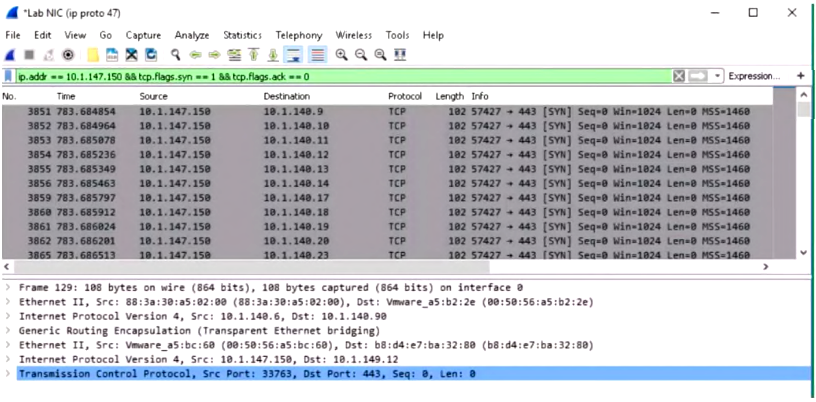
An administrator has configured a remote mirror between an AOS-CX switch and a station running a protocol analyzer. The exhibit displays a sample of the packet capture.

Packet trace details:

Source: 10.1.147.150 -> Destination: 10.1.140.9 TCP 57427 -> 443 [SYN] Seq=0 Len=0

Source: 10.1.147.150 -> Destination: 10.1.140.10 TCP 57427 -> 443 [SYN] Seq=0 Len=0

Source: 10.1.147.150 -> Destination: 10.1.140.11 TCP 57427 -> 443 [SYN] Seq=0 Len=0

Source: 10.1.147.150 -> Destination: 10.1.140.12 TCP 57427 -> 443 [SYN] Seq=0 Len=0

Source: 10.1.147.150 -> Destination: 10.1.140.13 TCP 57427 -> 443 [SYN] Seq=0 Len=0

Packet encapsulation tree shows Generic Routing Encapsulation (Transparent Ethernet bridging).

Which characteristic is suspicious?

Correct answer: A

The Wireshark capture illustrates a clear pattern of horizontal network scanning / host discovery. Endpoint 10.1.147.150 is systematically generating initial TCP connection requests (SYN frames) targeting a single destination service (HTTPS port 443) across sequential destination IP addresses in rapid succession (10.1.140.9, .10, .11, .12, .13, .14, etc.).

In legitimate client behavior, endpoints do not systematically iterate through consecutive IP addresses on a subnet attempting to establish SSL/TLS handshakes across identical source and destination ports within milliseconds. This behavior is indicative of automated network reconnaissance or an infected host attempting lateral movement and worm propagation.

The other technical characteristics observed in the trace are normal: TCP SYN packets routinely have a length of 0 with no payload; TCP flags (SYN=1, ACK=0) are standard for initial session handshakes; and Generic Routing Encapsulation (GRE) is expected because the administrator configured remote port mirroring (ERSPAN) on the AOS-CX switch to deliver mirrored packets to the analyzer station.

Question 3

Single answer

A customer requires you to configure Aruba ClearPass Policy Manager (CPPM) to authenticate domain users on domain computers. Domain users, domain computers, and domain controllers obtain certificates from a Windows CA. CPPM must validate these certificates and confirm that the users and computers have accounts in Windows AD. The customer requires encrypted communication for all traffic between CPPM and the domain controllers.

You have imported the Windows CA root certificate into the ClearPass CA Trust list.

Based on these requirements, which usages should be added to it?

Correct answer: B

ClearPass Policy Manager isolates trust verification using distinct usage flags assigned to each Certificate Authority within its local CA Trust List.

1. **EAP Usage**: The Windows CA issues user certificates and computer certificates used for certificate-based 802.1X authentications (EAP-TLS or TEAP). When endpoints authenticate, ClearPass validates the certificate chain presented by the supplicant. The `EAP` trust usage allows the ClearPass RADIUS server engine to trust this CA chain during 802.1X/EAP handshakes.

2. **AD/LDAP Server Usage**: The customer mandates encrypted transport for all communications between ClearPass and Active Directory domain controllers. This requires LDAP over SSL (LDAPS, TCP port 636) or StartTLS. During the LDAPS TLS handshake, domain controllers present server certificates signed by the internal Windows Enterprise CA. ClearPass must validate these directory server certificates; enabling the `AD/LDAP Server` usage flag allows the directory connector to trust the Windows CA for secure Active Directory lookups.

Usages such as RadSec and Aruba Infrastructure apply to RADIUS-over-TLS access devices and central management endpoints, not Active Directory or EAP supplicants.

Question 4

Single answer

A company uses an HPE Aruba Networking AOS-10 mobility infrastructure. Network administrators recently enabled wireless detection on the APs, which checks for all infrastructure and client threats. However, the administrators quickly became overwhelmed and now want to disable most checks.

They want a recommendation for the checks most likely to indicate genuine threats.

Which one should be mentioned?

Correct answer: B

HPE Aruba Networking Wireless Intrusion Detection System (WIDS) provides tiered threat detection profiles (Low, Medium, High, and Custom). At the "High" level, APs detect dozens of behavioral anomalies (such as Information Element overflow, rate anomalies, and frame flooding), many of which generate frequent false alarms triggered by poorly implemented third-party client drivers or benign RF interference.

When tuning WIDS policies to eliminate noise while preserving defense-in-depth against high-risk attacks, "Detect AP Spoofing" is a core signature that must remain enabled. AP spoofing occurs when an unauthorized or malicious device transmits 802.11 beacon or probe response frames impersonating an authorized enterprise BSSID. This represents the preliminary reconnaissance and execution phase of Evil Twin attacks, credential harvesting, and rogue AP insertions.

Because AP spoofing targets the fundamental trust boundary of the enterprise wireless infrastructure, HPE Aruba Networking includes it even in baseline (Low) security profiles as a high-confidence, actionable threat indicator.

Question 5

Single answer

You are helping a company add HPE Aruba Networking ClearPass to its network, which uses HPE Aruba Networking infrastructure devices.

The company already has a Windows domain and Windows CA. The Windows CA issues certificates to domain computers, domain users, and servers such as domain controllers.

ClearPass cluster IP addressing and hostnames

Publisher = 10.47.47.5

Subscriber 1 = 10.47.47.6

Subscriber 2 = 10.47.47.7

Virtual IP with Subscriber 1 and Subscriber 2 = 10.47.47.8

Refer to the scenario.

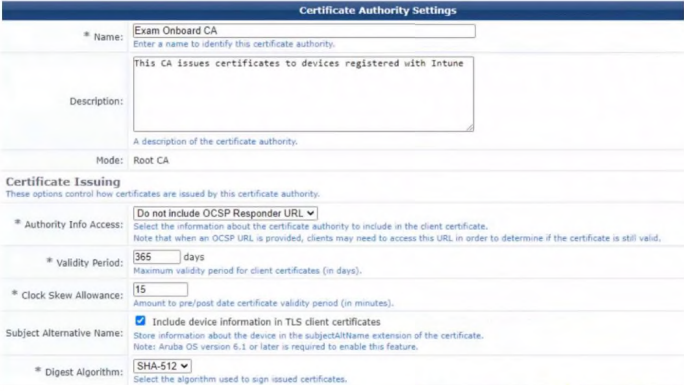
You have begun creating a CA to meet the customer's requirements for issuing certificates to mobile clients, as shown in the exhibit below.

Certificate Authority Settings:

Name: Exam Onboard CA

Mode: Root CA

Authority Info Access: Do not include OCSP Responder URL

Validity Period: 365 days

Clock Skew Allowance: 15

Subject Alternative Name: [X] Include device information in TLS client certificates

Digest Algorithm: SHA-512

What change will help meet those requirements and the requirements for authenticating clients?

Correct answer: D

When ClearPass Onboard functions as a Certificate Authority issuing certificates to mobile devices, real-time revocation verification is critical during 802.1X/EAP-TLS authentication.

In the exhibited configuration, `Authority Info Access` is set to "Do not include OCSP Responder URL." Consequently, client certificates issued by this CA will omit the Authority Information Access (AIA) extension containing the OCSP URI. When ClearPass authenticates these certificates via EAP-TLS, the EAP method cannot dynamically determine revocation status via OCSP unless an explicit OCSP URL is embedded or globally defined.

By changing the Authority Info Access parameter to "Specify an OCSP responder" and setting the hostname to `localhost` (e.g., `http://localhost/guest/mdps_ocsp.php/`), ClearPass automatically inserts its local OCSP responder service URL into the certificate. When Policy Manager validates client certificates locally on cluster nodes, it queries its internal OCSP engine directly without requiring external revocation infrastructure, ensuring revoked client certificates are rejected in real time.

More HP practice questions

Unlock all HP HPE7-A10 questions

Full exam access, validated answers, and unlimited practice with no download limits.